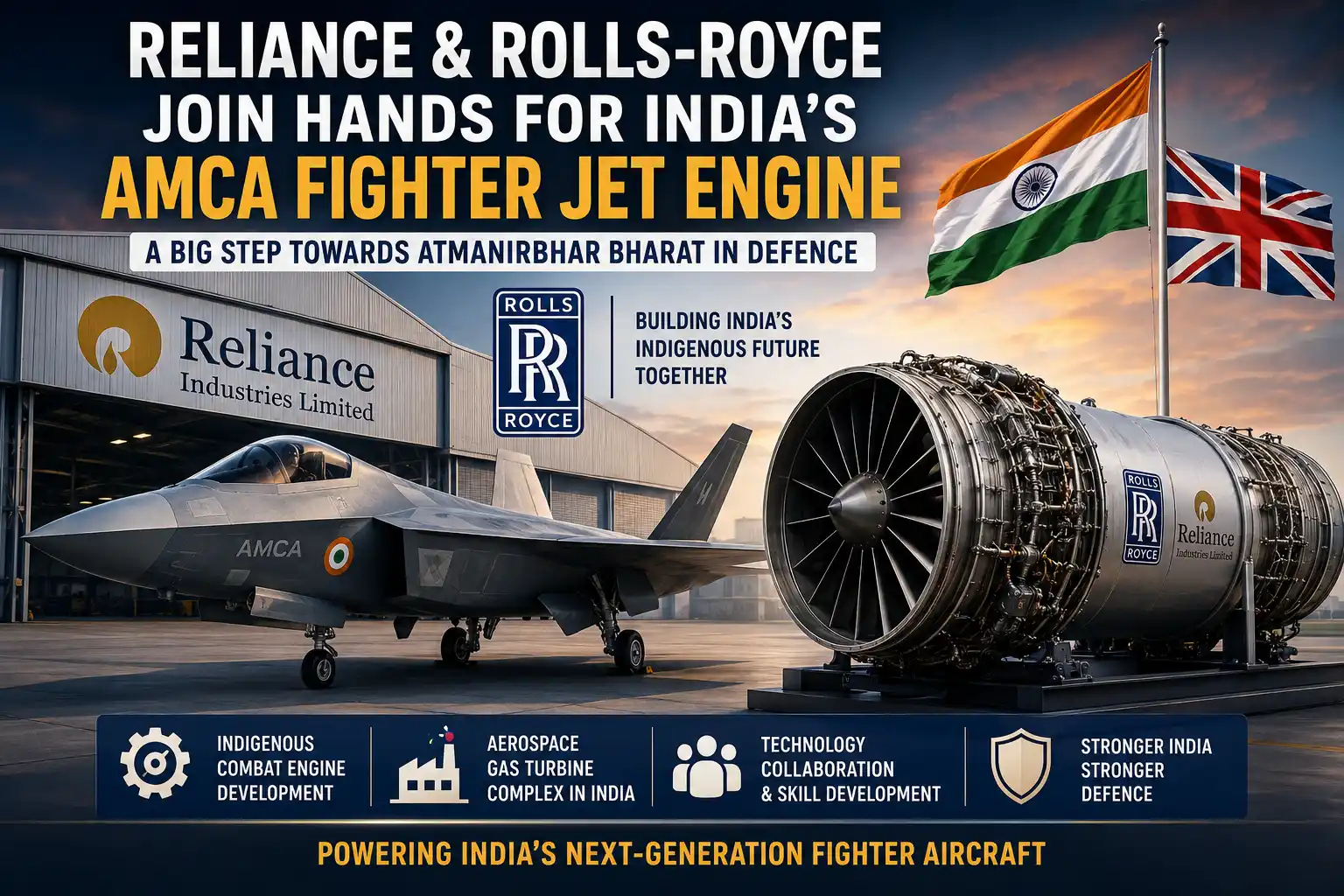
Reliance Industries and British aerospace giant Rolls-Royce have announced a strategic partnership to jointly pursue the development and manufacturing of an indigenous combat aircraft engine for India’s Advanced Medium Combat Aircraft (AMCA) programme.
The announcement was made on August 14, 2026, marking a major development in India’s effort to build advanced fighter aircraft and reduce dependence on imported propulsion technology. The two companies plan to explore the establishment of a dedicated Aerospace Gas Turbine Complex in India, which could become a major centre for advanced aircraft propulsion technology.
However, it is important to understand that this is not yet a final order to supply engines for the AMCA. Reliance and Rolls-Royce are presenting their joint capability for the programme, while India’s AMCA engine selection and development process remains subject to the government’s procurement and programme framework.
Company Introduction
Reliance Industries:
Reliance Industries Limited (RIL) is one of India’s largest diversified business groups.
The company has major operations across energy, petrochemicals, telecommunications, retail and digital services.
Under its broader industrial strategy, Reliance has also been expanding into new technology-intensive sectors.
Its participation in the AMCA engine programme would represent one of its most ambitious moves into advanced aerospace and defence technology.
The key strength Reliance brings is its ability to finance, build and operate large industrial projects at scale.
Rolls-Royce:
Rolls-Royce is a major British engineering and aerospace company known globally for its aircraft engines and advanced power systems.
The company develops propulsion technologies for civil and military aviation as well as other critical applications.
Its long relationship with India’s armed forces includes engines powering several Indian military aircraft.
Rolls-Royce says it has supported India’s defence aviation sector for decades and remains committed to localisation and self-reliance in India’s aerospace ecosystem.
What Is the Reliance-Rolls-Royce Deal?
In simple terms, the partnership brings together two very different strengths.
Reliance Industries can provide capital, industrial infrastructure, project execution capabilities and large-scale manufacturing expertise, while Rolls-Royce brings decades of experience in designing and developing advanced aircraft engines.
Together, the companies want to develop an engine specifically suited to India’s future combat aircraft requirements.
The proposed partnership covers:
- Combat engine design
- Engine development
- Manufacturing in India
- Advanced aerospace technologies
- Power and propulsion systems
- Development of an Aerospace Gas Turbine Complex
The objective is to create a stronger Indian ecosystem for high-end aircraft propulsion rather than simply importing a completed foreign engine.
What Is India’s AMCA Fighter Jet?
The Advanced Medium Combat Aircraft (AMCA) is India’s planned fifth-generation stealth fighter aircraft.
The aircraft is being developed under India’s indigenous aerospace programme and is expected to become one of the country’s most advanced combat aircraft.
AMCA is designed around technologies such as:
- Stealth
- Internal weapons carriage
- Advanced sensors
- Modern avionics
- Network-centric warfare
- High-performance propulsion
- Supercruise-oriented capabilities
- Advanced electronic warfare
The Indian government has been trying to create a larger domestic industrial ecosystem around the programme rather than depending entirely on government-owned defence companies.
In May 2025, the Ministry of Defence approved an AMCA Programme Execution Model that allows both private and public-sector companies to compete for the programme, either independently or through joint ventures and consortia.
This policy change is particularly important because it opened the door for major Indian private companies to participate in one of India’s most strategically important aerospace projects.
Why Is the Fighter Jet Engine So Important?
A fighter aircraft is not just an airframe.
The engine is one of its most difficult and strategically important technologies.
A modern fighter engine must generate enormous thrust while operating under extreme temperature and pressure. It also needs to be lightweight, reliable and efficient.
Developing such an engine requires expertise in:
- Advanced metallurgy
- Turbine blades
- High-temperature materials
- Combustion technology
- Compressors
- Turbines
- Thermal management
- Digital engine controls
- Manufacturing precision
- Testing and certification
India has developed several aircraft and missiles domestically, but developing a modern high-thrust fighter engine has remained one of the country’s biggest technological challenges.
The Defence Ministry itself has described aero-engine development as an extremely complex engineering challenge involving thermodynamics, material science, fluid mechanics and advanced mechanical engineering.
What Will Reliance Bring to the Partnership?
Reliance’s biggest contribution is expected to be on the industrial and manufacturing side.
The company has experience in building and operating very large industrial projects and complex supply chains.
For an aerospace engine programme, this could be valuable because eventually India will need:
- Large manufacturing facilities
- Precision production
- Supplier networks
- Testing infrastructure
- Skilled engineers
- Long-term investment
- Maintenance and support capabilities
Reliance is also attempting to establish a significant presence in India’s defence manufacturing ecosystem.
The company therefore sees aerospace as a potential long-term industrial opportunity rather than simply a one-time defence contract.
What Will Rolls-Royce Bring?
Rolls-Royce is the technology-heavy side of this partnership.
The British company is one of the world’s major aircraft-engine manufacturers and has extensive experience in military and civil aerospace propulsion.
Its engines already have a long history with India’s armed forces.
According to Rolls-Royce, more than 750 of its engines across 10 engine types have powered Indian military aircraft. These include engines used on Jaguar combat aircraft, Hawk trainers and other military platforms.
This means the proposed Reliance partnership is not Rolls-Royce’s first involvement with India’s military aviation sector.
The company has previously worked with Hindustan Aeronautics Limited (HAL) on manufacturing, maintenance and supply-chain activities for its engines.
What Is the Proposed Aerospace Gas Turbine Complex?
One of the most interesting parts of the announcement is the proposed Aerospace Gas Turbine Complex.
The idea is to establish a dedicated Indian centre for advanced propulsion technologies.
A facility of this kind could potentially support activities across the engine development cycle, including:
- Research and engineering
- Engine design
- Component development
- Testing
- Manufacturing
- Maintenance
- Supply-chain development
If successfully established, such a facility could become more important than a single AMCA engine programme.
It could help India build capabilities that may eventually be used for other military aircraft and aerospace platforms.
Is This a Final AMCA Engine Contract?
No — this distinction is very important.
The August 2026 announcement represents a strategic intent to partner and offer capabilities for the AMCA engine programme.
It should not be interpreted as India having already selected the Reliance-Rolls-Royce engine as the final AMCA powerplant.
India has been considering different international technology partnerships for its future fighter-engine requirements.
Therefore, the actual development contract, technology arrangements, government approvals and final engine selection remain critical next steps.
This also means the headline should preferably say “Reliance and Rolls-Royce plan to develop AMCA engine” rather than “India orders fighter engines from Reliance-Rolls-Royce.”
Rolls-Royce vs Safran: Why the Competition Matters
The Reliance-Rolls-Royce announcement comes at a time when India is also pursuing another major international partnership option involving France’s Safran.
Rolls-Royce had already proposed developing a next-generation fighter engine in India, including substantial technology participation and intellectual-property arrangements.
Earlier in 2026, Rolls-Royce said its proposal could involve an engine core test around 2030, a first flight around 2034, and production around 2036, assuming the programme proceeds on the proposed timeline.
This creates an interesting strategic situation for India.
The country is not simply looking for an engine supplier. It wants to build the ability to understand, develop, manufacture and maintain advanced fighter engines domestically.
That makes technology transfer and intellectual property potentially as important as the engine’s performance.
Why India Wants Indigenous Fighter Engines
India has historically depended heavily on foreign suppliers for aircraft engines.
This creates several problems.
If an engine is imported, India can become dependent on another country for:
- Spare parts
- Upgrades
- Maintenance
- Technology
- Production schedules
- Future modifications
A domestically developed engine could provide greater control over the entire lifecycle of a fighter aircraft.
For a fifth-generation aircraft such as AMCA, this becomes even more important because propulsion technology is closely linked to the aircraft’s performance and future upgrades.
India’s defence strategy has therefore increasingly focused on Atmanirbhar Bharat and domestic defence production.
The government has also explicitly pushed private-sector participation in the AMCA programme.
AMCA Development Is Moving Forward
The engine partnership comes as the wider AMCA programme itself is moving forward.
In May 2026, the Ministry of Defence announced the foundation stone for an AMCA Core Integration & Flight Testing Centre in Andhra Pradesh.
The facility is intended to support aircraft integration, testing, validation and certification for AMCA and future indigenous platforms.
This shows that India is building not only the aircraft but also the infrastructure required to test and develop it.
What Could This Mean for Reliance?
For Reliance, this partnership could represent a major expansion into high-technology aerospace manufacturing.
The company already operates in sectors such as energy, telecommunications, retail and digital services.
A successful entry into advanced aerospace could give Reliance exposure to a completely different long-term growth industry.
The opportunity could extend beyond India’s domestic requirements.
If the company eventually develops sufficient manufacturing and engineering capabilities, India could potentially become part of the global aerospace supply chain.
However, this will depend heavily on successful technology absorption, engineering capability, government contracts and execution.
- What Could This Mean for Rolls-Royce?
For Rolls-Royce, India represents both a major aerospace market and an increasingly important manufacturing and engineering base.
The company has repeatedly highlighted India’s importance to its long-term localisation strategy and has previously discussed moving beyond simple manufacturing toward deeper co-development and technology capabilities in India.
A partnership with a large Indian industrial group could therefore help Rolls-Royce expand its manufacturing footprint and participate more deeply in India’s future military aerospace programmes.
What Could This Mean for India?
If the partnership eventually becomes a successful engine programme, the benefits could go far beyond AMCA.
It could create an ecosystem involving:
- Indian aerospace suppliers
- Precision engineering companies
- Materials manufacturers
- Electronics companies
- Research institutions
- Universities
- Defence startups
- Maintenance companies
- Export-oriented manufacturers
It could also create highly skilled jobs in aerospace engineering and advanced manufacturing.
Most importantly, India could gradually develop the ability to design and manufacture one of the most difficult components of a modern fighter aircraft.
The Biggest Challenge: Technology Absorption
The biggest question is not simply whether Rolls-Royce has the technology.
The bigger question is how much of that technology India can actually absorb and independently use in the future.
A modern fighter engine involves decades of accumulated knowledge.
Even with an international partner, India will need engineers, testing infrastructure, advanced materials and a strong domestic supply chain.
This is why the proposed Aerospace Gas Turbine Complex could be strategically important.
If it becomes a genuine engineering and development centre rather than only an assembly or manufacturing facility, the long-term value for India could be much greater.
What Happens Next?
The next major milestones to watch are:
1. Government selection and approvals
India will need to determine how the competing engine proposals fit into the AMCA programme.
2. Detailed technology agreement
The exact level of technology transfer, intellectual-property rights and Indian manufacturing content will be critical.
3. Aerospace complex
The proposed Aerospace Gas Turbine Complex will need to move from concept to actual investment and construction.
4. Engine development
Once the programme receives the necessary approvals and contracts, detailed design and testing can begin.
5. AMCA prototype
India is targeting the development of the AMCA prototype as a major milestone in its fifth-generation fighter programme. Government plans and infrastructure development indicate that the programme is being actively pushed forward.
Why This Partnership Is Strategically Important
The Reliance-Rolls-Royce partnership is important because India is trying to move from buying advanced defence technology to developing it domestically.
Building the aircraft itself is only one part of that journey.
Building the engine is arguably an even bigger technological challenge.
If India can successfully develop a high-performance fighter engine with meaningful domestic intellectual-property and manufacturing capabilities, it could represent a major technological milestone for the country’s aerospace industry.
For Reliance, it could open the door to a new high-value industrial sector.
For Rolls-Royce, it could deepen its position in India’s rapidly expanding defence and aerospace ecosystem.
And for India, the ultimate goal is clear: develop advanced fighter aircraft with much greater control over the technology behind them.
Source: Rolls-Royce, Reliance, Press Information Bureau (Government of India).