In today’s digital payment environment, one of the major challenges for small businesses is accepting card payments without investing in expensive payment terminals. Traditional Point of Sale (POS) machines can involve additional costs, rental charges and installation procedures, making them less accessible to small shopkeepers, freelancers and independent sellers.
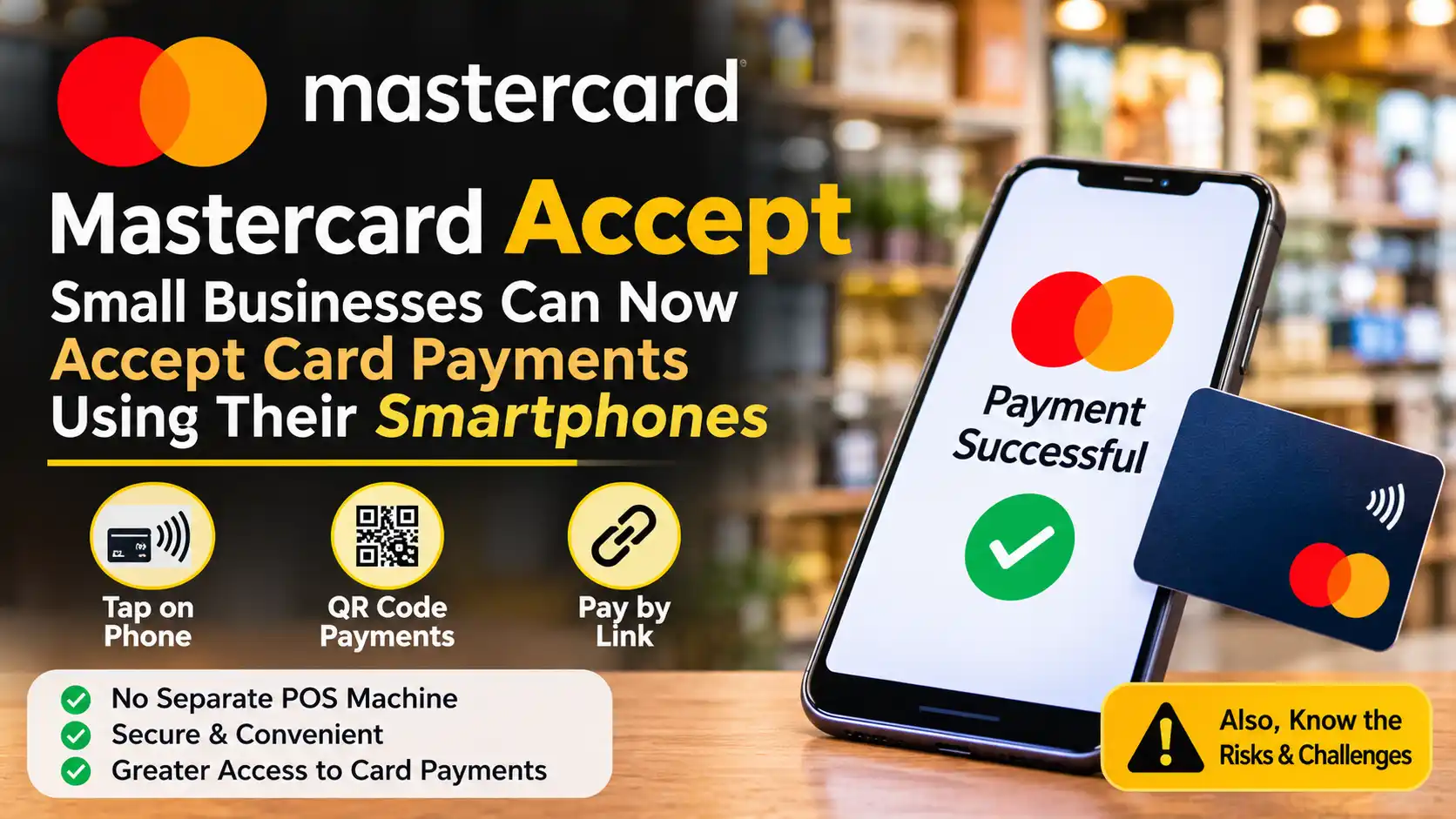
To address this challenge, Mastercard has introduced Mastercard Accept, a smartphone-based payment acceptance solution. It allows eligible small businesses, freelancers and individual sellers to accept card payments through their existing smartphones and participating banking or payment applications, without necessarily requiring a separate POS terminal.
However, this service should not be considered a replacement for India’s UPI system or an entirely new QR payment technology. QR-based payments are already widely used across India. The more distinctive feature of Mastercard Accept is its ability to turn a compatible smartphone into a contactless card payment acceptance device.
This could make card acceptance easier for small businesses, particularly in markets where access to traditional card payment terminals remains limited.
What Is Mastercard Accept?
Mastercard Accept is a payment solution designed to help eligible debit and prepaid cardholders receive payments directly into their existing accounts using participating banking and payment applications.
Mastercard announced the service on November 17, 2026. Its main objective is to make card payment acceptance more accessible to small businesses and individuals who may not have access to traditional POS terminals.
Instead of purchasing a separate payment machine, eligible sellers can use their smartphones to accept payments through supported banking or payment apps.
The service is intended to support different types of sellers, including:
- Street vendors and small shopkeepers
- Home-based business owners
- Freelancers and independent professionals
- Tutors and service providers
- Gig workers
- Small retailers and individual sellers
The service is designed to reduce the cost and complexity of accepting card payments, although actual availability and charges will depend on participating banks and payment partners.
How Does Mastercard Accept Work?
To use Mastercard Accept, a seller must first be eligible through a participating bank or payment provider. The seller can then access the payment acceptance feature through the supported mobile banking or payment application.
For example, imagine a shopkeeper selling a product worth ₹800. The shopkeeper opens the banking application, selects the payment acceptance option and enters ₹800 as the transaction amount.
The customer can then pay using a supported contactless card or digital wallet.
Mastercard Accept offers three major payment methods.
1. Tap on Phone: Accepting Card Payments Through a Smartphone
One of the most important features of Mastercard Accept is Tap on Phone technology.
It allows a compatible smartphone to function as a contactless payment acceptance device. Instead of using a traditional card terminal, the seller can receive payments directly through their smartphone.
The process generally works as follows:
- The seller opens the participating banking application.
- The seller enters the payment amount.
- The smartphone becomes ready to accept a contactless payment.
- The customer taps a compatible contactless debit or credit card near the smartphone’s NFC area.
- The payment is processed through the relevant payment network and banking system.
- The seller receives confirmation once the transaction is approved.
Does the seller’s smartphone need NFC?
Yes. NFC (Near Field Communication) is required for the Tap on Phone feature. The seller’s smartphone must support NFC and meet the necessary technical and security requirements.
The customer’s payment card must also support contactless payments. Alternatively, the customer may use a compatible mobile wallet.
Therefore, not every smartphone will support this feature. A phone without NFC cannot accept contactless card payments through Tap on Phone, although other supported payment methods may still be available.
2. QR Code and Pay by Link
Mastercard Accept also supports QR-based payments and Pay by Link.
Under this method, the seller can generate a payment link through the supported application. The link may be displayed as a QR code on the seller’s smartphone or shared directly with the customer.
The customer can scan the QR code or open the payment link and complete the transaction using an available supported card payment option.
Unlike Tap on Phone, this method does not require NFC hardware because the customer does not need to tap a physical card against the seller’s smartphone.
However, the customer generally needs internet access and a supported payment method to complete the transaction.
3. Payments Through Existing Banking Applications
Another important feature is its integration with existing banking and payment applications.
Rather than requiring every seller to download and use an entirely new payment platform, Mastercard Accept can be made available through participating financial institutions’ existing applications.
This approach may simplify onboarding and payment management for eligible sellers.
The payment is directed to the seller’s existing eligible account, subject to the participating provider’s rules and settlement arrangements.
How Will Mastercard Accept Protect Customers?
Accepting card payments through a smartphone is convenient, but it also raises important security questions.
For example, if a seller enters the payment amount, how can the customer make sure that the correct amount is being charged? And what happens if someone uses another person’s contactless card?
These questions are important when evaluating any smartphone-based payment system.
1. Customers Must Check the Payment Amount
Suppose a customer purchases a product worth ₹500, but the seller accidentally enters ₹5,000.
The customer should check the amount displayed before tapping the card. If the amount is incorrect, the customer should not proceed with the payment.
Mastercard’s public announcement explains how the seller enters the amount and how the customer makes a contactless payment. However, it does not specify one universal customer confirmation interface for every participating bank or payment partner.
Therefore, the exact amount-display and confirmation process may vary depending on the implementation.
Clear transaction information and an opportunity for customers to review the amount are important safeguards.
2. Protection Against Unauthorized Card Usage
Another concern is the possibility of someone using a stolen or unauthorized contactless card.
EMV contactless technology provides transaction-level security, while banks use authorization systems and fraud monitoring to identify suspicious activity.
However, contactless payments are not completely immune to unauthorized use.
In India, RBI rules allow eligible EMV-compliant contactless card-present transactions of up to ₹5,000 without an Additional Factor of Authentication (AFA), subject to applicable requirements. Transactions above this limit require AFA. Banks may also apply additional security checks based on risk.
Mobile wallets may provide additional protection through fingerprint authentication, facial recognition or device PINs, depending on the wallet and device.
3. The Role of Mastercard and Banks
A payment transaction must pass through the relevant payment network and banking authorization systems.
The issuing bank may approve or decline a transaction depending on available funds, card status, transaction limits and security checks.
Mastercard provides the payment network infrastructure, while participating banks and payment providers are responsible for their respective onboarding, authorization and compliance processes.
This combination of network security, bank authorization and fraud monitoring is essential for building customer confidence.
Mastercard Accept vs UPI: What Is the Difference?
India is already one of the world’s major digital payment markets. Millions of small businesses accept payments through UPI QR codes.
This raises an important question: What additional value does Mastercard Accept bring to a market where QR payments are already widely available?
The answer lies in understanding the difference between the two systems.
| Feature | UPI | Mastercard Accept |
| Payment network | India’s UPI system | Mastercard network |
| Main payment methods | QR code, UPI ID and other supported methods | Tap on Phone, QR and Pay by Link |
| Physical card required | No, for normal UPI payments | Card or supported wallet for card-based payments |
| NFC requirement | Not required for normal QR payments | Required for Tap on Phone |
| Main users | People making bank-account-based UPI payments | Eligible cardholders and businesses accepting card payments |
| Main purpose | Digital payments between bank accounts | Extending card payment acceptance to small sellers |
The QR payment feature of Mastercard Accept is not a major technological innovation for India because UPI QR payments are already widely established.
Its more distinctive feature is Tap on Phone, which allows small sellers to accept contactless card payments without purchasing a separate POS machine.
This could be particularly useful in markets where card acceptance infrastructure is still limited.
Which Countries Will Get Mastercard Accept?
Mastercard has initially focused on selected markets across Asia Pacific, Latin America, the Middle East and Africa.
The company plans to make the service available through participating banks and payment partners.
Some of the organizations included in its initial partner network are:
| Partner | Associated Market |
| Maya Bank | Philippines |
| Bank of Ceylon | Sri Lanka |
| Equity Bank | Kenya |
| KCB Bank Kenya | Kenya |
| Network International | Middle East and Africa markets |
| areeba | Middle East region |
| Banco Davivienda | Latin America |
| Kardal | Cambodia |
| LOLC | Sri Lanka and other associated markets |
These partnerships are intended to support the service’s expansion into different markets.
However, the inclusion of a financial institution in the partner network does not necessarily mean that Mastercard Accept is already operational across all its markets. Actual availability will depend on local launches, technical integration and regulatory requirements.
What about India?
Mastercard’s initial announcement did not explicitly identify India as one of the first launch markets for this particular rollout. Therefore, its general availability to Indian merchants and a specific Indian launch date should not be assumed.
Benefits of Mastercard Accept for Small Businesses
Reduced Dependence on Traditional POS Machines
Traditional POS terminals can involve purchase, rental, installation and maintenance costs.
Tap on Phone offers an alternative for eligible sellers who already own NFC-enabled smartphones. This could make accepting contactless card payments more accessible to smaller businesses.
Opportunities for Freelancers and Independent Sellers
Not everyone who accepts payments operates a permanent retail shop.
Freelancers, tutors, home-based business owners and gig workers may occasionally need to accept card payments. Mastercard Accept could provide these individuals with another payment option.
Integration With Existing Banking Applications
The ability to use participating banks’ existing applications may reduce the need to manage a separate payment platform.
It could also simplify the process of receiving payments into an eligible existing account.
Access to Card-Paying Customers
In some markets, customers prefer paying through debit cards, credit cards or digital wallets.
By making card acceptance easier, Mastercard Accept could help small businesses serve customers who prefer these payment methods.
Risks and Challenges of Mastercard Accept
Although Mastercard Accept could improve access to card payments, the service also faces several practical challenges.
1. Requirement for NFC-Enabled Smartphones
The Tap on Phone feature requires an NFC-enabled smartphone.
Not all smartphones support NFC, particularly some older and lower-cost models. This could limit adoption among sellers who do not have compatible devices.
2. Risk of Incorrect Payment Amounts
Since the seller enters the transaction amount, mistakes can happen.
For example, entering ₹5,000 instead of ₹500 could create a payment dispute if the customer does not notice the error.
Clear amount display, customer review and appropriate confirmation procedures will be important for preventing such situations.
3. Risk of Stolen or Unauthorized Cards
Contactless technology offers security protections, but it cannot completely eliminate the risk of unauthorized transactions.
Banks will need effective fraud monitoring, transaction controls and customer protection mechanisms. Customers must also report lost or stolen cards promptly.
4. Dependence on Internet Connectivity
Smartphone-based payment acceptance generally depends on internet connectivity and the availability of banking applications.
Network interruptions, application failures or banking system outages could delay or prevent transactions.
5. Strong Competition From UPI in India
India already has an extensive UPI QR payment ecosystem.
Small merchants can accept digital payments without purchasing NFC-enabled devices or installing traditional POS machines.
Therefore, Mastercard Accept may find it difficult to compete through QR payments alone. Its stronger opportunity in India would be expanding contactless card acceptance and offering benefits that existing payment methods do not already provide.
6. Dependence on Banks and Payment Partners
Mastercard Accept will not automatically become available to every merchant.
Sellers must meet the eligibility requirements of participating banks or payment providers. Availability, transaction charges, settlement times and supported features may vary between markets and institutions.
What Could Be the Future Impact of Mastercard Accept?
Mastercard Accept represents an effort to expand the role of smartphones in the payment industry.
Until now, smartphones have primarily been used by customers to make digital payments. With Tap on Phone technology, compatible smartphones can also become payment acceptance devices.
This could help reduce dependence on dedicated POS terminals and make card acceptance more accessible to small businesses.
Its success will depend on how many banks adopt the technology, how easily merchants can register, and whether customers find the payment experience convenient and secure.
In countries like India, where UPI is already well established, Mastercard will need to demonstrate a clear advantage beyond QR-based payments.
Conclusion
Mastercard Accept introduces another option for small businesses, freelancers and independent sellers to accept card payments using their smartphones.
Its most distinctive feature is Tap on Phone, which allows eligible sellers to accept contactless card payments through NFC-enabled smartphones without necessarily purchasing a separate POS machine.
However, it should not be viewed as a replacement for UPI or an entirely new QR payment technology. Its potential value is greater in markets where access to card payment acceptance remains limited.
Security, correct payment amount display, unauthorized card usage, NFC compatibility and banking partnerships will all play important roles in determining its success.
If Mastercard can make the service affordable, widely available and easy to use, it could become an additional payment acceptance option for small businesses around the world.
Sources: Mastercard Official Announcement | Mastercard Accept Product Information | Mastercard Tap on Phone Implementation Guide |
Disclaimer: This article is intended for informational and educational purposes only. Actual service availability, features, charges and security procedures may vary depending on participating banks, payment partners and local regulations.