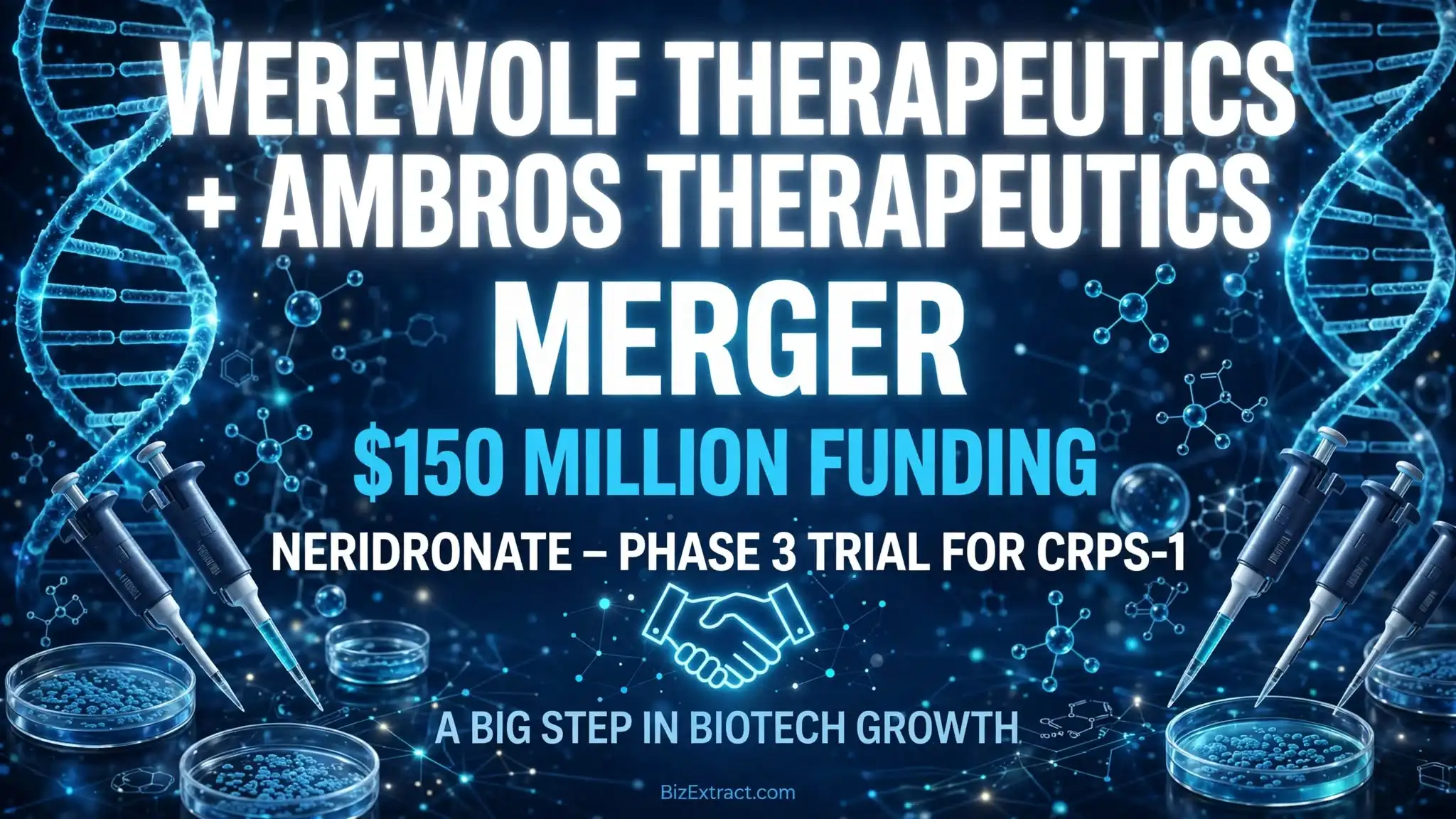
The biotechnology industry is witnessing an important corporate development as Werewolf Therapeutics and Ambros Therapeutics have agreed to combine their businesses through an all-stock merger. The transaction is designed to bring Ambros Therapeutics’ clinical-stage drug development programme, particularly its experimental treatment Neridronate for Complex Regional Pain Syndrome Type 1 (CRPS-1), into a publicly listed company.
One of the most important financial details of this transaction is Werewolf Therapeutics’ implied valuation of approximately $47.5 million, compared with an implied pre-financing valuation of approximately $500 million for Ambros Therapeutics. These figures help explain the relative valuations of the two businesses before the merger. The companies have also arranged a $150 million private investment in public equity (PIPE) financing to support the combined company’s development plans.
The merger is not a conventional cash acquisition. Instead, it is an all-stock business combination in which Ambros will become a wholly owned subsidiary of Werewolf. After completion, Werewolf plans to change its corporate name to Ambros Therapeutics and use the proposed Nasdaq ticker symbol AMBX.
The transaction was announced on August 21, 2026, and is expected to close by the first quarter of 2027, subject to regulatory approvals and other closing conditions. The merger was still proposed in the updated preliminary proxy statement filed on October 26, 2026.
Deal Snapshot
| Deal Detail | Information |
| Acquirer | Werewolf Therapeutics, Inc. |
| Target | Ambros Therapeutics, Inc. |
| Industry | Biotechnology, pharmaceutical |
| Acquirer Country | United States |
| Target Country | United States |
| Acquirer Exchange | Nasdaq |
| Acquirer Ticker | HOWL |
| Proposed Combined Company Name | Ambros Therapeutics |
| Proposed Post-Merger Ticker | AMBX |
| Announcement Date | August 21, 2026 |
| Deal Structure | All-stock merger |
| Implied Werewolf Valuation | Approximately $47.5 million |
| Implied Ambros Valuation | Approximately $500 million, before financing |
| Concurrent Funding | $150 million PIPE financing |
| Expected Closing | First quarter of 2027 |
| Main Development Programme | Neridronate for CRPS-1 |
Important: The $47.5 million and $500 million figures represent the companies’ respective implied valuations under the transaction terms. They are not a cash purchase price paid by Werewolf to Ambros.
Werewolf Therapeutics: Company Introduction
Werewolf Therapeutics, Inc. is a US-based clinical-stage biotechnology company focused on developing treatments that use the body’s immune system to fight cancer.
The company was listed on the Nasdaq stock exchange under the ticker symbol HOWL. Its research focused on immunotherapy, particularly treatments designed to activate or improve the body’s immune response against cancer.
Werewolf developed its proprietary INDUKINE platform, which was designed to create conditionally activated immune-system proteins. The objective was to stimulate immune activity more selectively and potentially reduce unwanted effects on healthy tissues.
Some of the company’s research programmes included:
- WTX-124: An investigational IL-2-based immunotherapy programme.
- WTX-330: An investigational IL-12-based immunotherapy programme.
These programmes formed part of Werewolf’s earlier research and development activities. The merger with Ambros represents a major strategic shift towards a business focused on developing Neridronate for CRPS-1.
Ambros Therapeutics: Company Introduction
Ambros Therapeutics is a US biotechnology company focused on developing treatments for serious neurological and pain-related conditions.
Its most important development programme is Neridronate, an investigational drug being studied for Complex Regional Pain Syndrome Type 1 (CRPS-1).
CRPS-1 is a painful condition that can develop after an injury, surgery or other physical trauma. It may cause severe and persistent pain, swelling, changes in skin temperature and sensitivity to touch. In some patients, the pain can be much greater than would normally be expected from the original injury.
Ambros is working to develop Neridronate as a potential treatment for patients with this condition, particularly those with an early-stage form of CRPS-1.
The company’s drug development programme is important because, according to the companies’ announcement, there is currently no FDA-approved treatment specifically for CRPS-1 in the United States.
Understanding the $47.5 Million Werewolf Valuation
The approximately $47.5 million implied valuation of Werewolf Therapeutics is one of the most important financial details of this merger.
Under the announced transaction terms, Werewolf’s implied valuation is significantly lower than Ambros Therapeutics’ approximately $500 million pre-financing valuation.
This difference reflects the relative valuations assigned to the two companies for the proposed business combination. Ambros brings the principal clinical development opportunity, while Werewolf provides an existing publicly listed corporate structure.
How do the two valuations compare?
| Company | Implied Valuation | Position in the Transaction |
| Werewolf Therapeutics | Approximately $47.5 million | Publicly listed merger company |
| Ambros Therapeutics | Approximately $500 million | Private biotechnology company being combined with Werewolf |
The difference is substantial. Ambros’ implied valuation is more than ten times Werewolf’s implied valuation.
However, these figures should not be interpreted as the amount of cash that one company is paying to acquire the other. This is an all-stock merger, meaning the transaction uses shares and an agreed ownership structure rather than a conventional cash purchase.
Why is Werewolf’s valuation important?
Werewolf was already a publicly listed company on Nasdaq. Its approximately $47.5 million implied valuation provides a reference point for understanding how much of the combined business is attributed to the existing Werewolf shareholders under the merger arrangement.
The transaction also gives Ambros an opportunity to become part of a publicly listed company without following a traditional standalone IPO process.
For investors, the valuation difference is important because it helps explain why existing Ambros shareholders are expected to own a substantially larger portion of the combined company.
It is also important to remember that an implied transaction valuation is not necessarily the same as a company’s current stock-market capitalisation. Market prices can change, and the final ownership and share calculations may be affected by the merger agreement and closing adjustments.
Why Is Ambros Valued at Approximately $500 Million?
Ambros’ implied pre-financing valuation is approximately $500 million. Its main value proposition is its Neridronate development programme.
Neridronate is a bisphosphonate medicine that has been used in Italy for several approved medical indications, including CRPS-1. The company announcement states that the drug has been administered to approximately 600,000 patients across its approved indications.
This previous clinical use is an important part of the drug’s background. However, historical use in another country does not automatically mean that the medicine is approved for CRPS-1 in the United States.
Ambros is pursuing US regulatory approval through a clinical development programme, including the ongoing Phase 3 CRPS-RISE trial.
The approximately $500 million valuation therefore reflects the company’s development opportunity and the potential commercial value of its drug programme. It should not be understood as proof that Neridronate has already received FDA approval or achieved commercial success in the United States.
What Is Neridronate and How Could It Help CRPS-1 Patients?
Neridronate is the central asset behind Ambros Therapeutics’ development strategy.
CRPS-1 can cause long-lasting pain, swelling and sensitivity, often affecting an arm or leg. Even a relatively small injury can sometimes lead to severe symptoms.
For example, a patient may experience an injury to the wrist. Although the original injury heals, the patient may continue to experience intense pain, swelling and sensitivity in the affected area. In some cases, even light touch can become painful.
This condition can affect daily activities, mobility, work and quality of life.
Neridronate is being investigated as a potential treatment that may help reduce pain and improve patient outcomes. Its development programme is particularly focused on patients with early-stage CRPS-1.
The medicine is still investigational for this US development programme. Its safety and effectiveness must be established through the required clinical trials and regulatory review before it can be marketed for this use in the United States.
CRPS-RISE: The Phase 3 Clinical Trial
Ambros is conducting a Phase 3 clinical trial called CRPS-RISE to evaluate Neridronate in patients with CRPS-1.
Phase 3 is an important stage of clinical development. It generally involves a larger patient population and is designed to provide evidence about a drug’s effectiveness and safety.
The CRPS-RISE trial is designed as a multicentre, randomised, triple-blind and placebo-controlled study.
Key Trial Details
| Trial Detail | Information |
| Trial Name | CRPS-RISE |
| Drug Candidate | Neridronate |
| Condition | Complex Regional Pain Syndrome Type 1 |
| Trial Phase | Phase 3 |
| Planned Participants | Approximately 270 |
| Study Design | Randomised, triple-blind, placebo-controlled |
| Treatment Groups | Neridronate and placebo |
| Allocation | 1:1 |
| Treatment | Four intravenous infusions |
| Dose | 100 mg per infusion |
| Total Dose | 400 mg over 10 days |
| Main Evaluation | Change in pain intensity |
| Primary Assessment Point | Week 12 |
| Expected Topline Results | 2028 |
Who Can Participate in the Trial?
The trial focuses on a defined group of patients with early-stage CRPS-1.
The announced study design includes patients who:
- Have the warm subtype of CRPS-1.
- Have a positive triple-phase bone scan (TPBS).
- Meet the Budapest Clinical Criteria for CRPS-1.
- Have had the condition for six months or less.
- Experience moderate to severe pain.
These requirements help researchers study the medicine in a specific patient population rather than combining patients with very different disease characteristics.
How Will the Treatment Be Given?
Participants will be assigned to one of two groups. One group will receive Neridronate, while the other will receive a placebo.
The Neridronate group will receive four intravenous infusions, each containing 100 mg of the drug, over a period of 10 days. This means the total planned dose is 400 mg.
The trial’s primary endpoint is the change in pain intensity from the beginning of the study to week 12. Pain will be measured using an 11-point Numerical Rating Scale (NRS).
Researchers will also evaluate other pain-related outcomes and patient-reported measures.
The study is expected to provide important evidence about whether Neridronate can produce meaningful improvements in patients with CRPS-1.
FDA Designations: Breakthrough Therapy, Fast Track and Orphan Drug
Neridronate has received several important designations from the US Food and Drug Administration (FDA), including:
- Breakthrough Therapy Designation
- Fast Track Designation
- Orphan Drug Designation
These designations can provide development and regulatory support for medicines addressing serious conditions or unmet medical needs.
For example, Fast Track status is intended to facilitate the development and review of medicines for serious conditions where there is an unmet medical need. Breakthrough Therapy Designation can provide additional FDA guidance and development support when preliminary clinical evidence suggests substantial improvement over available treatment options.
Orphan Drug Designation relates to medicines being developed for rare diseases or conditions that meet the relevant regulatory criteria.
However, these designations do not mean that the FDA has approved Neridronate. The company still needs to complete the necessary clinical development and satisfy regulatory requirements.
$150 Million PIPE Financing: Why Is It Important?
Alongside the merger, the companies announced an oversubscribed $150 million private investment in public equity (PIPE) financing.
PIPE financing is a way for a publicly listed company to raise money by selling shares or securities to selected institutional and other qualified investors through a private placement.
The financing is expected to close alongside the merger.
The investment was co-led by RA Capital Management and Janus Henderson. Other participating investors included Aberdeen, Adage, ADAR1, Affinity, Arkin, Balyasny, Enavate Sciences, SilverArc, Sphera and Woodline.
Where Will the Funding Be Used?
The new capital is expected to support the combined company’s clinical development and operating requirements.
Its major priorities include:
- Continuing the Phase 3 CRPS-RISE trial.
- Supporting the development of Neridronate.
- Funding clinical and regulatory activities.
- Supporting the company’s operations and future development plans.
The companies expect the combined business to have a cash runway extending into the first half of 2029.
This is important because clinical-stage biotechnology companies often require substantial capital over several years before a drug can potentially generate commercial revenue.
The $150 million financing is therefore a major part of the transaction, providing additional financial resources for the development programme.
How Will Ownership Be Divided After the Merger?
The proposed merger structure gives different ownership percentages to the existing shareholders and the new investors.
According to the announced transaction terms, the expected ownership distribution is:
| Shareholder Group | Expected Ownership |
| Existing Ambros Shareholders | Approximately 71.7% |
| PIPE Investors | Approximately 21.5% |
| Existing Werewolf Shareholders | Approximately 6.8% |
| Total | 100% |
These percentages are subject to the transaction terms and applicable adjustments.
What Does This Ownership Structure Mean?
Existing Ambros shareholders are expected to hold the largest share of the combined company, at approximately 71.7%.
PIPE investors are expected to own approximately 21.5%, reflecting their investment in the $150 million financing.
Existing Werewolf shareholders are expected to retain approximately 6.8% of the combined company.
This ownership structure helps explain the importance of the two companies’ different implied valuations. Ambros has the larger valuation and is expected to receive the majority ownership in the combined business.
For existing Werewolf shareholders, the transaction means that their ownership percentage will be substantially diluted. However, they will retain an interest in the combined company and its future development opportunities.
Why Is Werewolf Using a Merger Instead of a Traditional Acquisition?
This transaction is structured as an all-stock merger rather than a conventional cash acquisition.
In a traditional acquisition, the buyer may pay cash, issue shares or use a combination of both to purchase the target company.
Here, Ambros will become a wholly owned subsidiary of Werewolf. After the merger, Werewolf plans to change its name to Ambros Therapeutics.
The combined company is expected to trade on Nasdaq under the proposed ticker symbol AMBX.
This structure allows Ambros to become part of a publicly listed company while giving its existing shareholders ownership in the combined business.
It also provides a route for the combined company to access public capital markets and institutional investors.
What Happens to Werewolf’s Existing Shareholders?
Existing Werewolf shareholders are expected to own approximately 6.8% of the combined company after the merger, based on the announced ownership structure.
The transaction documents also describe a contingent value right (CVR) arrangement for eligible legacy Werewolf shareholders.
A CVR is a contractual right that may provide additional payments if specified future events occur. It is not the same as receiving guaranteed cash at the time of the merger.
The potential value of such rights depends on the conditions and events described in the transaction documents. Investors should therefore review the merger agreement and proxy statement to understand the exact terms.
Merger Timeline and Current Status
| Date / Period | Event |
| August 21, 2026 | Merger and $150 million PIPE financing announced |
| September 22, 2026 | Preliminary merger proxy statement filed |
| October 26, 2026 | Updated preliminary proxy statement filed with the SEC |
| First Quarter 2027 | Expected merger completion, subject to conditions |
| 2028 | Expected topline results from the Phase 3 CRPS-RISE trial |
| First Half 2029 | Expected cash runway for the combined company |
As of October 31, 2026, the merger should be treated as proposed and pending, not completed. The companies must satisfy the applicable closing conditions and obtain the required approvals.
After completion, the combined company is expected to operate under the Ambros Therapeutics name and use the proposed Nasdaq ticker AMBX.
What Could This Merger Mean for the Biotechnology Industry?
The transaction is an example of how a private biotechnology company can use a merger with a publicly listed company to access capital markets and institutional funding.
Ambros brings a clinical-stage drug development programme, while Werewolf provides an existing public-company structure.
The $150 million PIPE financing is also significant because drug development requires substantial investment. A Phase 3 programme involves patient recruitment, clinical sites, monitoring, data collection and regulatory work.
If Neridronate produces positive Phase 3 results, it could strengthen Ambros’ position in the CRPS-1 treatment market. However, the outcome is uncertain, and the company still needs to demonstrate the drug’s safety and effectiveness.
The transaction also shows how investors are willing to finance biotechnology companies based on the potential of clinical-stage assets, even before those products have received commercial approval.
Key Risks Investors Should Understand
Although the merger and financing provide a development opportunity, several risks remain.
Clinical trial risk: The Phase 3 trial may not produce positive results. A drug that has shown promise in earlier research can still fail in a larger study.
Regulatory risk: FDA designations do not guarantee approval. Neridronate must meet the relevant safety and effectiveness requirements.
Merger completion risk: The transaction remains subject to closing conditions, approvals and other requirements. Delays or failure to complete the merger could affect the companies and their shareholders.
Funding and operating risk: Although the $150 million financing is expected to provide a cash runway into H1 2029, additional funding could be needed if development takes longer or costs more than expected.
Commercial risk: Even if Neridronate receives approval, the company will need to establish market access, pricing, distribution and physician adoption.
Shareholder dilution: Existing Werewolf shareholders are expected to own approximately 6.8% of the combined company. Investors should understand how the new ownership structure affects their stake.
Conclusion
The proposed merger between Werewolf Therapeutics and Ambros Therapeutics is a major strategic development in the biotechnology sector.
The financial structure is particularly interesting: Werewolf has an implied valuation of approximately $47.5 million, while Ambros has an implied pre-financing valuation of approximately $500 million. These figures help explain why existing Ambros shareholders are expected to hold approximately 71.7% of the combined company, compared with approximately 6.8% for existing Werewolf shareholders.
The additional $150 million PIPE financing is intended to support the combined company’s development plans, particularly the Phase 3 CRPS-RISE trial of Neridronate for CRPS-1.
The biggest future milestone will be the Phase 3 trial results expected in 2028. Positive results could improve the drug’s regulatory and commercial prospects, while unsuccessful results could significantly affect the combined company’s future.
For investors, the key points to monitor are merger completion, the final ownership structure, the use of PIPE funding, clinical trial progress and the FDA’s eventual regulatory decision. The transaction remains pending, and Neridronate should not be described as an FDA-approved CRPS-1 treatment.
Sources
- Werewolf Therapeutics – Official merger and $150 million PIPE financing announcement, August 21, 2026.
- U.S. Securities and Exchange Commission (SEC) – Werewolf Therapeutics Form 8-K and merger agreement, August 21, 2026.
- Globenewswire