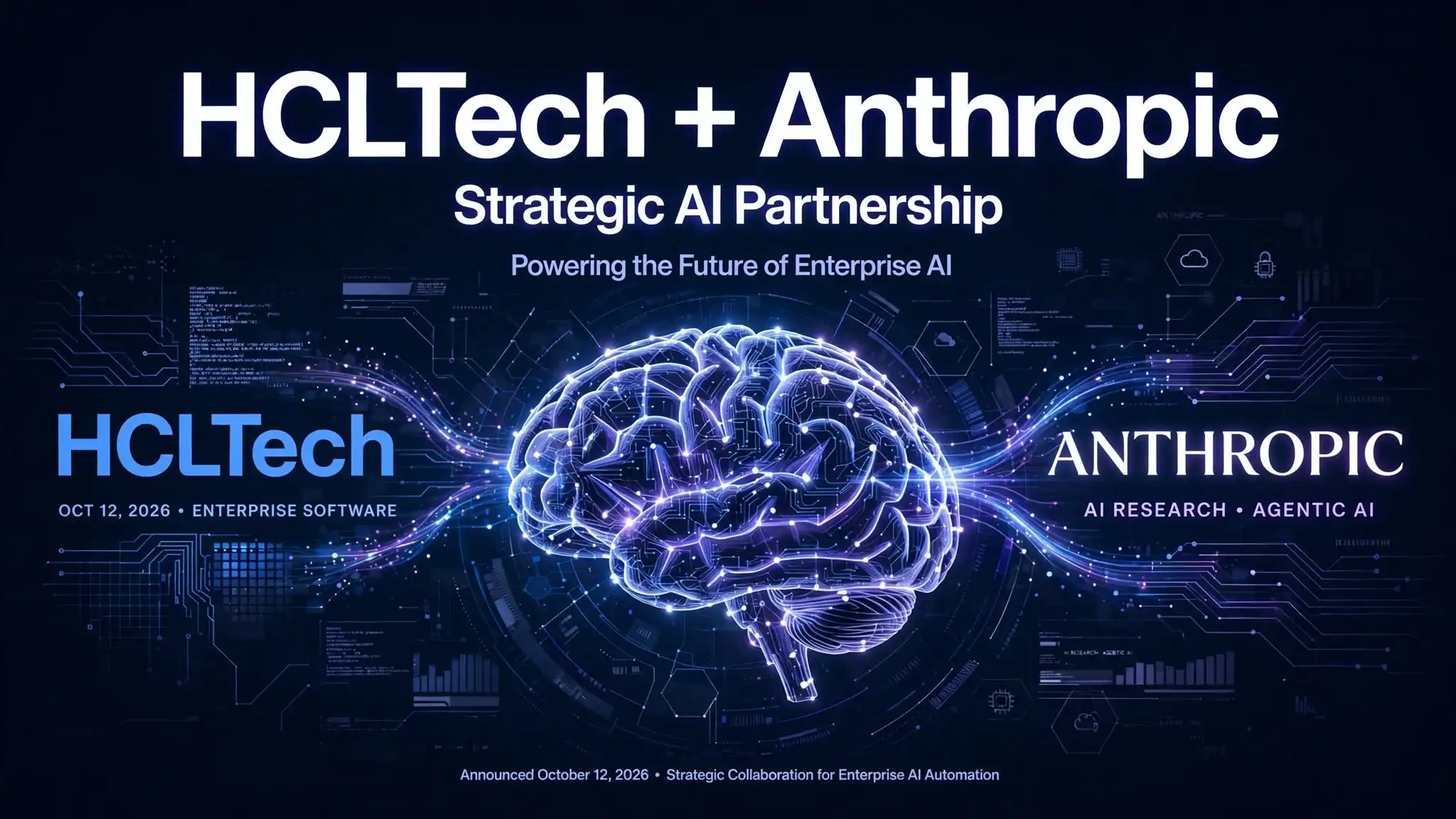
HCLTech and Anthropic have announced a Global Premier Partnership to help businesses adopt advanced Artificial Intelligence (AI) more safely and efficiently. Under this partnership, HCLTech will establish a dedicated Anthropic Business Unit and a Center of Excellence to develop and deploy AI solutions powered by Anthropic’s Claude models.
The partnership goes beyond simply using an AI chatbot. It aims to bring agentic AI into real business operations, including software development, IT support, cybersecurity, automation and enterprise applications. HCLTech will also integrate Claude and Claude Code into selected products offered by its software division.
The announcement is significant because it brings together Anthropic’s AI technology and HCLTech’s enterprise software, engineering and consulting capabilities. The main objective is to help large organisations move from experimenting with AI to using it in their daily operations.
Deal Snapshot: HCLTech–Anthropic Strategic AI Partnership
| Deal Details | Information |
| Partner 1 | HCLTech |
| Partner 2 | Anthropic |
| Deal Type | Strategic AI Partnership |
| Announcement Date | October 12, 2026 |
| HCLTech Country | India |
| Anthropic Country | United States |
| Industry | Artificial Intelligence, IT Services and Enterprise Software |
| Main Objective | Accelerate enterprise AI adoption and deploy agentic AI solutions |
| Key AI Technology | Claude, Claude Code and Claude Cowork |
| Key Initiatives | Dedicated Anthropic Business Unit and Center of Excellence |
| Software Integration | HCLSoftware products, including HCL BigFix and HCL AppScan, and Actian AI Analyst |
| Key Business Areas | AI engineering, software development, IT support, cybersecurity and automation |
All deal list – click here
What Is the HCLTech–Anthropic Partnership?
The partnership is a strategic collaboration between an established IT services company and an AI model developer.
HCLTech works with large organisations to build, maintain and modernise their technology systems. Anthropic develops Claude, a family of AI models designed for tasks such as reasoning, writing, coding and analysing information.
Under the agreement, HCLTech will use Anthropic’s AI technology to create solutions for enterprise customers. It will also help companies implement those solutions, integrate them with existing systems and establish safeguards for their use.
For example, a bank may want to automate software testing, a manufacturer may want to analyse equipment-related reports, and a telecom company may want to improve IT support. HCLTech can develop and integrate AI-based workflows for these needs using Claude.
The key point is that Anthropic provides the AI technology, while HCLTech helps turn that technology into practical business solutions. The exact division of responsibilities will vary by customer and implementation.
What Is Agentic AI, and Why Is It Important?
Agentic AI is one of the central technologies behind this partnership.
Traditional AI tools generally respond to a question or complete a specific request. Agentic AI systems can go further: within defined permissions, they can plan multiple steps, use approved tools, check results and carry out a larger task with limited human intervention.
Consider the following example.
Example: AI-powered software maintenance
- Identify a problem: The system receives an alert about a software error.
- Investigate the issue: It examines approved logs, error messages and relevant code.
- Suggest a solution: It identifies a likely cause and proposes a code correction.
- Test the correction: It runs approved tests to check whether the proposed fix works.
- Request approval: A human engineer reviews and approves a high-impact change before deployment.
Illustrative example of how an agentic workflow could operate; not a claim that every step is already deployed through this partnership.
This approach could reduce repetitive work, help engineers solve problems faster and allow employees to focus on more complex tasks.
However, agentic AI does not mean that every process can safely run without people. Systems still need access controls, testing, monitoring and human approval where the consequences of an error are significant.
HCLTech Will Establish a Dedicated Anthropic Business Unit
One of the most important parts of the agreement is the creation of a dedicated business unit focused on Anthropic’s AI technology.
This unit will have a Center of Excellence (CoE), which will bring together specialists, engineering knowledge and implementation capabilities to develop and deploy agentic AI solutions.
Its expected responsibilities include:
- Developing AI solutions for enterprise customers.
- Helping organisations test Claude in secure environments before wider deployment.
- Training employees to work with AI tools.
- Supporting companies as they introduce AI into existing business processes.
- Developing best practices for secure and responsible AI implementation.
The partnership also mentions Forward Deployed Engineers (FDEs). These are technical specialists who work closely with customers to understand their specific problems and implement solutions in real business environments.
For example, a manufacturer may want to automate quality-control reports, but its data may be stored across several existing systems. HCLTech’s engineers could help connect the relevant systems, configure the AI workflow and test it before production deployment.
This customer-focused approach is important because large businesses often need more than an AI model: they need integration, technical support, security controls and ongoing maintenance.
Claude and Claude Code Will Be Integrated into HCLSoftware Products
The partnership also extends to HCLSoftware, HCLTech’s enterprise software business.
HCLSoftware has become an Independent Software Vendor (ISV) partner of Anthropic. An ISV develops and sells software products, sometimes integrating technology from other companies into its own offerings.
Under the agreement, HCLSoftware plans to embed Claude capabilities into selected enterprise products, including HCL BigFix and HCL AppScan. The announcement also mentions enabling Actian AI Analyst.
Here is what the main products do.
HCL BigFix — IT operations and endpoint management
BigFix helps organisations manage and secure computers, servers and other connected devices. AI integration could help IT teams interpret system information, investigate issues and support routine operational tasks.
HCL AppScan — Application security
AppScan focuses on identifying security weaknesses in software applications. AI capabilities could help security teams understand findings, investigate vulnerabilities and prioritise remediation work.
Actian AI Analyst — Data analysis
The announcement also identifies Actian AI Analyst as part of the integration initiative. AI-assisted analysis can help users interpret business data and obtain insights more easily, although the exact new functionality has not been fully detailed in the announcement.
These integrations could make advanced AI more accessible to companies that already use HCLSoftware products. However, the announcement does not mean that all these features are immediately available to every customer; the scope of integration and commercial availability will depend on the specific product and rollout.
Claude Code and AI Force Will Support Software Engineering
Another major area of the partnership is software development and IT support.
HCLTech plans to integrate Claude and Claude Code into its AI Force platform, which supports agentic software engineering. The announced areas include IT support, code remediation and digital employee services.
What is Claude Code?
Claude Code is an AI-powered coding tool that helps developers understand codebases, make code changes and work through software-development tasks.
For example, if a company maintains a large software application built over many years, developers may spend considerable time finding the source of an error or understanding how different modules interact.
AI coding tools can help developers investigate the code, suggest changes and assist with testing. Human engineers still need to review the output, particularly where changes affect security, financial systems or critical business operations.
What is AI Force?
AI Force is HCLTech’s platform for AI-enabled software engineering and related workflows. Integrating Claude and Claude Code could help HCLTech combine AI reasoning and coding capabilities with its own engineering processes and enterprise services.
The company says these workflows will include policy guardrails, exception handling and human oversight for high-impact changes.
This is particularly important because an incorrect code change can introduce new bugs, expose sensitive information or disrupt business services.
Safety, Cybersecurity and AI Governance Are Central to the Deal
Businesses cannot adopt AI simply by connecting a model to their internal systems. They also need to control what the model can access, what actions it can perform and how its output is reviewed.
For this reason, HCLTech and Anthropic have highlighted three areas.
| Area | What it means for businesses |
| AI safety | Reduce the risk of incorrect or harmful AI actions through testing and controls. |
| Cybersecurity | Protect systems, sensitive data and access permissions. |
| AI governance | Establish policies, monitoring, accountability and human approval requirements. |
For example, an AI agent might be permitted to analyse a financial report and prepare a draft recommendation. That does not automatically mean it should be allowed to approve a payment or change a customer’s account.
A well-designed enterprise AI system separates these permissions and requires appropriate approval for sensitive actions.
The partnership’s focus on governance is therefore commercially important: many large companies want AI automation but cannot accept uncontrolled access to their internal systems.
Which Industries Could Benefit?
HCLTech serves customers across financial services, manufacturing, healthcare, telecommunications, technology and other sectors. Its existing enterprise relationships provide potential routes for introducing Anthropic’s technology into real business operations.
Banking and financial services
AI could help employees summarise documents, assist with software maintenance and analyse operational information. Sensitive financial decisions would still require appropriate controls and human review.
Manufacturing
Businesses could explore AI-assisted maintenance reporting, engineering documentation, quality-control analysis and support for complex industrial software systems.
Healthcare and life sciences
Potential uses include document processing, administrative support, research assistance and software engineering. Patient data protection and clinical oversight remain essential.
Telecommunications
AI could assist with incident analysis, technical documentation, network-support workflows and troubleshooting across complex systems.
IT services and enterprise software
This is one of the most direct areas of opportunity, including code assistance, application modernisation, IT support and workflow automation.
These are potential applications based on the announced partnership’s capabilities and HCLTech’s industry coverage. They should not be interpreted as confirmed customer deployments or guaranteed commercial results.
What Does HCLTech Gain from the Partnership?
The partnership could strengthen HCLTech in several ways.
Access to advanced AI technology
HCLTech can incorporate Claude capabilities into selected services, products and engineering workflows rather than developing every underlying AI model itself.
More enterprise AI projects
Customers that want to adopt AI often need help with implementation, integration, employee training and ongoing support. HCLTech can offer these services alongside AI-powered solutions.
Expansion of software products
Integrating Claude into selected HCLSoftware products could create opportunities to improve existing offerings and potentially develop additional AI-related services.
A stronger position in AI-led IT services
As businesses increasingly experiment with AI agents, technology providers need to demonstrate that they can deploy them safely and deliver measurable results. This partnership could help HCLTech compete for such projects.
The actual financial benefit will depend on customer adoption, project pricing, implementation costs and the ability to convert pilot projects into long-term business. The partnership announcement did not disclose a deal value, minimum revenue commitment or guaranteed financial return.
What Does Anthropic Gain?
The agreement also offers potential advantages to Anthropic.
Anthropic develops the Claude family of AI models, but large enterprises often need additional support before deploying AI across important business processes.
HCLTech can help bridge that gap by providing:
- Access to enterprise customers across multiple industries.
- Engineering and consulting support for real-world deployments.
- Integration with existing enterprise software and systems.
- Assistance with employee training and organisational readiness.
- A channel for introducing Claude and Claude Code into selected software products.
This may help Anthropic expand its enterprise presence, while HCLTech can use Anthropic’s models to strengthen its own technology services.
The commercial terms of the agreement have not been publicly specified in the announcement, so the partnership’s precise revenue contribution to Anthropic cannot yet be calculated.
How Does This Partnership Fit into HCLTech’s Financial and Business Strategy?
The partnership was announced on October 12, 2026, alongside HCLTech’s second-quarter results for the July–September quarter.
HCLTech reported consolidated revenue of ₹35,620 crore, up 11.5% year over year, and net profit of ₹5,132 crore, up 21.2%. The company also reported annualised advanced AI revenue of $876 million in its own results announcement.
These figures provide useful context: AI is already a commercial area for HCLTech, rather than simply a research initiative.
The Anthropic partnership could support that strategy by adding another AI technology capability to the company’s enterprise offerings. However, HCLTech has not disclosed how much of its existing AI revenue, if any, will specifically come from this partnership.
It is also worth noting that AI creates both opportunities and challenges for IT services companies. Automation may help deliver projects more efficiently, but it can also reduce demand for some traditional, labour-intensive services. Providers will need to adapt their pricing models, employee skills and service offerings accordingly.
Key Risks and Challenges
Although the partnership offers significant opportunities, several factors will determine its success.
1. Enterprise adoption: Companies may take time to move from testing AI to deploying it across core operations.
2. Data privacy and security: Enterprise customers need confidence that sensitive data and intellectual property are adequately protected.
3. Reliability: AI systems can produce incorrect answers or flawed code. Testing, monitoring and human review are necessary.
4. Implementation costs: Integrating AI into legacy systems, training employees and maintaining governance controls can require substantial investment.
5. Competition: HCLTech and Anthropic will compete in a fast-moving market where other IT services firms and AI providers are also developing enterprise solutions.
6. Measurable financial returns: A partnership announcement does not guarantee new contracts or increased profits. Its success will depend on customer demand and profitable execution.
These are general business risks associated with enterprise AI deployment, not evidence that either company has experienced a specific problem under this agreement.
What Should Investors and Businesses Watch Next?
The most useful indicators for assessing the partnership’s progress will be:
- The launch and operational progress of HCLTech’s dedicated Anthropic Business Unit and Center of Excellence.
- The availability of Claude integrations in HCLSoftware products.
- New enterprise customer deployments and publicly announced contracts.
- The growth of HCLTech’s AI-related revenue and demand for AI engineering services.
- Evidence of productivity improvements, lower operating costs or faster software delivery.
- Updates on security controls, customer adoption and commercial availability.
These indicators will help distinguish the strategic potential of the announcement from its eventual financial impact.
Conclusion
HCLTech’s partnership with Anthropic is an important development in the enterprise AI market.
The creation of a dedicated business unit, integration of Claude into selected HCLSoftware products and planned use of Claude Code within AI Force show that the partnership is focused on practical enterprise applications.
For HCLTech, it could create new opportunities in AI-led software engineering, automation and enterprise transformation. For Anthropic, it provides another route to bring Claude into large organisations.
The key question now is execution: how quickly customers adopt these solutions, what measurable business benefits they deliver and whether those benefits translate into sustainable revenue growth.