When lightning flashes in the sky at night, we close our windows. But have you ever thought how much power is in that one flash?
Science says, one common lightning bolt contains about 1 Billion Joules of energy. That’s enough to run 1,000 homes for a whole month. And such lightning strikes our Earth 1.4 Billion times a year.
So, a treasure of electricity is floating right above our heads, for free. We just need someone to catch it.
This technology of catching this treasure is called Lightning Harvesting. It used to sound like madness, but now the biggest companies in the world are running behind it. Let’s understand it from scratch.
What is Lightning Harvesting?
In simple words, it’s a tank to catch electricity from electricity.
Just like you install a tank on your roof to catch rainwater, this is a technology to catch lightning falling from the sky, bottle it, and then send it to our homes.
In a normal power plant, electricity is made from coal or water. Here, the factory is the clouds in the sky.
This entire system has 3 parts:
1. Trigger System: The bait to call lightning towards itself.
2. Conduit System: The super-highway to bring lightning from the sky to the ground.
3. Storage System: The super-bottle to store that lightning.
Normal batteries or inverters are useless here, because the current of lightning is so fast that a normal battery will blast in a second. That’s why Super-Capacitors and Super-Conducting Magnetic Storage are used here, which can drink thousands of amperes in one jolt.
How Does This Technology Work?
This is the most filmy part of this technology. Catching lightning is not that easy.
The Biggest Problem: Lightning doesn’t strike after telling you. It’s random. No one knows when and where it will strike.
Scientists have found 2 ways to solve this problem:
Method A: Making a Path with a Laser (LIPC Technology)
This is the most advanced method.
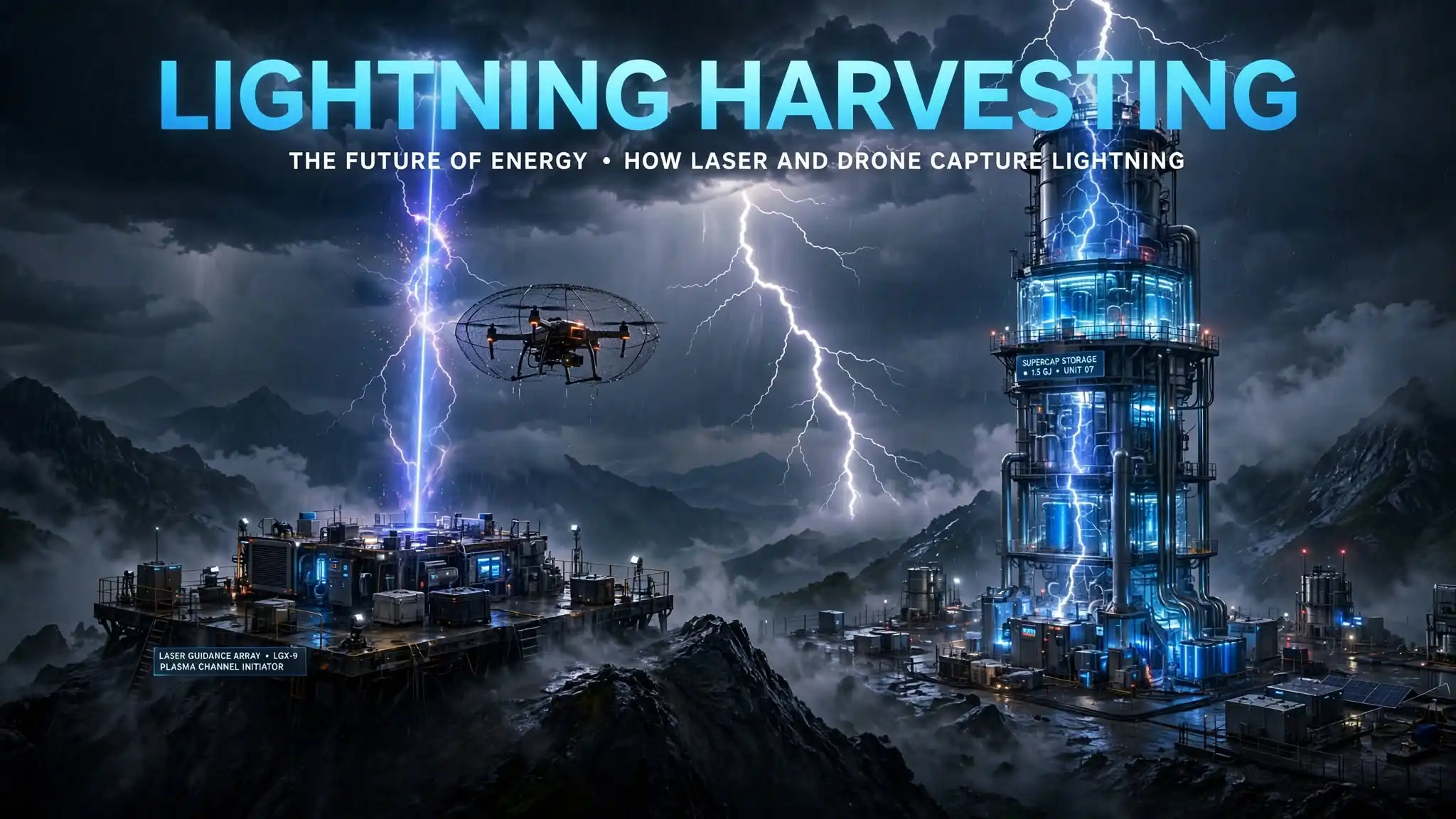
1. A very powerful Terawatt Laser is fired from the ground towards the sky.
2. The laser heats the air so much that air molecules break and a Plasma Channel is created in the air. Meaning, the air itself becomes a wire for electricity.
3. Now the charge filled in the cloud gets a path. It comes straight down this laser path to the tower below.
This is called Laser-Induced Plasma Channel. In simple language – Making a highway for electricity in the air with a laser.
Method B: Laying a Net with a Drone
This is Japan’s new idea.
1. A special drone with a Faraday Cage on it is sent below the cloud.
2. A long conducting wire hanging from the drone is connected to the ground.
3. When the charge in the cloud increases, as soon as the drone’s switch is turned ON, lightning is pulled through that wire.
Because of the Faraday Cage, nothing happens to the drone, the lightning slips over it and goes down.
In both methods, after the lightning comes down, it is put into a Super-Capacitor bank, from there it is slowly converted into AC and sent to the Grid.
Who is Researching It and How Far Has The Research Reached?
A) EUROPE – The Biggest Win
Project Name: LLR – Laser Lightning Rod
Funded By: European Union
Who is in The Team?
– TRUMPF Scientific Lasers, Germany: Made a 5-ton, 9-meter-long super-laser that fires 1000 laser pulses in 1 second.
– University of Geneva, Switzerland
– EPFL and Ecole Polytechnique, Paris
Where Was It Tested: On Mount Säntis in Switzerland. This is a 2500-meter high mountain that gets struck by lightning more than 100 times a year. There is also a Swisscom tower there.
How Far Has It Reached: This is the biggest success so far. Between 21 July and 30 September 2021, there were huge storms. The team ran the laser for 6 hours.
What was the result? When the laser was ON, 4 out of 4 lightning strikes came straight on the laser’s path. One lightning was recorded by 2 high-speed cameras that it traveled 50 meters on the laser’s plasma channel to reach the tower.
This result was published in the world’s biggest journal Nature Photonics (Jan 2023). It proves we can now call lightning.
B) JAPAN – World’s First Drone Capture
Company: NTT Corporation (Nippon Telegraph and Telephone)
NTT is Japan’s biggest telecom company. Their problem was that their mobile towers would shut down due to lightning strikes.
What Did They Make: A Quadcopter Drone with a metal cage (Lightning Protection Cage) around it.
When Was It Tested: In December 2024 and January 2025 in the mountains of Hamada City, Shimane at 900 meters altitude.
What Happened: The drone went 300 meters up, a 300-meter wire hanging from it was connected to the ground. As soon as the charge in the cloud increased, the switch was turned ON and real lightning was triggered and pulled. The drone didn’t even get a scratch.
NTT’s calculation is: One lightning contains 278 kWh of electricity, and the world’s lightning can make 383.6 TWh per year. Now they are making a system to store it.
C) JAPAN’S SECOND PLAYER – Electricity From Air
Institute: Kanazawa Institute of Technology
They don’t even wait for lightning to strike. Their concept is Atmospheric Current Power Generation. Meaning, pull the charge that is roaming in the cloud without falling, slowly, just like extracting water from air. This is considered the safest method and Japan has been working on it since 2010.
D) AMERICA
Alternate Energy Holdings (AEHD), Idaho: Back in 2007, they patented a method to catch lightning and charge a capacitor.
NASA + US Naval Research Lab: Together with the University of Bergen, Norway, they flew inside clouds for 1 month in a plane to understand how lightning is formed.
What Will Happen If It Succeeds?
Imagine if this technology comes in 2035, how will the world change?
– Lightning Farms: In places like Rajasthan, Gujarat, Florida, Africa where lightning strikes the most, Lightning Farms will be installed instead of farms. Farmers will grow electricity.
– Free Electricity Cities: In the rainy season, your electricity bill will become zero.
– No More Blackouts: One big lightning farm will give a whole year’s electricity in one storm.
What Are The Risks and Difficulties?
Every big thing has a big risk too.
1. Storage Problem: Lightning comes for 0.0001 second. No battery has yet learned to drink such fast energy. Super-capacitors are still very expensive.
2. Cost: One laser tower of TRUMPF costs more than $1.8 Million. And its electricity bill to run is separate.
3. Safety: If the system fails, 30,000 Amperes of current will burn the entire area. That’s why it is still being tested only on mountains far from cities.
When Will It Come To Your Home?
According to scientists, it will come in 3 Phases:
Phase 1 (2021-2025) – COMPLETE: We learned to call lightning. Europe and Japan have done it.
Phase 2 (2025-2030) – ONGOING: Storing it. As soon as Solid-State Batteries become cheap, this will happen.
Phase 3 (2030-2035): First Commercial Lightning Farm. It will first be installed in Japan and Europe.
So friends, Lightning Harvesting is no longer Science Fiction, it is on its way to becoming Science Fact. The sky’s electricity will never end, it has no bill. We just need to learn how to catch it.
Sources: LLR Project – Nature Photonics Jan 2023 (TRUMPF, University of Geneva, EPFL, Ecole Polytechnique on Mount Säntis), NTT Corporation Global – Drone Lightning Trigger Test Dec 2024-Jan 2025 Hamada City, Kanazawa Institute of Technology Japan, NASA/US Naval Research Lab & Alternate Energy Holdings USA.