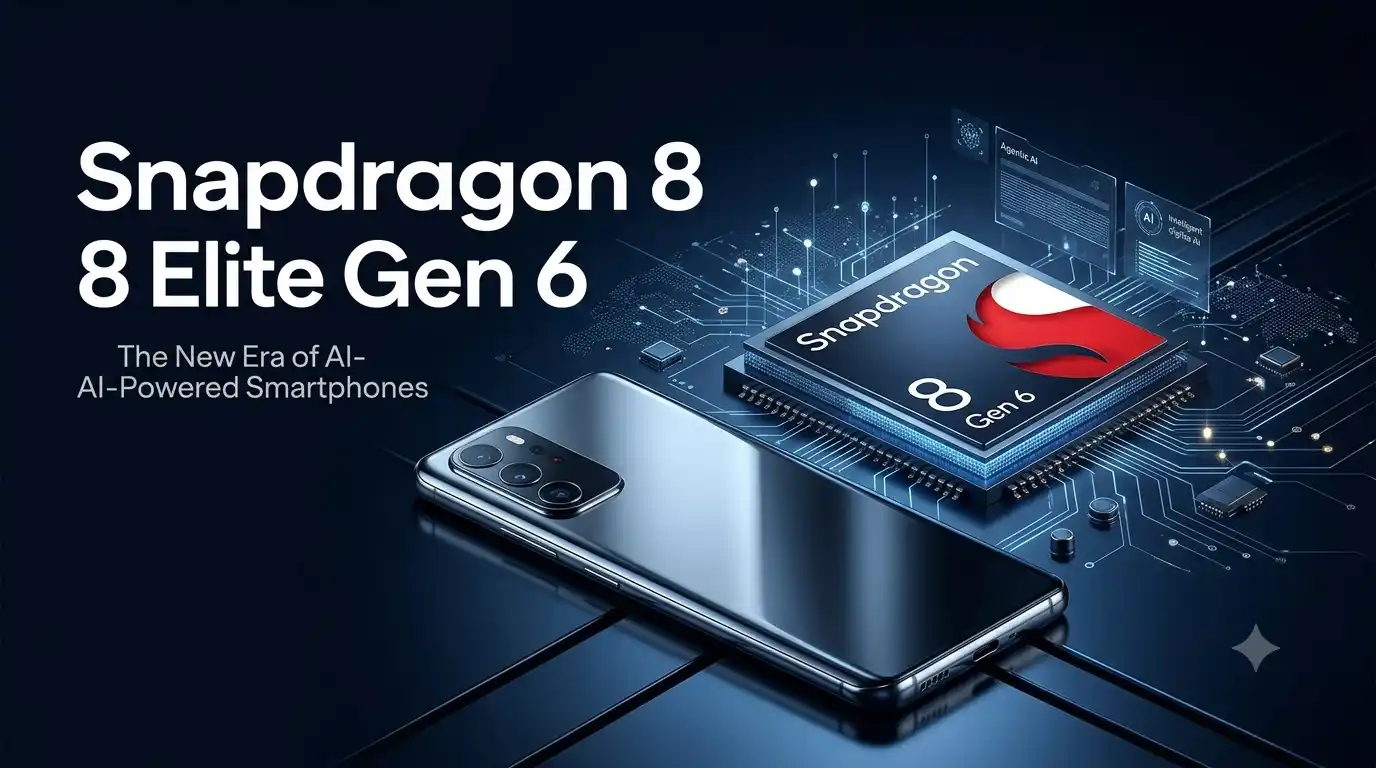
Qualcomm has unveiled two new flagship smartphone platforms — the Snapdragon 8 Elite Extreme Gen 6 and Snapdragon 8 Elite Gen 6 — as it looks to push smartphones into a new era of on-device and agentic artificial intelligence.
Announced at Snapdragon Summit 2026, the two new chipsets combine Qualcomm’s latest Oryon CPU, Adreno GPU and Hexagon NPU technologies with improvements in AI, gaming, photography, video processing and connectivity.
The biggest change, however, is not simply higher processor speed. Qualcomm is positioning the new Snapdragon platforms around agentic AI, where smartphones can understand context, learn user preferences and potentially perform multi-step tasks with less continuous user input.
Both platforms are built using a 2nm process technology and feature CPU cores capable of reaching speeds of up to 5GHz, according to Qualcomm. The company says the Snapdragon 8 Elite Extreme Gen 6 is its most advanced mobile platform for the next generation of premium smartphones.
Snapdragon 8 Elite Gen 6 Series: Key Highlights
| Feature | Snapdragon 8 Elite Extreme Gen 6 | Snapdragon 8 Elite Gen 6 |
| Manufacturing Process | 2nm | 2nm |
| CPU | Qualcomm Oryon | Qualcomm Oryon |
| Maximum CPU Speed | Up to 5GHz | Up to 5GHz |
| CPU Performance Improvement | Up to 13% | Up to 10% |
| GPU Performance Improvement | Up to 44% | Up to 35% |
| GPU Power Efficiency | Up to 40% better | Up to 40% better |
| NPU Performance | Up to 35% faster | Up to 14% faster |
| Agentic AI | Advanced on-device AI | Multi-step agentic AI |
| Video Recording | Up to 8K60, 4K240 | Advanced AI-enhanced imaging |
| 5G | Up to 14.8Gbps | Up to 14.8Gbps |
| Wi-Fi | FastConnect 8800, up to 11.6Gbps | FastConnect 8800, up to 11.6Gbps |
Performance improvements are Qualcomm’s claimed figures compared with the previous generation.
What Is New About the Snapdragon 8 Elite Extreme Gen 6?
The Snapdragon 8 Elite Extreme Gen 6 is designed as the higher-performance member of Qualcomm’s new flagship lineup.
The platform combines a custom Qualcomm Oryon CPU, redesigned Adreno GPU and Hexagon NPU. Qualcomm says the Oryon CPU can reach 5GHz and delivers up to a 13% improvement in CPU performance over the previous generation.
The GPU is another major area of improvement. Qualcomm claims up to 44% higher GPU performance along with up to 40% better power efficiency.
This combination is important for smartphones because modern flagship devices increasingly need to handle demanding workloads such as generative AI, advanced gaming, computational photography and high-resolution video processing on the device itself.
Snapdragon 8 Elite Gen 6 Brings Flagship Technology to More Premium Phones
Alongside the Extreme version, Qualcomm has introduced the standard Snapdragon 8 Elite Gen 6.
It uses the same 2nm manufacturing technology and Qualcomm Oryon CPU architecture, with CPU speeds reaching up to 5GHz.
According to Qualcomm, the standard Snapdragon 8 Elite Gen 6 delivers:
- Up to 10% higher CPU performance
- Up to 37% better CPU power efficiency
- Up to 35% higher GPU performance
- Up to 40% better GPU efficiency
- Up to 14% higher NPU performance
This means Qualcomm is not limiting its latest AI and performance technologies to only the most expensive Extreme configuration. The standard Gen 6 is also designed to support premium smartphones with advanced on-device AI capabilities.
Agentic AI Is the Biggest Change
The most important part of Qualcomm’s announcement is its focus on agentic AI.
Traditional smartphone AI generally works by responding to a specific command. For example, a user may ask an AI assistant to summarize a document or create an image.
Agentic AI aims to take this a step further.
An AI agent can potentially understand the user’s context, preferences and objectives and then perform multiple steps to complete a task.
For example, instead of repeatedly giving instructions, a user could eventually ask a smartphone AI to organize a trip. The system could potentially understand the user’s preferences, search relevant information, compare options and prepare the required information across multiple applications — subject to the software, permissions and services available on the device.
Qualcomm is therefore trying to make the smartphone more proactive rather than simply reactive.
The company’s AI architecture combines the Oryon CPU, Hexagon NPU and Sensing Hub to support these workloads directly on the device.
Why On-Device AI Matters
One of the major advantages of running AI directly on a smartphone is reduced dependence on cloud processing for supported workloads.
When an AI task can be processed locally, it can potentially provide:
Faster Response Times
Data does not always have to travel to a remote server and return to the smartphone. This can reduce latency for supported AI workloads.
Better Privacy
Some personal information can potentially remain on the device instead of being sent to a cloud service, depending on how an application is designed.
AI Without Constant Connectivity
Local AI processing can also be useful when a smartphone has limited or no internet connectivity, although cloud connectivity may still be required for many advanced AI services.
However, these benefits should not be interpreted as meaning that every AI feature will work offline. Actual capabilities will depend on the operating system, applications, AI models, permissions and services implemented by smartphone manufacturers.
Extreme Gen 6 Gets Major Camera and Video Upgrades
Qualcomm is also targeting professional-level mobile photography and videography.
The Snapdragon 8 Elite Extreme Gen 6 supports video capture of up to 8K at 60 frames per second and 4K at up to 240 frames per second, according to Qualcomm.
The platform also introduces technologies such as Intelligent Pixel Control and the Elite Color Engine.
Intelligent Pixel Control is designed to analyze and optimize individual pixels within a scene, helping improve image quality in challenging conditions.
The Elite Color Engine is designed to improve color processing and video quality.
Qualcomm is also highlighting support for advanced multi-camera configurations, including support for triple 64MP cameras on the Extreme platform.
These technologies show how AI is becoming increasingly connected with smartphone cameras. Instead of simply increasing megapixel numbers, manufacturers are using computational processing to improve the final image or video.
Gaming Performance Gets a Major Upgrade
Gaming remains another important area for the new Snapdragon platforms.
The Extreme version uses a redesigned Adreno GPU and includes technologies such as Adreno Neural Fusion and dedicated graphics processing capabilities designed to improve AI-assisted graphics workloads.
Higher GPU performance can help smartphones handle demanding games, advanced lighting, higher-resolution textures and real-time graphics effects.
The improvement in power efficiency is also important because higher performance without better efficiency can lead to increased heat and battery consumption.
Qualcomm’s approach therefore focuses not only on making the GPU faster but also on improving performance per watt.
Connectivity Is Also Getting Faster
The new Snapdragon platforms are not limited to CPU, GPU and AI improvements.
Qualcomm has also upgraded connectivity through technologies including the Snapdragon X105 5G Modem-RF System and FastConnect 8800.
According to Qualcomm, the platforms can support peak 5G download speeds of up to 14.8Gbps, while FastConnect 8800 can deliver peak Wi-Fi speeds of up to 11.6Gbps under Qualcomm’s specified conditions.
These capabilities can support high-bandwidth activities such as cloud gaming, high-resolution streaming, large file transfers and AI services that still require cloud connectivity.
Actual network speeds, however, will depend on the carrier, network infrastructure, spectrum, device design and local conditions.
Snapdragon 8 Elite Extreme Gen 6 vs Snapdragon 8 Elite Gen 6
The two processors share several important technologies, including the 2nm process, Qualcomm Oryon CPU architecture and 5GHz CPU capability.
The main differences are in the level of GPU, AI and imaging performance.
The Extreme version is aimed at smartphones requiring the highest level of graphics and AI performance, while the standard Snapdragon 8 Elite Gen 6 is designed to bring many of the same next-generation technologies to a broader range of premium smartphones.
This two-platform strategy gives smartphone manufacturers more flexibility when designing different flagship models.
Which Smartphone Brands Will Use the New Snapdragon Platforms?
Qualcomm has announced that smartphones powered by the new platforms will come from several major brands.
The companies named by Qualcomm include:
- HONOR
- iQOO
- Motorola
- OnePlus
- OPPO
- REDMI
- RedMagic
- vivo
- Xiaomi
The exact processor used in each smartphone will depend on the individual manufacturer’s product strategy and model specifications.
Qualcomm’s Strategy: From Smartphone Processor to AI Platform
The latest Snapdragon announcement reflects a broader change taking place in the smartphone industry.
For years, smartphone processors were primarily discussed in terms of CPU speed, GPU performance, camera ISP capabilities and battery efficiency.
AI is now becoming another fundamental part of the mobile processor.
The NPU, CPU, GPU and sensing systems increasingly work together to process AI workloads. This means future smartphones may not simply have an AI application; AI could become part of the underlying operating experience.
Qualcomm’s focus on agentic AI suggests that the company expects smartphones to move toward more personalized and context-aware computing.
Instead of waiting for users to provide every instruction, future mobile AI systems are being designed to understand more of the user’s environment and preferences.
What Does This Mean for Future Smartphones?
The Snapdragon 8 Elite Gen 6 family indicates that the next phase of smartphone competition could be increasingly focused on AI capability rather than processor speed alone.
A smartphone with a powerful NPU and efficient local AI processing could support features such as:
- More personalized AI assistants
- AI-powered photo and video editing
- Real-time translation
- Smarter voice interactions
- Context-aware recommendations
- AI-assisted productivity
- More advanced gaming graphics
- On-device generative AI
- Multi-step AI agents
However, the hardware is only one part of this equation.
The real-world experience will also depend on the AI models, operating system, application ecosystem, memory capacity, software optimization and the way individual smartphone manufacturers implement Qualcomm’s technology.
The Bigger Picture
Qualcomm’s Snapdragon 8 Elite Extreme Gen 6 and Snapdragon 8 Elite Gen 6 represent a shift in how premium smartphone processors are being designed.
The headline numbers — including 5GHz CPU speeds, 2nm manufacturing, higher GPU performance and faster NPUs — show the continued push for raw computing power and efficiency.
But the more significant development is Qualcomm’s emphasis on agentic and on-device AI.
If software developers and smartphone manufacturers successfully take advantage of these capabilities, future smartphones could become more capable of understanding context, processing information locally and completing complex tasks with fewer instructions.
For consumers, this could eventually change the smartphone from a device that mainly waits for commands into a more intelligent computing platform that can assist with tasks proactively.
The Snapdragon 8 Elite Extreme Gen 6 and Snapdragon 8 Elite Gen 6 are therefore not just another generation of faster mobile processors. They represent Qualcomm’s attempt to establish the hardware foundation for the next stage of AI-powered smartphones.