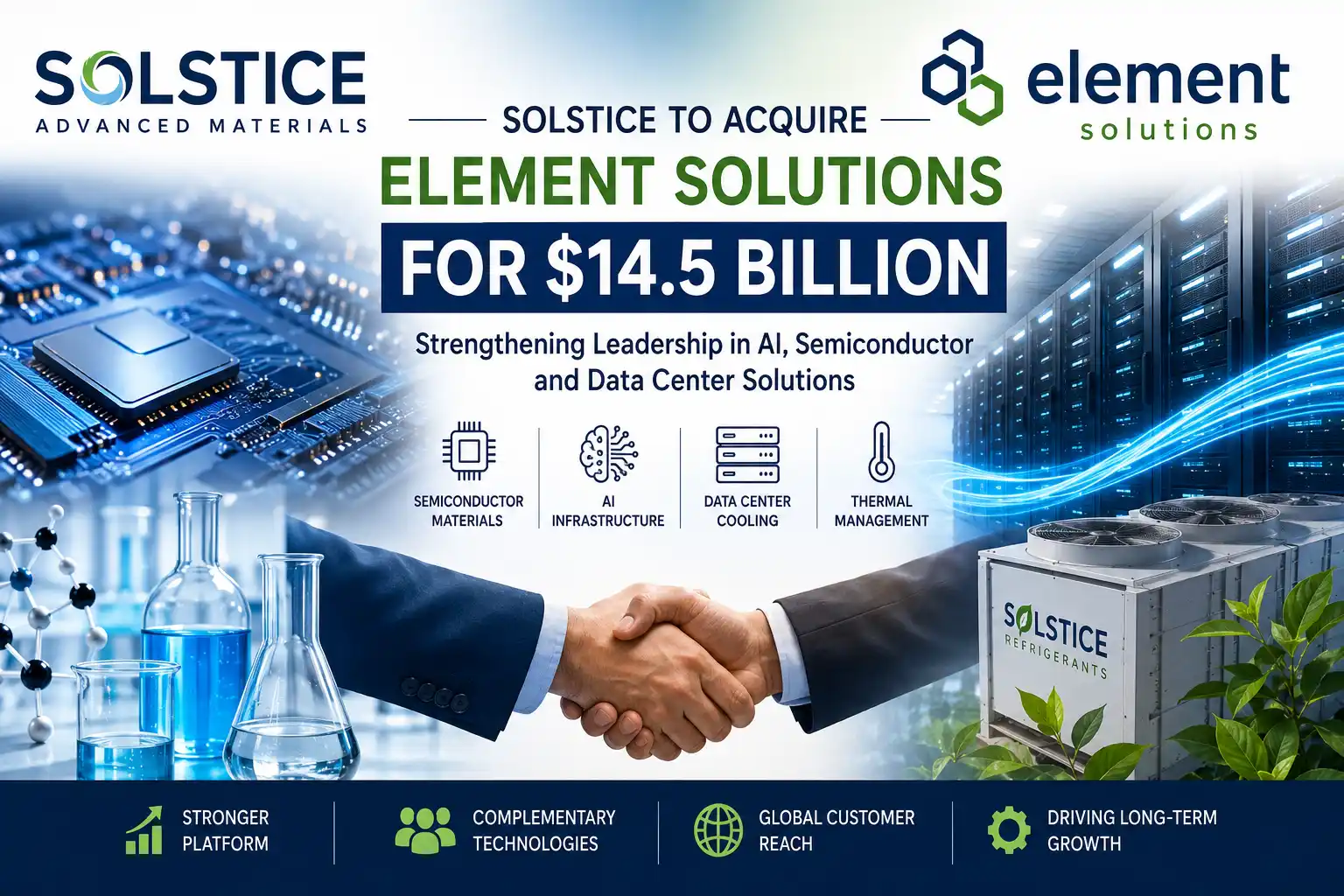
Solstice Advanced Materials has agreed to acquire Element Solutions in a cash-and-stock transaction valued at approximately $14.5 billion, including net debt.
The two companies announced the deal on July 6, 2026. Under the agreement, Element Solutions shareholders will receive $10 in cash and 0.5 Solstice shares for each Element Solutions share. The offer represents an implied value of approximately $50.10 per Element share, around a 15% premium to Element Solutions’ closing price on July 2, 2026.
After the transaction closes, Element Solutions shareholders are expected to own approximately 44% of the combined company. The combined company will continue operating under the Solstice Advanced Materials name, with David Sewell continuing as CEO.
The transaction still requires shareholder and regulatory approvals and is currently expected to close in the first half of 2027.
Deal Details at a Glance
| Deal Detail | Information |
| Acquirer | Solstice Advanced Materials |
| Target | Element Solutions |
| Acquirer Country | USA |
| Deal Type | Cash + Stock Acquisition |
| Announcement Date | July 6, 2026 |
| Deal Value | Approximately $14.5 Billion |
| Industry | Semiconductor & Electronics Mat |
| Implied Value per ESI Share | Approximately $50.10 |
| Premium | Approximately 15% |
| Cash Consideration | $10 per ESI share |
| Stock Consideration | 0.5 Solstice share per ESI share |
| Element Shareholders’ Ownership | Approximately 44% |
| Expected Closing | First Half of 2027 |
| Combined Company Name | Solstice Advanced Materials |
| Combined CEO | David Sewell |
| Solstice Ticker | NASDAQ: SOLS |
| Element Solutions Ticker | NYSE: ESI |
Company Introduction: What Does Solstice Advanced Materials Do?
Solstice Advanced Materials is a global specialty materials company that develops advanced materials and chemical solutions for industries such as:
- Semiconductor manufacturing
- Electronics
- Data-center cooling
- Refrigerants
- Nuclear power
- Healthcare packaging
- Protective materials
Its major brands include Solstice, Genetron, Aclar, Spectra, Fluka and Hydranal.
The company has approximately 4,100 employees, serves more than 3,000 customers and has operations or customers across more than 120 countries and territories.
Solstice was previously part of Honeywell and became an independent publicly traded company in October 2025 following its spin-off.
Company Introduction: What Does Element Solutions Do?
Element Solutions is a specialty chemicals technology company focused heavily on electronics and industrial applications.
Its technologies are used in areas including:
- Semiconductor manufacturing
- Advanced electronics
- Printed circuit boards
- Power electronics
- High-performance computing
- Communications
- Data storage
- Automotive systems
- Industrial surface finishing
- Offshore energy
Element Solutions generated approximately $2.55 billion in net sales in 2025. Around 70% of its revenue came from its Electronics segment, making electronics and semiconductor-related applications a major part of the company.
Why Is Solstice Buying Element Solutions?
The acquisition is not simply about increasing revenue or company size.
Solstice is targeting markets expected to benefit from long-term growth in AI infrastructure, semiconductors, electronics and data centers.
Element Solutions has a strong electronics and semiconductor-related materials business, while Solstice already has capabilities in advanced materials, refrigerants and thermal-management solutions.
Combining the two businesses could allow Solstice to offer a broader range of technologies to customers across the electronics and AI infrastructure supply chain.
How Is AI Connected to the Acquisition?
AI is one of the most important strategic reasons behind this deal.
AI data centers require powerful computing systems, but the AI infrastructure ecosystem involves much more than GPUs.
It also requires:
Semiconductor manufacturing → Advanced packaging → Electronics → Thermal management → Data-center cooling
Element Solutions has technologies used in semiconductor manufacturing, electronics and advanced packaging.
Solstice, meanwhile, has expertise in refrigerants and thermal-management technologies.
Therefore, the combined company could have a stronger position across multiple parts of the AI infrastructure ecosystem.
In simple terms:
Element Solutions helps make and package advanced electronics and chips.
Solstice provides materials and technologies that can help manage heat and support critical infrastructure.
That combination could become increasingly valuable as AI computing demand grows.
Stronger Position in the Semiconductor Industry
Element Solutions’ Electronics segment is an important part of the acquisition.
The company develops specialty chemicals and process technologies used in electronics manufacturing and semiconductor-related applications.
These capabilities include technologies associated with printed circuit boards, semiconductor manufacturing and advanced packaging.
After the acquisition, Solstice could gain:
- Greater exposure to semiconductor manufacturing
- Stronger advanced-packaging capabilities
- A larger electronics customer base
- Additional research and development capabilities
- Greater exposure to high-performance computing
- More opportunities for cross-selling
This could make the combined company more relevant to semiconductor manufacturers and electronics companies.
Data-Center Cooling Is Another Major Opportunity
AI servers generate significantly more heat as computing performance increases.
As a result, efficient cooling is becoming a critical part of modern data-center infrastructure.
Solstice already has businesses related to refrigerants and thermal management.
Element Solutions brings complementary electronics and semiconductor materials capabilities.
Together, the companies could potentially serve a wider range of requirements linked to AI data centers—from semiconductor and electronics manufacturing to thermal-management technologies.
This is one of the most important long-term strategic opportunities created by the acquisition.
How Large Will the Combined Company Become?
Based on the companies’ 2025 results, the combined business would have approximately $6.8 billion in annual sales.
The companies also expect the combined business to achieve an Adjusted EBITDA margin of approximately 26% after including expected run-rate synergies.
That would create a much larger and more diversified specialty-materials company.
What Are the Expected Synergies?
Management expects the acquisition to create both cost and revenue synergies.
1. Cost Savings
The companies can potentially reduce overlapping corporate, procurement and operational costs.
The companies expect annual cost synergies of more than $180 million within three years.
2. Cross-Selling
Solstice could sell its products to Element Solutions customers, while Element Solutions’ products could be introduced to Solstice’s customer base.
3. Combined R&D
Combining research and development capabilities could help the company develop new specialty materials and chemical solutions.
4. Larger Customer Network
The combined company would have a broader customer base across electronics, semiconductors, industrial markets and specialty materials.
5. Economies of Scale
A larger company could potentially achieve better manufacturing, procurement and distribution efficiency.
How Will the Acquisition Be Financed?
The transaction is not an all-cash acquisition.
Element Solutions shareholders will receive:
$10 cash + 0.5 Solstice share
for each Element Solutions share. Solstice has secured approximately $4.7 billion in bridge financing from Goldman Sachs to help fund the cash portion of the transaction.
The company plans to replace this bridge financing with permanent debt financing. This means financing and post-deal leverage will be important issues for investors to monitor.
Is the Deal Risky for Solstice?
Yes. Although the strategic opportunity is significant, the transaction is also very large compared with Solstice’s existing business.
The key risks include:
High Financing Requirements
The cash component requires significant financing.
Integration Risk
Combining two companies with different systems, employees, operations and corporate structures can be challenging.
Synergy Risk
The expected cost savings and revenue opportunities may take longer to achieve than management expects—or may not reach the projected level.
Regulatory Risk
The transaction requires regulatory approvals in addition to shareholder approvals.
Shareholder Dilution
Because Element Solutions shareholders will receive Solstice shares, existing Solstice shareholders will own a smaller percentage of the combined company.
Why Did Solstice’s Stock Fall After the Announcement?
Despite the strategic logic of the acquisition, investors initially reacted negatively.
Solstice shares fell sharply following the announcement, with Reuters reporting a decline of around 15%. The market’s concerns centered mainly on the large size of the transaction and the financing required to complete it.
This highlights an important point:
A strategically attractive acquisition does not necessarily create short-term value for shareholders.
Investors will want to see whether:
- The acquisition price is justified
- Debt remains manageable
- Expected synergies are achieved
- Earnings become accretive
- Integration proceeds smoothly
Solstice’s Latest Financial Performance
Solstice reported its second-quarter 2026 results on July 30, 2026.
The company reported:
- Net Sales: $1.148 billion, up 11% year over year
- Net Income: $119 million, up 23%
- Diluted EPS: $0.75
- Adjusted EPS: $0.88
- Adjusted EBITDA: $290 million
- Operating Cash Flow in H1 2026: $461 million
- Free Cash Flow in H1 2026: $248 million
The company also raised its full-year 2026 guidance.
Solstice now expects:
Net Sales: $4.125–$4.185 billion
Adjusted EBITDA: $1.035–$1.055 billion
Adjusted EPS: $2.75–$2.95
This shows that Solstice’s standalone business was already experiencing solid growth before the acquisition.
What Does Solstice’s Balance Sheet Look Like?
As of June 30, 2026, Solstice had approximately $750 million in cash and around $1.97 billion in total debt. Its net leverage ratio was approximately 1.3x, while total liquidity stood at approximately $1.75 billion.
The balance sheet therefore had some financial flexibility, but the Element Solutions acquisition will significantly increase the importance of financing and leverage management.
What Will Element Solutions Shareholders Receive?
Element Solutions shareholders will receive a combination of cash and stock.
For every Element Solutions share, they will receive:
$10 in cash + 0.5 Solstice share
After completion of the transaction, Element Solutions shareholders are expected to own approximately 44% of the combined company.
This means Element investors will continue to participate in the future performance of the combined business instead of simply receiving cash and exiting the company.
When Will the Acquisition Close?
The acquisition has not yet been completed.
The transaction still requires:
- Element Solutions shareholder approval
- Solstice shareholder approval where required
- Regulatory approvals
- Other customary closing conditions
The companies currently expect the transaction to close during the first half of 2027.
Until then, Solstice and Element Solutions remain separate publicly traded companies.
What Will the Combined Company Look Like?
Following completion, the combined company will operate under the Solstice Advanced Materials name.
David Sewell will remain CEO.
Element Solutions CEO Benjamin Gliklich is expected to join the combined company’s board along with two additional directors nominated by Element Solutions. The planned board will have 11 directors.
The Biggest Strategic Advantage of the Deal
The biggest advantage of this acquisition is not simply the increase in revenue.
It is the complementary nature of the two businesses.
Solstice has strengths in:
- Refrigerants
- Thermal management
- Advanced materials
- Nuclear applications
- Healthcare packaging
Element Solutions has strengths in:
- Electronics chemicals
- Semiconductor materials
- Advanced packaging
- Industrial specialty chemicals
- Surface-finishing technologies
Therefore, the acquisition could create a more diversified advanced-materials platform.
How Much Could AI Growth Benefit the Combined Company?
The AI boom is driving investment throughout the semiconductor and data-center supply chain.
But AI infrastructure is not limited to chip designers and GPU manufacturers.
The ecosystem also includes:
Semiconductor manufacturing → Packaging → Electronics → Cooling → Data Centers
Specialized materials are required at almost every stage.
This gives the combined Solstice business an opportunity to benefit indirectly from the long-term growth of AI infrastructure.
However, it is important to note that Solstice is not an AI company. Its potential AI exposure comes mainly through the materials, semiconductor, electronics and thermal-management technologies used by companies building AI infrastructure.
What Does This Deal Really Mean?
In our view, this acquisition is more than a traditional revenue-growth transaction.
It is an attempt by Solstice to significantly strengthen its long-term position in advanced materials, electronics, semiconductors and AI-related infrastructure.
Solstice is still a relatively young independent public company after being spun off from Honeywell in 2025.
Acquiring Element Solutions gives it a much larger platform and adds a business with strong exposure to electronics and semiconductor manufacturing.
At the same time, Solstice brings thermal-management and cooling capabilities that complement Element Solutions’ electronics expertise.
That creates an interesting strategic combination.
However, the biggest question for investors is whether Solstice can generate enough additional growth and cost savings to justify the $14.5 billion transaction value.
Final Takeaway
The Solstice Advanced Materials–Element Solutions acquisition is a major $14.5 billion deal in the specialty materials industry.
The transaction could significantly strengthen Solstice’s position in:
- Semiconductor manufacturing
- Advanced packaging
- Electronics
- AI infrastructure
- Data-center cooling
- Thermal management
- Specialty materials
Element Solutions shareholders will receive $10 in cash plus 0.5 Solstice share for each Element share, and are expected to own approximately 44% of the combined company after closing.
The transaction is expected to close in the first half of 2027, subject to shareholder and regulatory approvals.
For Solstice, the deal offers a potentially powerful long-term growth opportunity. But the success of the acquisition will ultimately depend on three things: how efficiently the companies integrate, whether the expected synergies are achieved, and how effectively Solstice manages the additional financing and debt.
Source: Solstice Advanced Materials, Element Solutions SEC filings and media reports