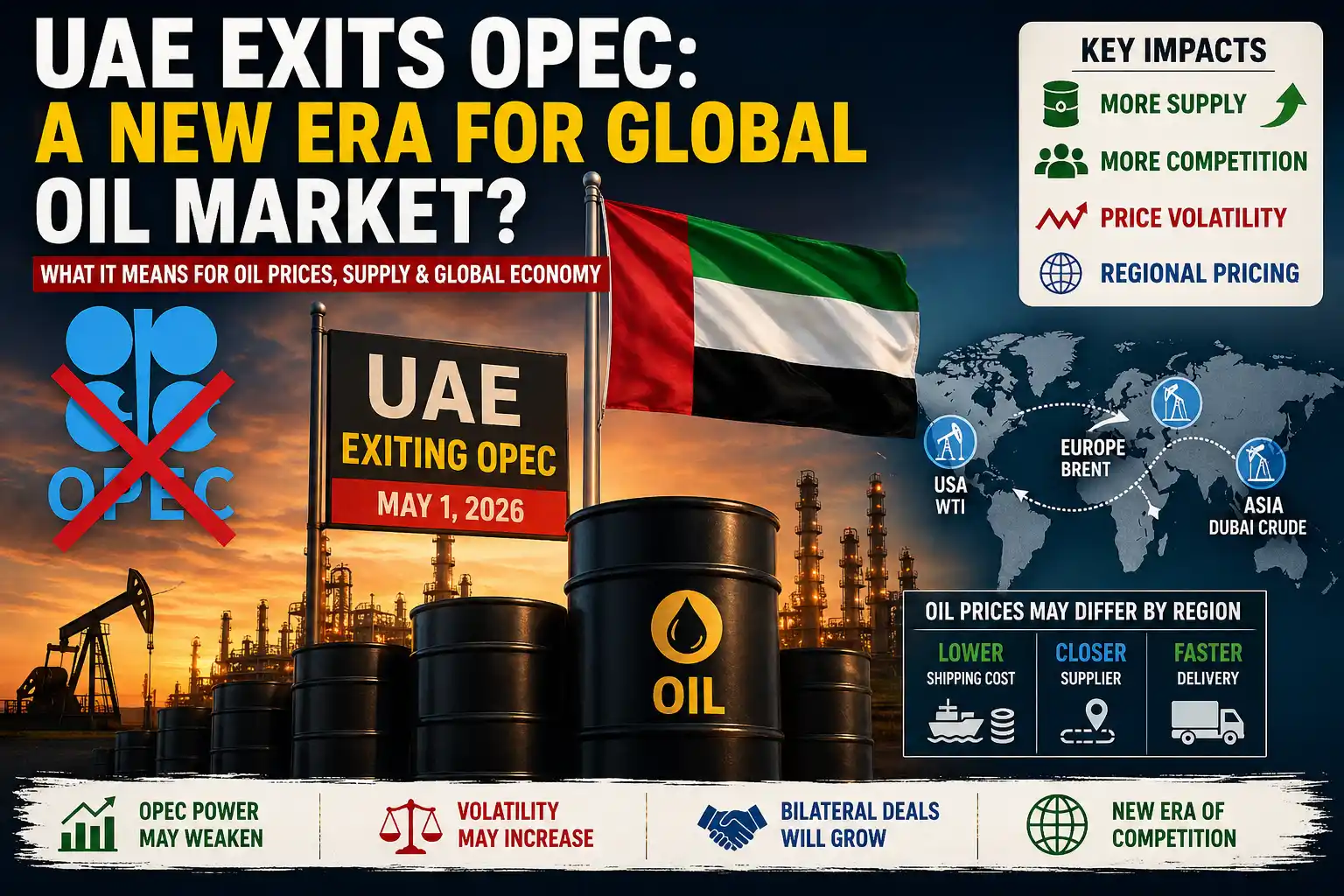
A major shift has emerged in the global oil market.
United Arab Emirates has officially announced that it will exit OPEC starting May 1, 2026.
This decision is highly significant for several reasons:
- The UAE has been a member of OPEC for nearly 60 years
- It is one of the top oil-producing nations in the world
- The move comes at a time when global oil prices are already high and geopolitical tensions in the Middle East are affecting supply
- Experts believe this decision could reshape the structure of the global oil market
The impact will not be limited to oil prices. It may affect:
- Global economy
- Inflation
- Stock markets
- Import-dependent countries like India
The biggest questions now are:
- Will OPEC’s control weaken?
- Will the oil market shift toward a free-market system?
- Will oil prices vary significantly across countries?
In this article, we will analyze all these aspects in detail in a simple and clear way.
What is OPEC and How Does It Work?
OPEC is an international group of major oil-producing countries that collectively influence the global oil market.
Key Functions of OPEC:
- Control oil supply
- Set production quotas
- Maintain price stability
How does it work in practice?
If global oil supply becomes too high, prices tend to fall. In such cases:
- OPEC reduces production
- Supply decreases
- Prices stabilize
Similarly, if supply is tight and prices rise too much, OPEC can increase production.
This is why OPEC is often called an “oil cartel,” as it collectively influences supply and pricing.
Why Did the UAE Exit OPEC?
1. Freedom to Increase Production
The UAE has significant oil production capacity, but OPEC quotas limited how much it could produce.
This meant:
- The UAE had the ability to produce more
- But was restricted by OPEC rules
Now, after exiting:
- The UAE can increase production freely
- Export more oil
- Generate higher revenue
2. Strategic Independence
The UAE wants full control over its energy policy.
Within OPEC:
- Decisions are collective
- Members must follow group rules
Outside OPEC:
- The UAE can decide its own production levels
- It can set pricing and supply strategies independently
This flexibility is crucial for long-term growth.
3. Internal Conflicts
Saudi Arabia plays a dominant role within OPEC.
However:
- The UAE had disagreements over production quotas
- Policy differences created tension
These internal conflicts contributed to the exit decision.
4. Future Growth Strategy
The UAE’s long-term goals include:
- Increasing oil production
- Expanding global market share
- Using oil revenues to diversify its economy
Exiting OPEC removes restrictions and supports these goals.
Impact on OPEC Structure
🔻 1. Weakening of Cartel Power
OPEC’s strength lies in coordinated action.
When a major producer like the UAE exits:
- Collective control weakens
- Coordination declines
This reduces OPEC’s global influence.
🔻 2. Breakdown of Discipline
OPEC relies on trust and compliance.
If one country exits:
- Others may ignore quotas
- Some may increase production unofficially
This weakens the supply control mechanism.
🔻 3. Domino Effect Risk
The UAE’s exit sends a signal:
“If it’s not beneficial, others can leave too.”
This could lead to:
- More countries considering exit
- Uncertainty around OPEC’s future
Changes in Oil Market Structure
1. Shift Toward a Free Market
Earlier: OPEC influenced prices through supply control
Now:
- Individual countries may act independently
- This makes the market more competitive and open.
2. Supply Increase
As the UAE increases production, and possibly others follow:
Global oil supply may rise
This could put downward pressure on prices in the long term.
3. Increased Price Volatility
With less coordination: Supply-demand imbalances may occur more frequently
Prices may:
- Spike sharply
- Or fall quickly
This leads to a more unstable market.
Will Oil Prices Differ Across Countries?
This is one of the most important and practical questions.
Current Reality
Even today, there is no single global oil price:
- Brent (Europe)
- WTI (USA)
- Dubai crude (Asia)
So regional pricing already exists.
Future Outlook
After the UAE’s exit:
- Direct bilateral deals may increase
- Pricing could become more flexible
- Regional price differences may widen
For example:
- Asia may get cheaper oil from the UAE
- Europe may rely on other suppliers
This means: Different regions could see different prices at the same time
Important Clarification
- Global benchmark pricing will not disappear
- Instead, regional pricing layers will strengthen
Role of Geography and Shipping Costs
1. Advantage of Nearby Suppliers
If a country is geographically closer:
- Shipping costs are lower
- Delivery is faster
Example:
- India imports oil from the UAE
- Europe sources from nearby regions
Proximity creates cost advantages.
2. How Final Oil Cost is Determined
The final cost of oil is not just the crude price:
Final Cost = Crude Price + Shipping + Insurance + Time Cost
Shorter distance = Lower total cost
3. Future Trend: Smart Sourcing Strategy
Countries will increasingly focus on:
“Who is the closest and cheapest supplier?”
This will strengthen regional trade patterns.
Important Limitations
Infrastructure
- Ports
- Pipelines
- Storage facilities
Without infrastructure, proximity offers limited benefit.
Long-Term Contracts
Countries sign multi-year agreements.
Immediate switching of suppliers is not always possible.
Oil Quality
Not all crude oil is the same.
Refineries require specific types of crude
Impact on the Global Economy
Negative Effects
- Higher price volatility
- Inflation uncertainty
- Market instability
Positive Effects
- Increased competition
- Higher supply
- Potential for cheaper oil in the long term
Impact on India
Positive
- Access to cheaper oil from the UAE
- Lower import costs
Risks
- Short-term price fluctuations
- Planning challenges due to volatility
Final Conclusion
The UAE’s exit from OPEC marks a structural turning point in the global oil market.
Key Takeaways:
- OPEC’s influence is gradually weakening
- The oil market is becoming more competitive and flexible
- Regional pricing systems will strengthen
- Geography and shipping costs will play a bigger role
- Volatility will increase, but so will opportunities
In Simple Terms:
“The oil market is shifting from cartel control toward a system driven by competition, geography, and smart trade decisions.”
Source: wam (UAE news agency)
( Analysis based on publicly available market data, global reports, and current industry trends.)