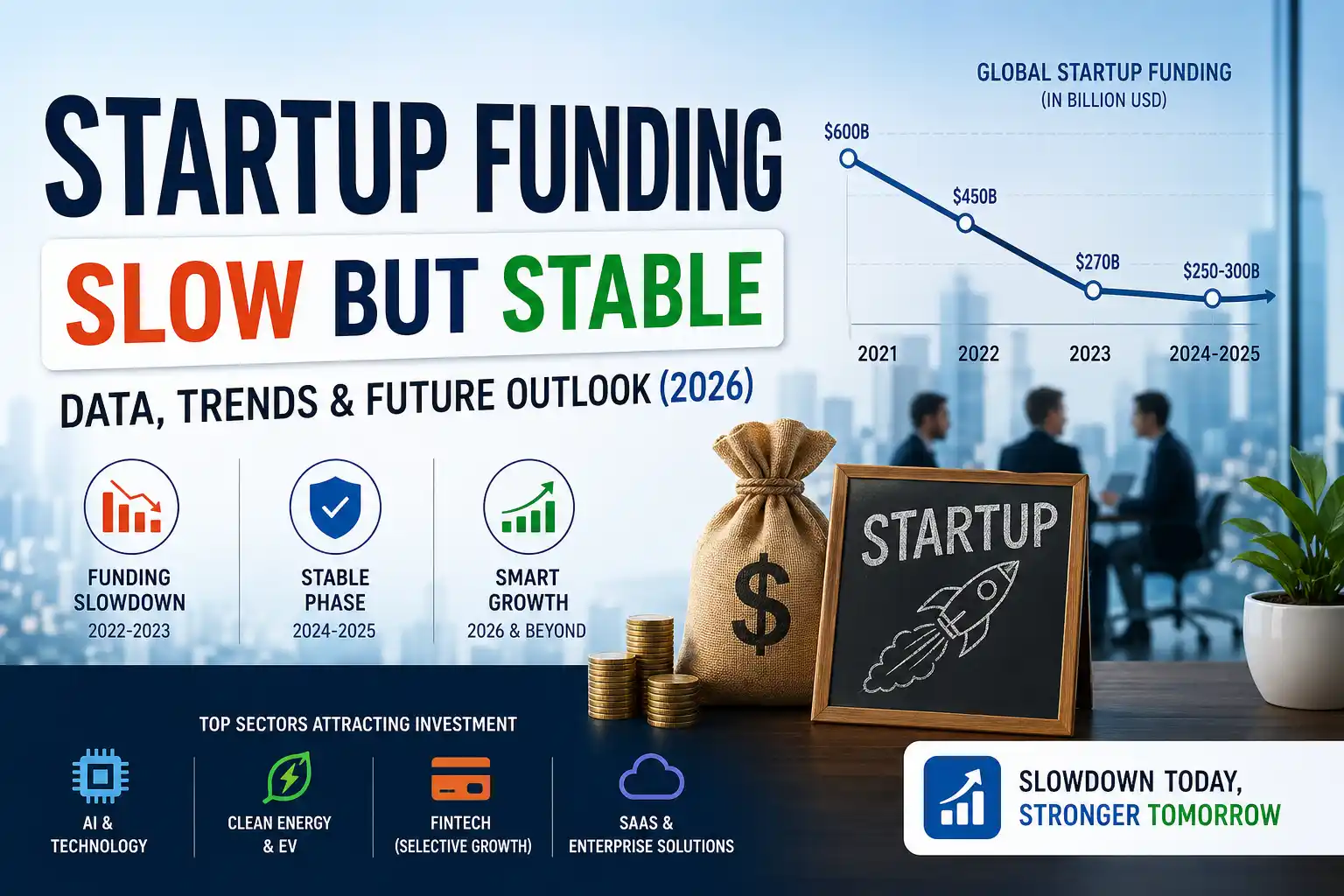
The startup ecosystem has gone through a major shift in the last few years. After a massive funding boom in 2020–2021, the market entered a slowdown phase from 2022 onward.
Now in 2025–2026, the situation is clearer — funding has slowed down, but it has not stopped. This phase is no longer a “funding winter,” but rather a “selective funding era,” where only strong and sustainable startups are attracting investment.
Global Funding Trend
- 2021: ~$600 Billion (Peak funding year)
- 2022: ~$450 Billion (Start of slowdown)
- 2023: ~$270 Billion (Sharp correction)
- 2024–2025: ~$250–300 Billion (Stabilization phase)
What this means:
- Earlier, capital was cheap and easily available
- Now, investors are more cautious and disciplined
India Startup Funding — Ground Reality
- 2021: ~$42 Billion (Peak)
- 2022: ~$38 Billion
- 2023: ~$25 Billion
- 2024–2025: ~$20–25 Billion (Stable range)
Key Changes:
- Fewer mega funding deals
- Early-stage funding is still active
- Late-stage startups are facing more pressure
Why Has Funding Slowed Down?
1. Interest Rate Impact
As central banks increased interest rates globally:
- Capital became more expensive
- Venture capital firms reduced risky investments
2. Overvaluation Correction
Many startups were overvalued during the boom period
Examples:
- Byju’s → Once valued at ~$22B, later faced valuation cuts and financial challenges
- WeWork → High hype initially, followed by a sharp valuation drop
Lesson: Growth without profitability is not sustainable
3. Profitability Pressure
Investors now focus on:
- When will the startup become profitable?
- How much cash is being burned?
The “growth at any cost” model is no longer acceptable
Where Is Funding Going? (Sector-wise Analysis)
1. AI & Technology
- OpenAI → Raised billions in funding
- Anthropic → Attracted heavy investments
AI is currently the hottest investment sector
2. EV & Clean Energy
- Ola Electric → Expanding EV ecosystem
- Tesla → Leading global EV push
Energy transition is attracting long-term capital
3. Fintech (Selective Growth)
- Razorpay → Stable growth with strong fundamentals
- Stripe → Consistent performance
Only strong fintech players are receiving funding
Impact on Startup Ecosystem
Negative Impact
- Unacademy → Layoffs and restructuring
- Swiggy → Cost-cutting measures
Many startups shifted into survival mode
Positive Impact
- Zoho → Strong profitability model
- Freshworks → Sustainable global growth
Strong companies have become even stronger
Investor Behavior — Major Shift
| Then (2020–21) | Now (2025–26) |
| Growth-first approach | Profit-first approach |
| High valuations | Realistic valuations |
| Fast funding cycles | Slower, selective funding |
| Risk-taking | Risk management |
Investors are now focusing on fundamentals and sustainability
Case Study
Case 1: High Growth, Low Profit
Byju’s
- Rapid expansion
- Weak profitability
Result: valuation decline
Case 2: Sustainable Growth
Zoho
- Limited external funding
- Strong profit model
Result: stable and successful business
Future Outlook (2026–2027)
- Funding is expected to gradually improve
- AI, SaaS, and Deep Tech will dominate
- India may emerge as a major hub for manufacturing and digital startups
Trend:
Correction → Stability → Smart Growth
Outcome
The slowdown in startup funding is not a crisis — it is a healthy reset for the ecosystem.
From now on, only those startups will succeed that:
- Have strong business models
- Can generate profits
- Focus on long-term sustainability
In the long run, this shift will make both the Indian and global startup ecosystem stronger and more resilient.