The amount of data being generated around the world is increasing at a very fast pace. Technologies like AI, cloud computing, video streaming, and IoT are producing massive volumes of data every year. Traditional storage technologies such as hard drives, SSDs, and magnetic tapes have limitations in terms of space, energy consumption, and long-term durability.
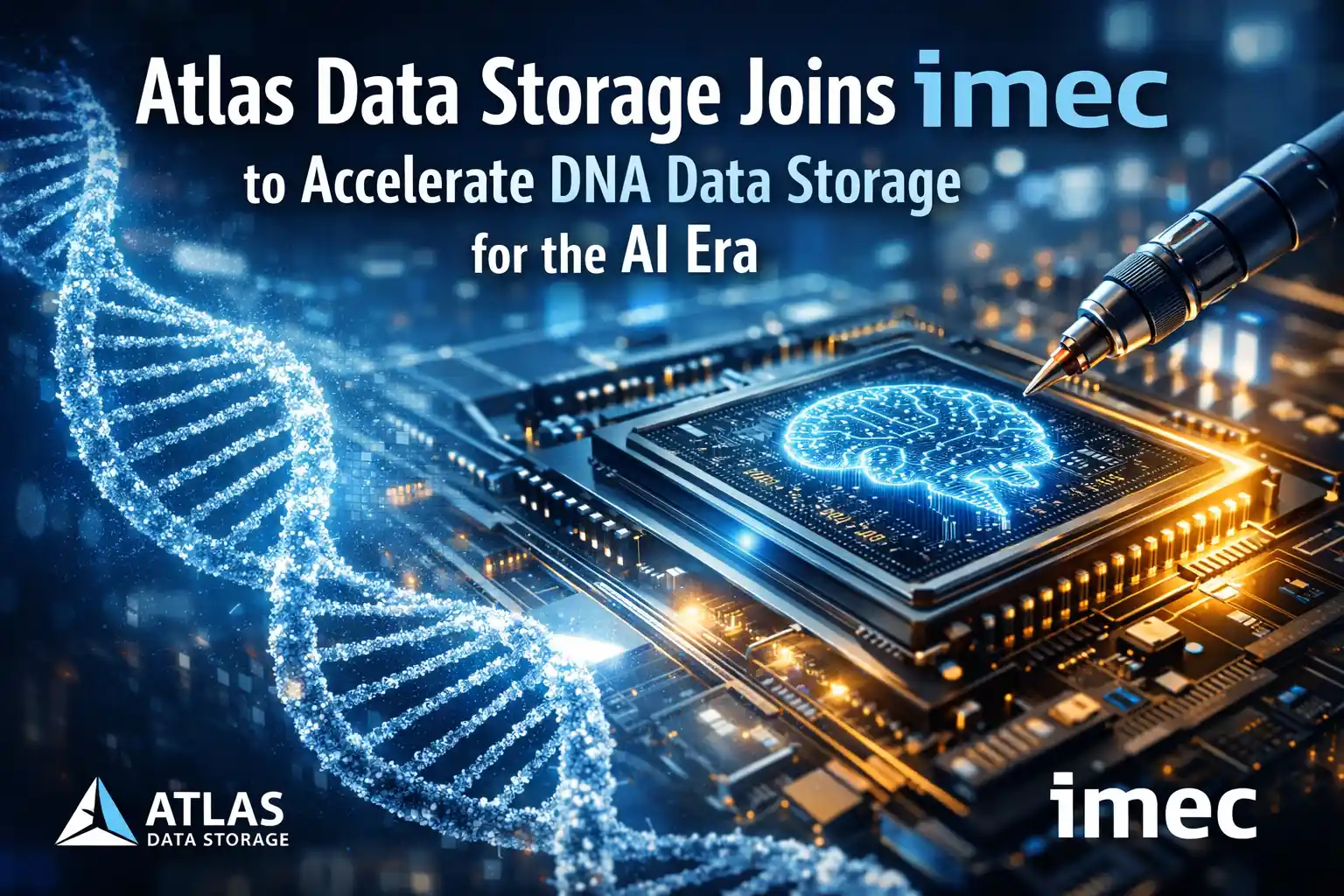
To address this growing challenge, Atlas Data Storage and imec have announced a strategic partnership to develop large-scale DNA-based digital data storage technology. The goal of this collaboration is to bring DNA storage closer to commercial deployment and make it capable of handling the massive data demands of the future.
Latest News
On March 5, 2026, Atlas Data Storage and imec announced a collaboration to accelerate the development of synthetic DNA-based data storage systems.
Under this partnership:
- Atlas Data Storage will contribute its expertise in DNA synthesis technology and custom ASIC chip design.
- imec will provide advanced semiconductor technology, nanoelectronics expertise, and chip manufacturing capabilities.
By combining these technologies, the two organizations aim to scale DNA data storage to industrial levels, making it more efficient, faster, and cost-effective for long-term data archiving.
In addition to technological collaboration, imec will also support the initiative through strategic investment in Atlas Data Storage.
Company Introduction
Atlas Data Storage
Atlas Data Storage is a deep-technology company focused on developing synthetic DNA-based digital storage solutions.
Key points about the company:
- It was spun out of biotechnology company Twist Bioscience in 2025.
- The company is building technology that allows digital information to be encoded and stored in DNA molecules.
- Its long-term vision is to create storage systems capable of preserving data for hundreds or even thousands of years.
Atlas has already introduced an early DNA storage system known as the Eon 100 DNA storage platform.
imec
imec is one of the world’s leading nanoelectronics and semiconductor research organizations.
Key facts:
- Headquarters: Leuven, Belgium
- More than 6,500 researchers and engineers
- Global leader in semiconductors, AI hardware, photonics, and advanced chip technology
imec collaborates with major technology companies and universities to develop next-generation technologies.
What is DNA-Based Data Storage
DNA data storage is an emerging technology where digital information is encoded into the genetic code of DNA molecules.
DNA uses four chemical bases:
A, C, G, and T
In this system:
- Digital binary data (0s and 1s) is converted into DNA code.
- The data is written into synthetic DNA strands.
- These DNA molecules store the information.
- When needed, the data can be retrieved through DNA sequencing technology.
Read more: DNA Data Storage: The Cloud Technology of the Future
Why DNA Storage is Unique
1. Extremely High Data Density
DNA is considered the most dense data storage medium known.
- Just one gram of DNA can theoretically store hundreds of petabytes of data.
This is thousands of times more efficient than conventional storage devices.
2. Long-Term Data Preservation
Under proper conditions, DNA can remain stable for thousands of years.
In comparison:
- Hard drives typically last 5–10 years
- Magnetic tape storage lasts 10–30 years
This makes DNA particularly suitable for long-term archival storage.
3. Low Energy Consumption
Unlike traditional data centers, DNA storage does not require continuous electricity to maintain the data.
This means:
- Lower energy consumption
- Reduced environmental impact
How Atlas and imec Technology Will Work
The collaboration focuses on combining DNA technology with semiconductor chips to improve the speed and scalability of DNA data storage.
1. Custom Chip Technology
Atlas has developed a CMOS ASIC chip designed to control the DNA synthesis process.
2. Nano-Scale Electrode Arrays
imec has developed extremely small nano-scale devices that help accelerate the DNA writing process.
3. High-Throughput DNA Synthesis
The technology allows millions of DNA synthesis sites to operate simultaneously, greatly increasing the speed at which data can be written.
Why This Technology Is Important
Global data creation is increasing rapidly.
Estimated data growth:
- Around 200 zettabytes of data in 2025
- Expected to exceed 1 yottabyte by 2030
Storing this massive volume of data with current technologies will become increasingly difficult. DNA storage is seen as a potential long-term solution to the global data storage challenge.
Future Applications of DNA Storage
DNA storage could be used in several industries in the future:
- Archiving massive AI datasets
- Government and national records
- Banking and financial data archives
- Scientific research datasets
- Cultural and historical archives
Challenges Still Exist
Although the technology is promising, several challenges remain:
- DNA synthesis is still expensive
- Writing and reading data takes time
- Large-scale commercialization is still under development
Experts believe it may take 3–5 years or more before DNA storage becomes widely available for commercial use.
Outcome
The partnership between Atlas Data Storage and imec represents an important step forward in the development of DNA-based digital storage technology.
This technology has the potential to transform the future of data storage because it offers:
- Extremely high storage capacity
- Very long-term durability
- Low energy consumption
If successfully commercialized, DNA data centers could become a major alternative to traditional hard drives and server-based storage systems in the future.
Source: prnewswire