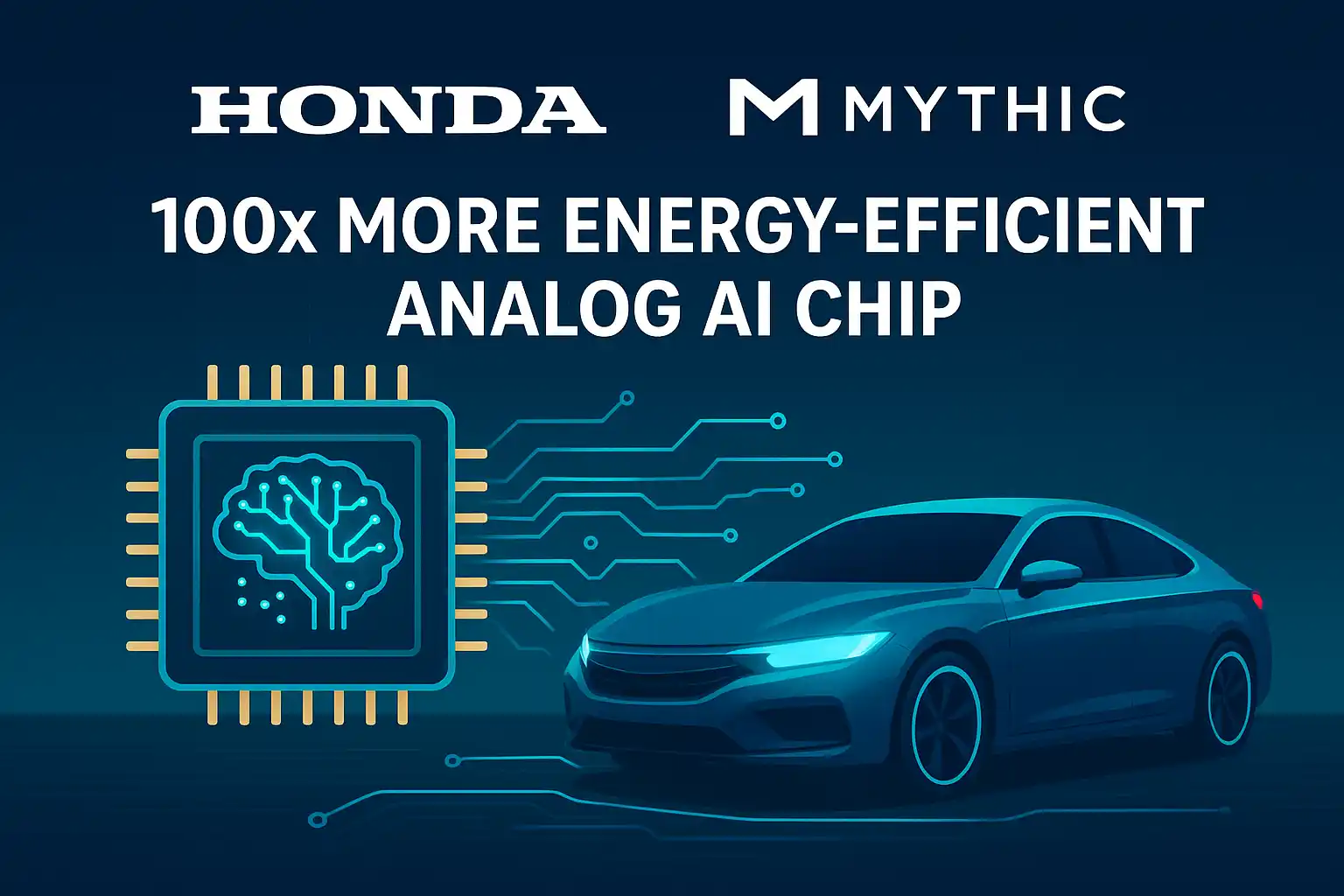
Honda Motor Co. and U.S.-based semiconductor company Mythic have announced a joint development initiative to create a 100-times more energy-efficient analog AI chip for future vehicles. The chip is being designed for next-generation and software-defined vehicles (SDVs), where artificial intelligence will play a central role in safety, automation, and in-car intelligence.
The companies said the project is focused on vehicles expected to enter the market after 2026, with an emphasis on delivering high AI performance while keeping power consumption extremely low.
What is this new AI chip?
Most AI processors used in vehicles today are digital chips, which require constant movement of data between memory and processing units. This process consumes significant power and generates heat.
Mythic’s approach is different. Its analog compute-in-memory technology combines memory and computation in the same location. As a result:
- Data movement is drastically reduced
- Power consumption drops significantly
- AI workloads can run much more efficiently
Because of this architecture, the new chip is expected to be up to 100 times more energy-efficient than conventional automotive AI processors.
Why does this matter for vehicles?
Future vehicles are expected to rely heavily on AI for:
- Advanced driver-assistance systems (ADAS)
- Real-time camera and sensor processing
- AI-based safety features
- In-car digital assistants
All of these functions require strong computing power. However, in electric vehicles especially, battery capacity is limited and high-power chips can reduce driving range.
The new analog AI chip aims to:
- Enable real-time AI processing directly inside the vehicle
- Reduce dependence on cloud computing
- Preserve battery life and improve overall efficiency
Performance targets
According to the companies, the chip under development is targeting:
- More than 100,000 TOPS (trillions of operations per second) of AI performance
- Automotive-grade reliability and durability
- High performance with minimal heat generation
This level of computing power is typically found in data centers. The goal of the Honda-Mythic collaboration is to bring similar capability into vehicles without the usual energy cost.
Honda’s long-term vision
Honda views this project as part of its broader safety and innovation strategy. The company has stated that:
- AI-driven systems can significantly reduce traffic accidents
- Faster, real-time decision-making improves vehicle safety
- The long-term goal is to move toward zero traffic-related fatalities
Energy-efficient AI hardware is seen as a key enabler for these objectives, especially as vehicles become more autonomous and software-driven.
Mythic’s role in the partnership
Mythic is a U.S.-based AI chip company known for its work on analog AI processors optimized for low-power edge computing. Its technology has been used in applications such as cameras and industrial systems, and this partnership marks a major step toward large-scale automotive deployment.
Under the agreement:
- Mythic will license its analog AI technology
- Honda and Mythic will jointly develop an automotive-grade AI system-on-chip (SoC)
When will this technology reach vehicles?
The companies have not announced a specific launch date. However, industry expectations suggest:
- Development and validation will take place between 2026 and 2028
- Commercial deployment in vehicles could begin around 2030
Bottom line
Honda and Mythic’s collaboration represents a significant move toward creating a more powerful yet highly energy-efficient “AI brain” for future vehicles. As cars continue to evolve into intelligent, software-driven machines, technologies like analog AI chips could play a critical role in improving safety, performance, and energy efficiency.
The partnership is being closely watched as an important step at the intersection of the automotive and semiconductor industries.
Source: businesswire