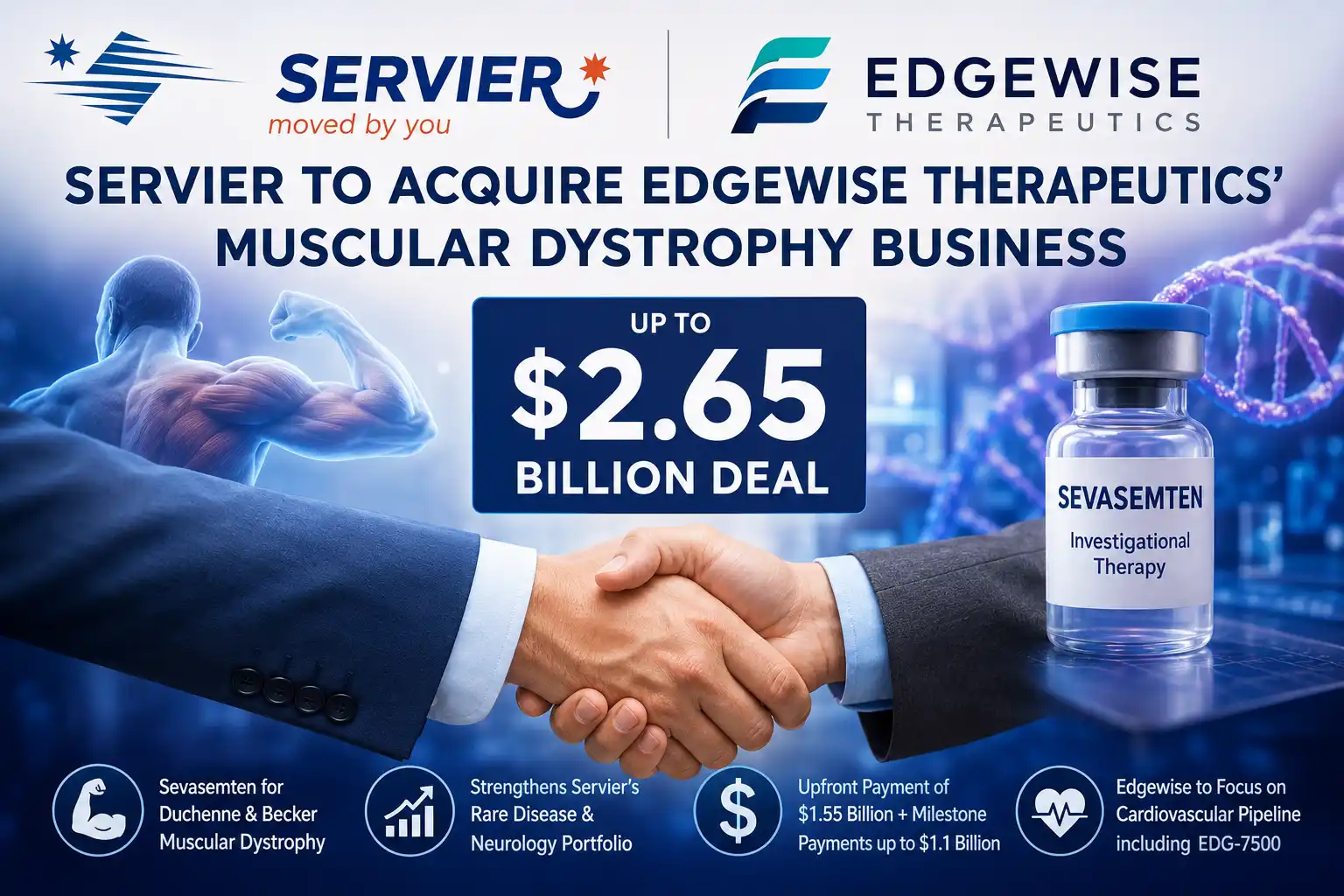
A major strategic transaction has emerged in the global pharmaceutical and biotechnology industry. French pharmaceutical company Servier has announced the acquisition of the Muscular Dystrophy business of U.S.-based biotech firm Edgewise Therapeutics. The deal is valued at up to $2.65 billion, making it one of the most significant biotech transactions of 2026.
Through this acquisition, Servier will gain control of Edgewise’s lead drug candidate, Sevasemten, along with the associated research, development, and commercial rights. The company believes the transaction will strengthen its long-term growth strategy in the Rare Diseases and Neurology segments.
Competition Continues to Grow in the Rare Disease Market
The global rare disease treatment market has expanded rapidly in recent years. Large pharmaceutical companies are increasingly investing in therapies for diseases that currently have limited treatment options.
Muscular Dystrophy is one such serious genetic disorder that progressively weakens muscles over time. Due to the lack of effective treatment options, demand for innovative therapies in this area continues to grow.
Servier’s acquisition is widely seen as a move to capitalize on this growing market opportunity.
Financial Structure of the Deal
Under the terms of the agreement, Servier will make an upfront cash payment of approximately $1.55 billion. In addition, Edgewise could receive up to $1.1 billion in milestone payments tied to regulatory approvals and commercial achievements.
This brings the total potential value of the transaction to as much as $2.65 billion.
The companies expect the deal to close during the third quarter of 2026, subject to customary regulatory approvals and closing conditions.
Why Sevasemten Is the Centerpiece of the Acquisition
The primary asset behind this transaction is Sevasemten, an investigational therapy being developed for Becker Muscular Dystrophy (BMD) and Duchenne Muscular Dystrophy (DMD).
Both Duchenne Muscular Dystrophy and Becker Muscular Dystrophy are rare genetic disorders that lead to progressive muscle weakness and loss of physical function. Patients affected by these diseases often face significant mobility challenges and declining quality of life over time.
Industry experts believe that if Sevasemten continues to demonstrate positive clinical results and secures regulatory approval, it could become an important treatment option in the Muscular Dystrophy market.
A Key Part of Servier’s Growth Strategy
Over the past several years, Servier has been expanding beyond traditional pharmaceutical markets and increasing its focus on high-growth areas such as Oncology and Rare Diseases.
The company has completed several strategic acquisitions and partnerships aimed at strengthening its long-term pipeline and enhancing future revenue opportunities.
By acquiring Edgewise’s Muscular Dystrophy business, Servier is not only adding a promising late-stage asset to its portfolio but also expanding its presence in the global rare disease market.
The company believes its research, development, and commercial capabilities can help accelerate the development and potential worldwide launch of Sevasemten.
What Edgewise Therapeutics Gains from the Transaction
The transaction is equally important for Edgewise Therapeutics.
The company will receive a significant cash infusion, strengthening its balance sheet and reducing future funding requirements.
In addition, Edgewise will be able to focus its resources on its cardiovascular disease programs. In particular, the company plans to accelerate development of EDG-7500, its lead cardiovascular therapy candidate.
EDG-7500 is being developed for Hypertrophic Cardiomyopathy (HCM), a serious heart condition, and is considered one of the company’s most important long-term growth opportunities.
Impact on Employees and Research Programs
According to the companies, many employees currently working on the Muscular Dystrophy program will have the opportunity to continue their work under Servier.
This approach is expected to ensure continuity across ongoing clinical trials and research activities. Servier will also gain access to an experienced scientific and development team that can help advance the program more efficiently.
Investor Response
Market reaction to the announcement has been largely positive. Investors view the transaction as beneficial for both companies.
For Servier, the acquisition represents a potentially high-growth opportunity in the rare disease space. For Edgewise, it provides substantial capital while allowing management to focus on a more streamlined business strategy.
Analysts note that successful rare disease therapies often generate significant commercial value. As a result, if Sevasemten reaches the market successfully, the acquisition could become a major long-term revenue driver for Servier.
Key Factors Investors Will Watch
In the coming months, investors and industry observers are expected to focus on three major developments:
- Clinical trial progress for Sevasemten
- Regulatory approval milestones
- Commercial opportunities within the Muscular Dystrophy market
These factors will ultimately determine the long-term success and value creation potential of the transaction.
Outcome
Servier’s acquisition of Edgewise Therapeutics’ Muscular Dystrophy business is more than just a corporate transaction; it is a strategic move aimed at strengthening the company’s position in the rapidly growing rare disease market. The deal, valued at up to $2.65 billion, provides Servier with a potentially high-value therapy and an expanded development pipeline, while giving Edgewise the financial resources needed to focus on its cardiovascular programs.
If Sevasemten successfully reaches the market and delivers on its clinical promise, this acquisition could become one of the most important and successful rare disease deals in the biotechnology industry.
Source: Servier Newsroom