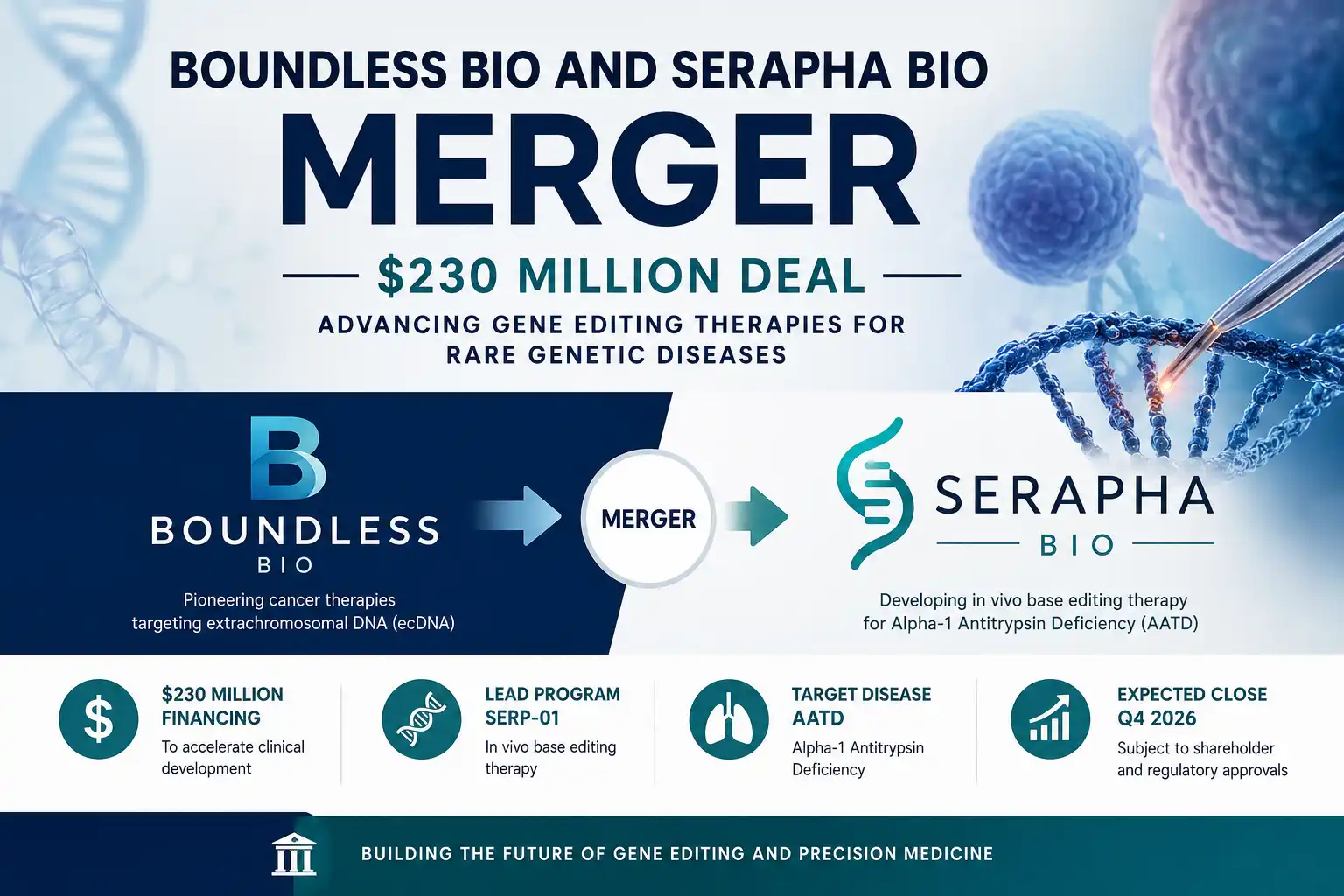
The biotechnology sector witnessed one of its most significant transactions of 2026 when Boundless Bio announced its merger with Serapha Bio. The combined company will operate under the Serapha Bio name and focus on developing advanced in vivo base-editing therapies for rare genetic diseases. Alongside the merger, the company has secured $230 million in private financing, providing strong financial support to accelerate clinical development.
This strategic transaction marks a major shift for Boundless Bio, which was previously focused on cancer therapeutics, toward the rapidly growing field of precision gene editing.
Boundless Bio and Serapha Bio Merger Detail
On June 23, 2026, Boundless Bio and privately held Serapha Bio announced that they had entered into a definitive all-stock merger agreement.
Key Highlights
- The combined company will operate as Serapha Bio.
- A $230 million concurrent private financing has been secured.
- The company will focus on advancing SERP-01, its lead gene-editing therapy.
- The strategic direction will shift from oncology research to rare genetic disease treatments.
- The merger is expected to close during the fourth quarter of 2026, subject to shareholder and regulatory approvals.
Company Introduction: Boundless Bio
Boundless Bio is a U.S.-based biotechnology company that develops innovative therapies for difficult-to-treat cancers.
The company became well known for its research on extrachromosomal DNA (ecDNA)—small circular DNA fragments found outside chromosomes in certain aggressive cancers.
Researchers believe ecDNA enables cancer cells to grow rapidly, develop drug resistance, and evolve more quickly than traditional cancer cells. Boundless Bio has been developing therapies designed to target this unique mechanism.
However, after facing challenges in advancing its oncology pipeline, the company decided to pursue a strategic transformation through its merger with Serapha Bio.
Merger Snapshot
| Item | Details |
| Announcement Date | June 23, 2026 |
| Acquirer Company | Serapha Bio (Combined Company) |
| Target Company | Boundless Bio |
| Deal Type | All-Stock Merger (Reverse Merger) |
| Deal Value | Not Disclosed (Concurrent Financing: $230 Million) |
| Industry | Biotechnology / Gene Editing |
| Acquirer HQ Country | United States |
| Acquirer Exchange | Nasdaq (expected after closing) |
| Ticker | Proposed: AATD |
More Deal : Click here
Company Introduction: Serapha Bio
Serapha Bio is a biotechnology company specializing in gene-editing technologies for inherited genetic disorders.
Its mission is to develop one-time treatments capable of correcting disease-causing genetic mutations directly inside the human body.
The company’s lead development program is:
What Is SERP-01?
SERP-01 is Serapha Bio’s lead therapeutic candidate.
It is designed to correct the SERPINA1 E342K (PiZZ) mutation, the most common genetic cause of Alpha-1 Antitrypsin Deficiency.
According to the company, preclinical studies have demonstrated encouraging proof-of-concept results, showing the potential to restore healthy Alpha-1 Antitrypsin protein production.
The therapy is expected to move forward through clinical development over the coming years.
SERP-01
SERP-01 is an in vivo base-editing therapy, meaning the genetic mutation is corrected inside the patient’s body without making a full double-strand break in DNA.
Compared with traditional CRISPR-based approaches, base editing is generally considered more precise because it changes a single DNA letter while minimizing unwanted genetic alterations.
The therapy is initially being developed for Alpha-1 Antitrypsin Deficiency (AATD).
What Is Alpha-1 Antitrypsin Deficiency (AATD)?
Alpha-1 Antitrypsin Deficiency is a rare inherited genetic disorder caused by mutations in the SERPINA1 gene.
Patients produce insufficient or defective Alpha-1 Antitrypsin protein, which normally protects the lungs from damage.
As a result, individuals with AATD may develop:
- Chronic lung disease
- Liver damage
- Liver cirrhosis
- Breathing difficulties
- In severe cases, the need for a liver transplant
Currently, there is no permanent cure, making gene-editing therapies a promising long-term treatment option.
Why Did the Merger Happen?
1. Boundless Bio Needed a New Strategic Direction
Boundless Bio’s oncology programs faced significant clinical and financial challenges.
Drug development in biotechnology requires substantial investment, and the company needed a new strategy to maximize shareholder value.
By merging with Serapha Bio, Boundless Bio gains access to a promising gene-editing pipeline with long-term growth potential.
2. Serapha Bio Gains Faster Access to Public Markets
As a private biotechnology company, Serapha Bio would have needed considerable time and capital to complete a traditional Initial Public Offering (IPO).
Through this reverse merger structure, Serapha Bio can become a publicly traded company more efficiently while immediately accessing additional funding.
Reverse mergers have become increasingly common among biotechnology companies seeking faster public market access.
The $230 Million Financing
Along with the merger announcement, the combined company secured approximately $230 million in private financing.
The capital will primarily be used for:
- Clinical trials
- Research and development
- Manufacturing expansion
- Regulatory submissions
- Commercial preparation
Large-scale biotechnology clinical trials require significant funding, making this financing a crucial component of the overall transaction.
SERP-01 is Serapha Bio’s lead therapeutic candidate.
It is designed to correct the SERPINA1 E342K (PiZZ) mutation, the most common genetic cause of Alpha-1 Antitrypsin Deficiency.
According to the company, preclinical studies have demonstrated encouraging proof-of-concept results, showing the potential to restore healthy Alpha-1 Antitrypsin protein production.
The therapy is expected to move forward through clinical development over the coming years.
Impact on Shareholders
Following the completion of the merger:
- The combined business will operate under the Serapha Bio name.
- Existing Boundless Bio shareholders will own a smaller percentage of the combined company due to the merger structure.
- Eligible shareholders are also expected to receive a cash dividend before the transaction closes.
- The combined company intends to trade on Nasdaq under the proposed ticker symbol AATD.
What This Means for the Biotechnology Industry
This merger reflects a broader trend within the biotechnology industry.
Over the past several years, many oncology-focused biotech companies have shifted toward emerging areas such as:
- Gene editing
- Base editing
- Rare disease therapeutics
- Precision medicine
Investor interest has increasingly focused on technologies capable of providing long-term or potentially curative treatments for genetic disorders.
The Boundless Bio–Serapha Bio merger demonstrates how companies are restructuring to align with these high-growth areas.
Risks Investors Should Consider
Although the merger provides strong financial backing and a clear strategic direction, biotechnology remains a high-risk investment sector.
Investors should closely monitor:
- Clinical trial progress
- Safety and efficacy data
- Regulatory approvals
- Future financing requirements
- Cash burn rate
- Commercial launch timelines
The long-term success of the company will largely depend on the performance of SERP-01 during clinical development.
Outcome
The merger between Boundless Bio and Serapha Bio represents a significant strategic transformation in the biotechnology industry. By combining Boundless Bio’s public company platform with Serapha Bio’s innovative gene-editing technology, the new organization is positioned to accelerate the development of potentially life-changing treatments for rare genetic diseases.
Backed by $230 million in fresh financing, the combined company has the resources to advance its lead candidate, SERP-01, through clinical development. If future clinical trials and regulatory approvals are successful, this merger could become an important milestone in the evolution of gene-editing therapies and precision medicine.