The role of LNG (Liquefied Natural Gas) in the world’s energy economy has been increasing rapidly. Many sectors such as power generation, industry, fertilizer, petrochemicals, and city gas distribution now depend heavily on LNG.
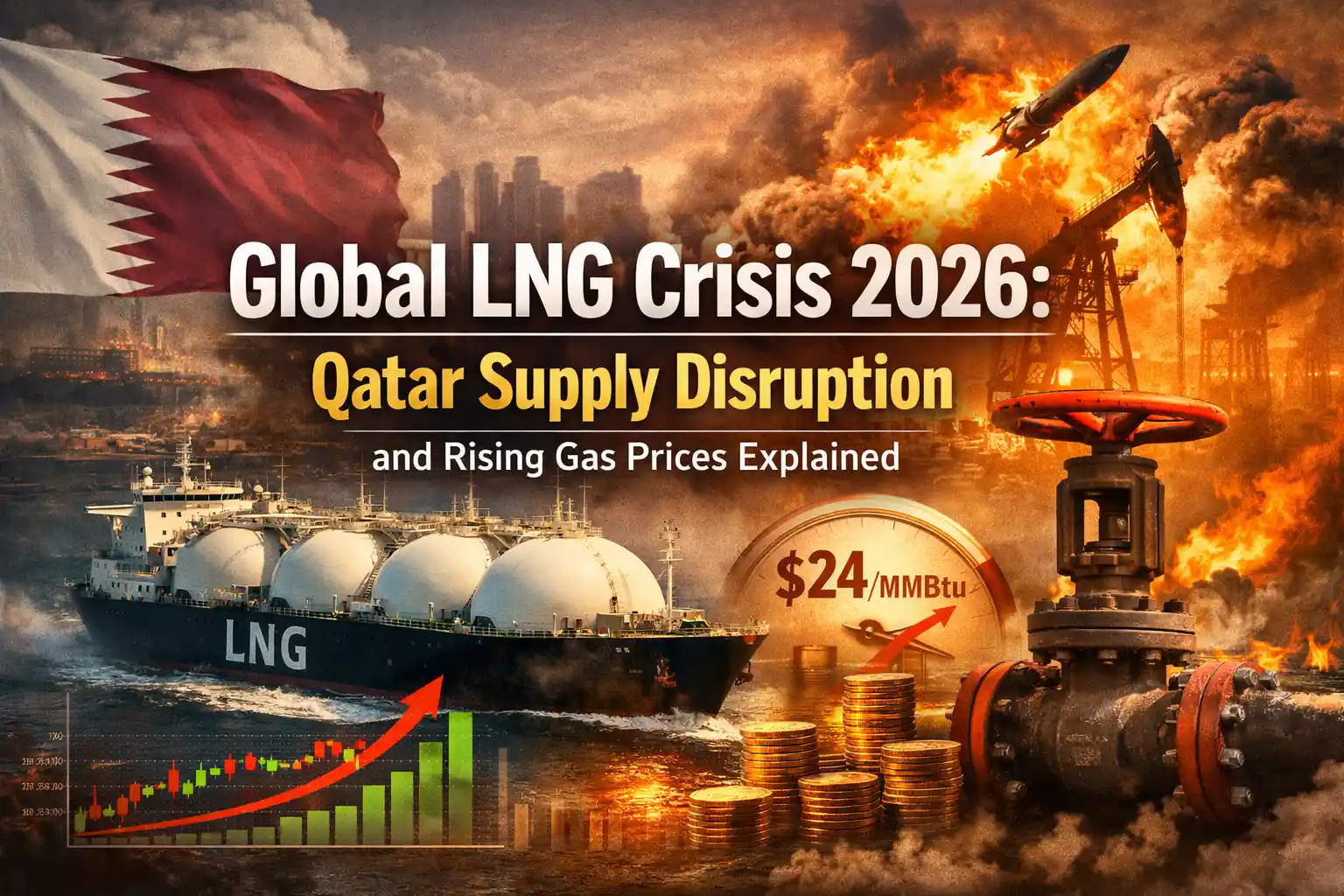
However, in March 2026, the global LNG market witnessed a sudden crisis. Rising geopolitical tensions in the Middle East, threats to key shipping routes, and the halt of LNG production in Qatar disrupted global gas supply. As a result, LNG prices in Asia and Europe surged sharply, and several countries had to purchase emergency cargo shipments.
Energy experts believe that if these disruptions continue for a longer period, the crisis could become even bigger than the 2022 Russia-Europe gas crisis.
In this article, we will understand in detail:
- What LNG is and its role in the global energy system
- Why a sudden crisis emerged in the LNG market in 2026
- Latest price data and global supply-demand trends
- The impact on countries around the world including India
- The future outlook of the LNG market
What is LNG and Why It Is So Important in Global Energy Trade
LNG stands for Liquefied Natural Gas. In this process, natural gas is cooled to about -162°C so that it turns into a liquid form. This makes it easier to transport gas across long distances through specialized ships.
Key advantages include:
- Gas can be exported without pipelines
- It produces less pollution compared to coal and oil
- It is an efficient fuel for power generation
- It makes global energy trade more flexible
Because of these advantages, LNG has become one of the fastest-growing segments in the global energy market, with demand rising across Asia, Europe, and the Middle East.
Global LNG Market Size and Latest Data (2026)
The LNG industry has grown significantly in recent years.
Key figures:
- Global LNG trade is around 400–420 million tonnes per year.
- Qatar accounts for nearly 20% of global LNG exports.
- Asia represents the largest share of global LNG demand.
- China, Japan, South Korea, and India are among the biggest importers.
Price data:
- At the beginning of 2026, the Asian LNG benchmark (JKM) was around $10–11 per MMBtu.
- After the recent crisis, reports indicated that spot prices surged to about $24 per MMBtu.
This represents almost a doubling of prices, creating a major shock for global energy markets.
Global Market Disruption Due to Qatar LNG Production Halt
One of the biggest events in March 2026 was the halt of LNG production in Qatar.
According to reports:
- QatarEnergy declared force majeure on LNG exports.
- Operations at the Ras Laffan LNG facility were halted.
- Restarting production could take several weeks.
This is a major issue because:
- Qatar is one of the world’s largest LNG exporters
- It supplies about 20% of the global LNG market
As a result, the halt in production immediately created concerns about shortages in the global gas market.
Strait of Hormuz: The Biggest Chokepoint for Energy Supply
Another major impact of the Middle East conflict has been on global shipping routes.
The Strait of Hormuz is one of the most important energy corridors in the world.
- A significant portion of global oil and LNG trade passes through this route.
- Due to the conflict, tanker traffic dropped sharply.
- Some reports suggest the number of vessels fell dramatically, disrupting energy shipments.
This situation caused delays in LNG deliveries and increased shipping risks.
Sharp Increase in LNG Prices
Following the supply disruptions, global LNG prices increased rapidly.
Key reasons include:
- Supply disruption from Qatar
- Shortage of available LNG tankers
- Strong competition for cargo between Asia and Europe
According to reports:
- LNG prices in Asia and Europe rose by around 50%.
- Spot LNG cargo prices reached around $24 per MMBtu.
This forced several countries to buy emergency LNG shipments at higher prices.
Competition for LNG Between Europe and Asia
After the 2022 Ukraine crisis, Europe significantly reduced its dependence on Russian pipeline gas.
As a result, Europe started importing large volumes of LNG.
This increased competition in the global LNG market:
- Europe is purchasing LNG to fill its storage facilities
- Asian buyers are also securing cargo to meet seasonal demand
When supply is limited and demand is high, prices tend to rise quickly.
Impact of the LNG Crisis on India
India is a major LNG importer, and several sectors depend on LNG.
Key sectors include:
- Power generation
- Fertilizer plants
- City gas distribution
- Petrochemical industry
Due to the recent disruptions:
- GAIL and Petronet LNG faced supply disruptions
- Some LNG cargo shipments were delayed
- Industries may need to purchase LNG at higher prices
However, India has diversified its energy imports, which could help reduce the overall impact of the crisis.
Global LNG Supply and Future Projects
Although the market is facing a short-term crisis, LNG supply is expected to increase significantly in the long term.
Several new LNG projects are under development in:
- The United States
- Qatar expansion projects
- Canada LNG terminals
- Australia LNG facilities
Experts believe that between 2026 and 2030, global LNG supply will grow significantly, which could gradually stabilize the market.
Future of the LNG Market
Energy experts expect three major trends in the LNG market in the coming years:
1. Rapid Growth in LNG Demand
Electricity demand in Asian economies is increasing rapidly.
2. Energy Security Will Become a Major Priority
Countries are increasingly diversifying their energy supply sources.
3. Investment in LNG Infrastructure Will Increase
More LNG terminals, storage facilities, and shipping capacity will be developed.
Outcome
The LNG crisis of 2026 highlights how vulnerable the global energy system remains to geopolitical risks.
The halt in Qatar’s LNG production, rising tensions in the Middle East, and disruptions in shipping routes have shaken the global gas market. As a result, LNG prices surged and many countries were forced to reconsider their energy security strategies.
Although LNG supply is expected to expand in the long term, short-term volatility in the energy market may continue.
Therefore, LNG is expected to play a crucial role in both global energy transition and energy security in the coming decades.
(This analysis is based on available market data and current global energy market developments.)