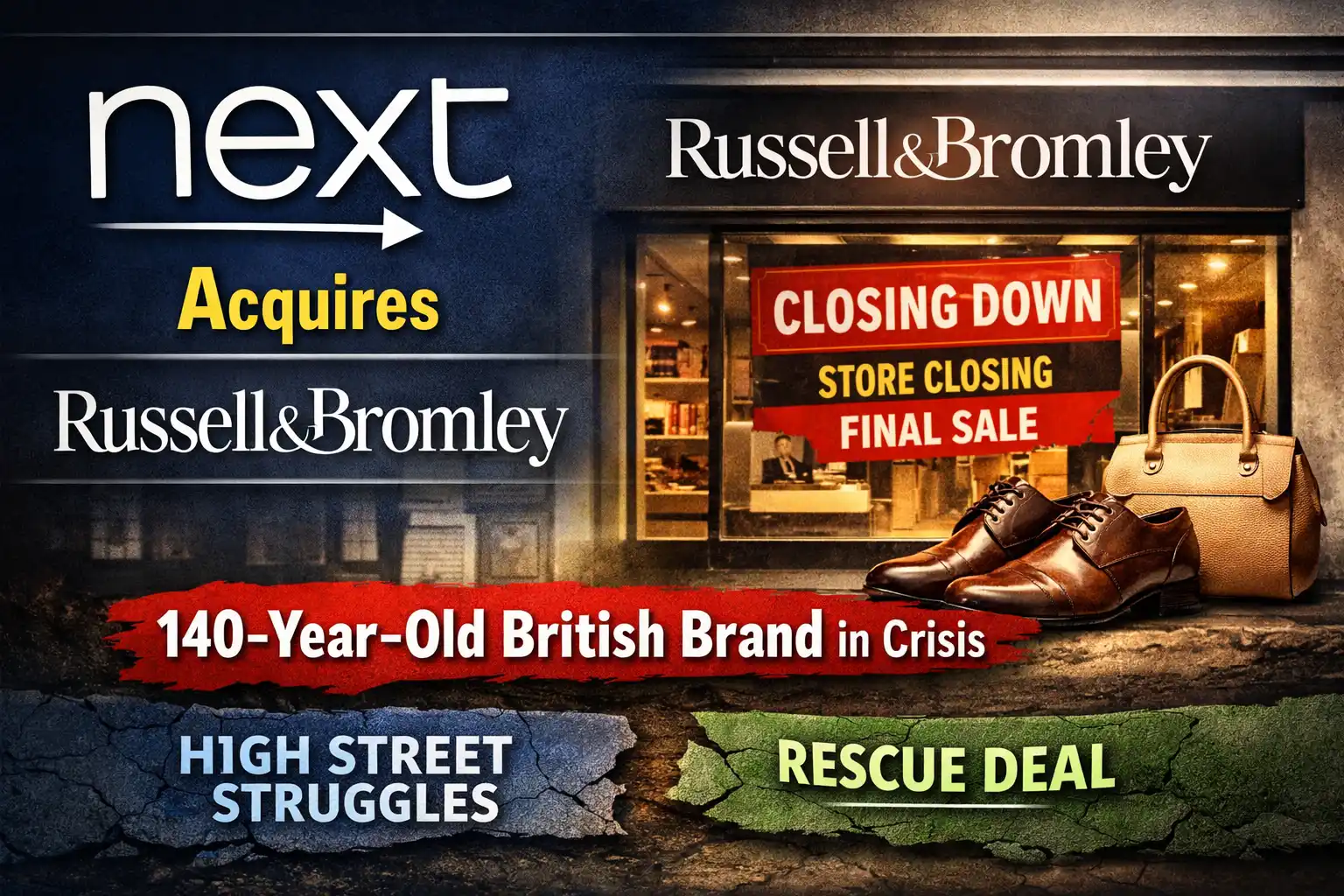
British fashion retailer Next plc has acquired the iconic footwear brand Russell & Bromley in a rescue deal after the company fell into administration. Under the agreement, Next has purchased the brand name, intellectual property (IP), selected inventory, and only three flagship stores of Russell & Bromley.
However, the deal does not include 33 other stores and most of the company’s workforce, putting around 440 jobs at risk. This acquisition highlights the continued struggle of traditional high-street retailers in the UK amid changing consumer behavior.
Who Is Russell & Bromley?
Russell & Bromley is one of Britain’s oldest and most respected footwear brands.
- Founded: 1879, Eastbourne, UK
- Products: Premium footwear, handbags, and accessories
- Brand Image: Classic design and craftsmanship
- Retail Presence: 36 stores and 9 concessions across the UK and Ireland
- Employees: Around 440
For decades, the brand symbolized British high-street luxury. But the same legacy later became a challenge in a fast-changing retail environment.
Deal Details: What Did Next Buy — and What Didn’t It Buy?
Key Highlights of the Deal
- Next acquired Russell & Bromley’s brand and intellectual property
- Estimated deal value: £3.8 million
- Only 3 premium stores were included
- 33 stores and 9 concessions excluded
- Most employees were linked to excluded stores, increasing job uncertainty
👉 This clearly shows that Next bought the brand value, not the loss-making physical retail network.
❓ Why Was Russell & Bromley Forced Into This Situation — and What Did It Fail to Do?
This is the most important part of the story.
1. Over-Dependence on High-Street Stores
Russell & Bromley’s business model relied heavily on:
- Physical retail stores
- Prime high-street locations
As UK footfall declined and shopping moved online, the company struggled to adapt quickly enough.
2. Delayed Shift to Online Retail
Although the company explored digital options, it hesitated due to:
- Fear of brand dilution
- High return rates in footwear
- Concerns about discount-driven online competition
As a result, online sales never became a strong growth engine, while competitors surged ahead.
3. Customer Preferences Changed — Product Strategy Didn’t
Customers increasingly demanded:
- Trend-focused designs
- Competitive pricing
- Faster delivery
Russell & Bromley stayed focused on:
- Classic, slow-evolving designs
- A traditional premium customer base
It failed to create a separate product line for younger, value-conscious consumers.
4. High Fixed Costs Crushed Profitability
Prime-location stores came with:
- Expensive rents
- High staffing costs
Even as sales declined, these fixed costs remained, steadily weakening the company’s finances.
5. Strategic Change Came Too Late
By the time management fully recognized:
- Declining cash flows
- An unsustainable business model
Losses had already mounted, and investor confidence had faded. Administration became unavoidable.
What Did Next Do Differently?
Next avoided repeating these mistakes:
- It did not acquire loss-making stores
- It will leverage its strong online platform and logistics
- The brand will be run on a digital-first, asset-light model
For Next, this acquisition is a low-risk, long-term brand opportunity.
Key Lessons for Businesses and Entrepreneurs
Major Takeaways
- Brand legacy alone cannot sustain a business
- Adapting to customer behavior is essential
- Treating digital transformation as optional is risky
- High fixed costs can destroy even strong brands
“If a business doesn’t change with time, the market forces it to change.”
Outcome
Russell & Bromley’s decline was not sudden. It was the result of:
- Slow strategic adaptation
- Delayed digital transformation
- Failure to align with evolving customer expectations
Under Next’s ownership, the brand now has a chance for revival — but with a leaner physical presence and a strong digital focus.
Source: Official statements from Next plc and Russell & Bromley websites, supported by media reports from Reuters, The Guardian, Yahoo Finance, and The Times.