Imagine standing beside a busy highway. Cars are honking, engines are running, and traffic is creating continuous noise. Normally, we consider this sound pollution and try to reduce it.
But what if some of that noise could be converted into electricity?
It may sound unusual, but scientists are exploring technologies that can convert sound waves into electrical energy. This emerging field is known as Sound Energy Harvesting or Acoustic Energy Harvesting.
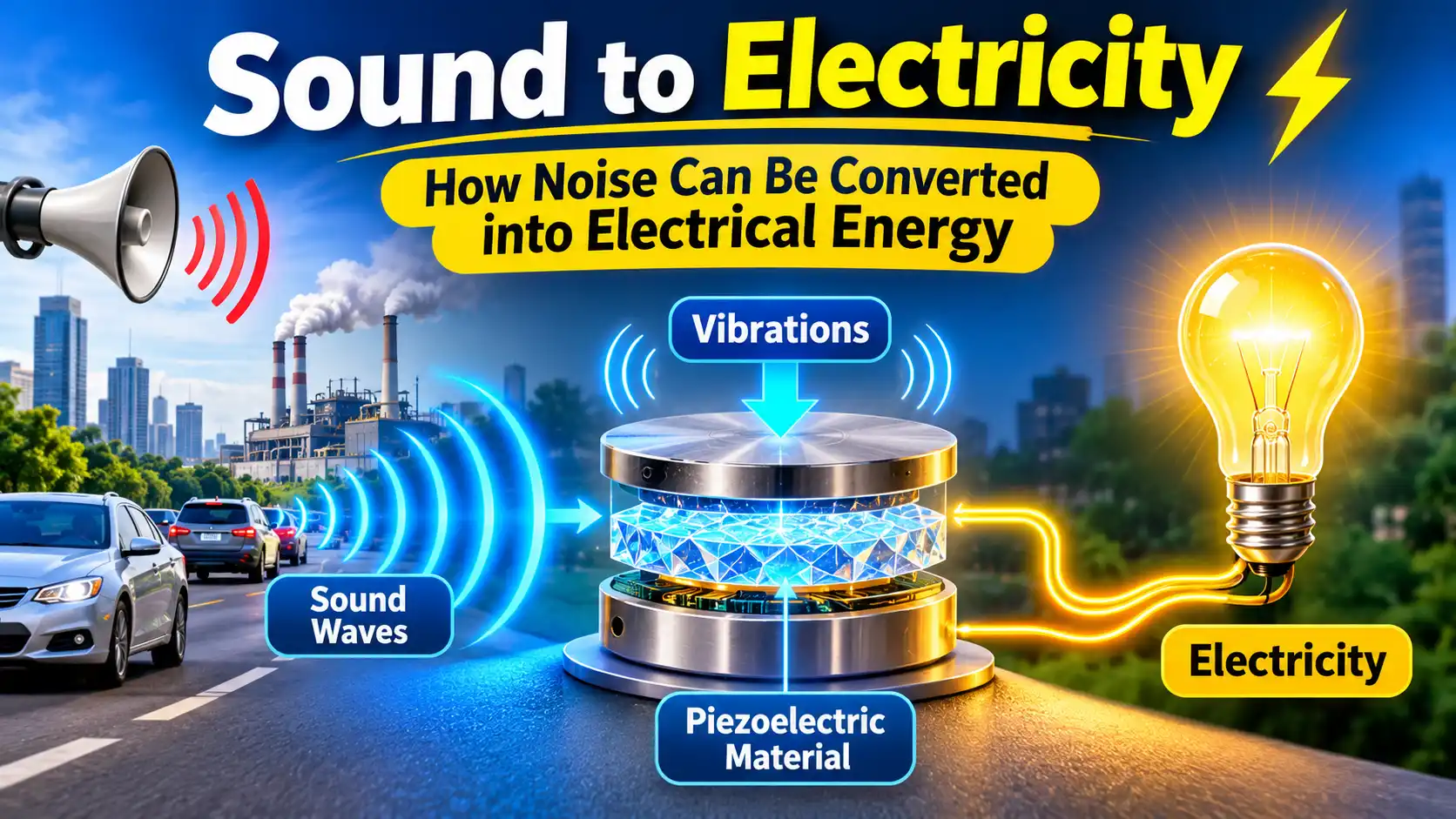
The basic idea is simple: when someone speaks, a vehicle passes, or an industrial machine operates, it creates sound waves. These waves can produce tiny vibrations in nearby materials. Special devices can capture these vibrations and convert a portion of their energy into electricity.
For example, imagine a factory where large machines operate throughout the day. A specially designed energy-harvesting device installed near one of these machines could potentially capture some of the energy from its noise and use it to support small sensors or monitoring equipment.
However, there is an important limitation. Ordinary environmental noise contains very little usable energy. Therefore, this technology is not currently practical for powering homes, electric vehicles, or other high-power equipment.
Its real potential may lie in small electronic devices that require very little electricity.
Let’s explore how sound can generate electricity, the science behind this technology, the research being conducted, and where it could be useful in the future.
What Is Sound Energy Harvesting?
Sound Energy Harvesting is a process in which energy from sound waves is converted into electrical energy.
Whenever someone speaks, a car horn sounds, or a machine operates, it creates small changes in air pressure. These pressure variations travel through the air in the form of sound waves.
When sound waves reach a surface, they can cause it to vibrate slightly.
Scientists are exploring ways to capture these vibrations and convert them into electricity.
Let’s understand this with a simple example.
Imagine a large machine operating continuously inside a factory. A thin piezoelectric sheet is installed near the machine. Sound waves create vibrations in the sheet, and these vibrations can generate an electrical charge inside the material.
In this way, a small portion of the energy associated with sound can be converted into electricity.
The main purpose of this technology is not to operate large power stations. Instead, it aims to recover small amounts of energy that would otherwise remain unused.
How Is Sound Converted into Electricity?
The process generally involves three main stages.
Stage 1: Capturing Sound Waves
First, a specially designed device or acoustic structure captures sound waves from the surrounding environment.
Stage 2: Producing Mechanical Vibrations
Sound waves create pressure variations that cause a thin plate, membrane, or another structure inside the device to vibrate.
In some designs, acoustic resonators are used to improve the response to particular sound frequencies.
Stage 3: Converting Vibrations into Electricity
The mechanical vibrations are converted into electrical energy using materials such as piezoelectric materials or other energy-conversion mechanisms.
An electronic circuit can then process the electricity. Depending on the design, it may be rectified, regulated, and stored in a capacitor or small battery.
A simple example: Just as wind rotates the blades of a wind turbine to generate electricity, sound waves can make a specially designed structure vibrate. Those vibrations can then be converted into electrical energy.
The two technologies work differently, but both capture energy from their surroundings.
Piezoelectric Technology: An Important Way to Generate Electricity from Sound
One of the most widely studied methods of Sound Energy Harvesting uses something called the Piezoelectric Effect.
Certain materials have a special property: when they are pressed, bent, or subjected to mechanical vibrations, they generate an electrical charge.
This phenomenon is known as the Piezoelectric Effect.
You may already have encountered this technology in everyday life.
Some gas lighters use a piezoelectric mechanism. When you press the button, a special crystal inside the lighter experiences mechanical pressure and produces a high voltage, creating a spark.
Sound Energy Harvesting uses a similar principle, but instead of pressure from a button, the mechanical vibrations are produced by sound waves.
Researchers are studying several materials for this purpose:
- PVDF (Polyvinylidene Fluoride): A flexible piezoelectric polymer that can be manufactured as a thin film.
- PZT (Lead Zirconate Titanate): An effective piezoelectric ceramic used in various sensors and energy-harvesting devices.
- ZnO (Zinc Oxide): Its nanowire structures are also being investigated for piezoelectric energy harvesting.
A review published in Microsystems & Nanoengineering in 2024 examined piezoelectric nanogenerators and their potential for harvesting acoustic energy. It discussed different materials, structures, and methods for improving energy conversion.
Acoustic Resonators: Capturing More Energy from Sound
One of the biggest challenges in Sound Energy Harvesting is that ordinary environmental noise contains very little energy.
To address this problem, scientists are developing structures that can capture or concentrate sound energy more effectively at particular frequencies.
These structures are known as Acoustic Resonators.
A familiar example is a Helmholtz Resonator.
Have you ever blown air across the opening of an empty bottle and heard a particular sound? This happens because the air inside the bottle vibrates at a specific frequency.
A Helmholtz Resonator works on a similar principle. It is designed to respond strongly to a selected range of sound frequencies.
When combined with piezoelectric materials, these structures can help produce stronger vibrations at the targeted frequencies, potentially improving electricity generation.
However, they do not capture every type of sound equally well. Their performance depends on the frequency for which the device is designed.
Research published in 2024 has discussed Helmholtz Resonators, quarter-wavelength tubes, and cantilever beams as important structures for improving acoustic energy harvesting.
Can Traffic Noise and Vehicle Horns Generate Electricity?
Yes. Researchers are investigating ways to harvest energy from highway and railway noise.
Imagine a special noise barrier installed beside a busy highway. The normal purpose of this barrier is to reduce the amount of traffic noise reaching nearby residential areas.
Now imagine integrating piezoelectric devices and acoustic resonators into that barrier.
The system could potentially capture some of the sound energy and convert it into electricity.
A similar idea could be explored near railway tracks.
When a train passes, it produces considerable noise and mechanical vibrations. Specially designed devices could potentially harvest some of this energy.
A research study published in the Ain Shams Engineering Journal in 2024 investigated an array of piezoelectric cantilever plates for harvesting environmental noise from highways and railways.
The study examined sound vibrations below 200 Hz and sound pressure levels of 85 dB and 100 dB.
This shows that scientists are not simply discussing the idea of generating electricity from traffic noise. They are also testing specific engineering designs.
However, the amount of electricity generated and the cost of installing such systems remain important considerations.
Research on Generating Electricity from Factory Noise
Factories contain large machines, compressors, chillers, industrial motors, and other equipment that can produce continuous noise.
Because this noise may remain present for long periods, industrial environments could provide useful locations for testing Sound Energy Harvesting devices.
A study published in Sustainable Energy Research in 2025 examined the possibility of converting industrial noise into electrical energy at a district cooling plant.
The researchers recorded sound levels of approximately 91–96 dB from a chiller and tested an acoustic energy harvester based on LDT1-028K PT piezoelectric film.
The study reported an output of approximately 0.0258 volts.
This result is interesting, but it is important to understand what the measurement means.
Voltage alone does not tell us how much useful electricity a device can produce. To evaluate its practical performance, researchers also need to measure current, electrical power, and the amount of energy generated over time.
The study demonstrates that industrial noise can be investigated as a potential energy source, but it does not prove that the technology is ready for large-scale electricity production.
Who Is Researching Sound Energy Harvesting?
Sound Energy Harvesting is still an emerging research field. Universities and research groups are investigating different materials, device designs, and methods of converting sound into electricity.
Some important research examples include:
| Research / Publication | Research Focus |
| Microsystems & Nanoengineering (2024) | Piezoelectric nanogenerators and acoustic energy harvesting |
| Ain Shams Engineering Journal (2024) | Piezoelectric plates for harvesting highway and railway noise |
| Sustainable Energy Research (2025) | Converting industrial noise into electrical energy |
| Sensors and Actuators A: Physical (2025) | Acoustic energy harvesters, efficiency improvements, and future applications |
These studies show that research is not limited to a single type of device. Scientists are experimenting with different materials, resonators, and energy-conversion techniques.
However, these are research publications and experimental studies, not proof that all the technologies are commercially available.
It would be premature to describe any one company as an established market leader in large-scale Sound-to-Electricity technology.
Can Sound Generate Enough Electricity to Power a Smartphone or Home?
This is probably the most important question.
When we hear extremely loud traffic or industrial noise, it may seem as though a large amount of energy is present. But loudness and usable energy are not the same thing.
Sound waves carry energy, but ordinary environmental noise has a very low energy density.
Even very loud sound generally provides limited energy compared with the requirements of modern electrical equipment.
Consider the difference:
- Smartphone: Requires sufficient power to operate its display, processor, camera, wireless connections, and other components.
- Sound Energy Harvester: May capture only a very small amount of energy from ordinary environmental noise.
- Small Sensor: May need so little electricity that harvested energy could potentially support its operation.
For this reason, the technology is currently more promising for low-power electronic devices than for smartphones, homes, or electric vehicles.
The goal is not necessarily to replace conventional batteries. It is to reduce battery dependence in devices that consume very little electricity.
Where Could Sound Energy Harvesting Be Used?
Although this technology cannot currently replace conventional electricity generation, it could become useful in specific applications.
A. Smart Cities and Traffic Monitoring
Modern cities use sensors to monitor traffic conditions, air quality, and noise levels.
If some of these sensors could harvest a small amount of energy from nearby traffic noise, their dependence on replaceable batteries could potentially be reduced.
B. Railway and Metro Stations
Trains and metro systems generate continuous noise and vibrations.
Special energy-harvesting devices could potentially convert some of this energy into electricity for low-power monitoring sensors.
C. Industrial Monitoring
Factories use sensors to monitor machine temperature, vibration, and operating conditions.
If a machine produces continuous noise and vibrations, an energy harvester installed nearby could potentially support some of the sensor’s electrical requirements.
D. Aircraft and Airports
Airports and aircraft-related environments can contain high levels of noise.
Specially designed energy harvesters could be investigated for low-power applications. However, aircraft use would require additional consideration of weight, safety, and reliability.
E. Wearable and Medical Devices
Future devices may be able to harvest energy from body movements, vibrations, or sound.
Such systems could potentially support certain low-power wearable sensors. However, medical implants and healthcare equipment require strict safety and performance testing before any real-world use.
Research reviews have identified environmental monitoring, wearable electronics, and medical devices as potential application areas for energy-harvesting technologies.
Could a Noise Barrier Both Reduce Noise and Generate Electricity?
This is one of the most interesting potential applications of the technology.
Highways and industrial areas often use noise barriers to reduce the sound reaching nearby homes and buildings.
Now imagine adding acoustic resonators and piezoelectric materials to these barriers.
Such a system could potentially perform two functions:
- Help control or reduce certain sound frequencies, limiting noise pollution.
- Convert a portion of the captured sound energy into electricity.
This concept can be described as an Energy-Harvesting Noise Barrier.
Research into industrial noise harvesting has also discussed noise barriers and special acoustic structures as possible ways to combine noise reduction with energy recovery.
However, not every noise barrier will generate useful electricity. The result depends on sound frequency, material properties, device design, and the amount of sound energy available.
What Are the Biggest Challenges?
The concept is exciting, but several scientific and practical challenges must be addressed before it can become widely useful.
Challenge 1: Very Low Energy in Sound
Ordinary environmental sound contains relatively little energy. This makes large-scale electricity generation difficult.
Challenge 2: Different Sound Frequencies
Many resonators are designed for particular frequency ranges. However, traffic and industrial noise usually contain several different frequencies.
A device designed for one frequency may not work equally well with all surrounding sounds.
Challenge 3: Energy Conversion Efficiency
Not all the mechanical energy produced by sound vibrations becomes electricity. Some energy is lost as heat or through other mechanisms.
Improving conversion efficiency is therefore important.
Challenge 4: Continuous Energy Availability
If the surrounding noise disappears or a machine stops operating, the energy generated by the harvester may also decrease.
Challenge 5: Manufacturing Costs
Piezoelectric materials, resonators, electronic circuits, and energy-storage systems must work together in a reliable and affordable device.
Challenge 6: Commercial-Scale Applications
Generating electricity in a laboratory is different from installing thousands of devices along highways or inside factories.
The technology must prove that it can operate reliably, produce enough useful energy, and justify its installation and maintenance costs.
What Is the Future of Sound-to-Electricity Technology?
The future of this technology will depend on whether scientists can generate more electricity from smaller amounts of sound energy.
Some important research directions include:
Advanced Piezoelectric Materials: Developing materials that can generate more electrical charge from small mechanical vibrations.
Acoustic Metamaterials: Designing special structures that can control, guide, or concentrate sound waves.
Better Resonator Designs: Developing devices that can capture a wider range of sound frequencies more effectively.
Smart Noise Barriers: Combining noise reduction systems with energy-harvesting technology near highways and industrial areas.
Self-Powered Sensors: Developing sensors that can operate with less dependence on replaceable batteries.
Research into piezoelectric nanogenerators and acoustic energy harvesting continues to explore improvements in materials, device structures, and conversion efficiency.
If these improvements become practical, Sound Energy Harvesting could become an additional energy source for certain low-power electronic devices.
Conclusion: Noise Could Become a Small Source of Electricity
Sound-to-Electricity technology is an interesting example of how scientists are trying to make use of energy that normally goes unnoticed.
Today, traffic, industrial machines, and railway noise are mainly considered sources of noise pollution. But in the future, some of the energy carried by these sound waves could potentially be converted into electricity.
The most promising opportunities appear to be in small sensors, industrial monitoring systems, and smart infrastructure.
However, the technology still has limited power-generation capabilities. It would be unrealistic to expect it to power homes, smartphones, or electric cars.
If researchers can develop better piezoelectric materials, acoustic resonators, and more efficient energy-conversion systems, some sensors installed near busy roads or industrial machines may eventually be able to generate a portion of their own electricity from surrounding noise.
In other words, noise may never become a major source of electricity, but in the future, even a small part of it could become useful energy.