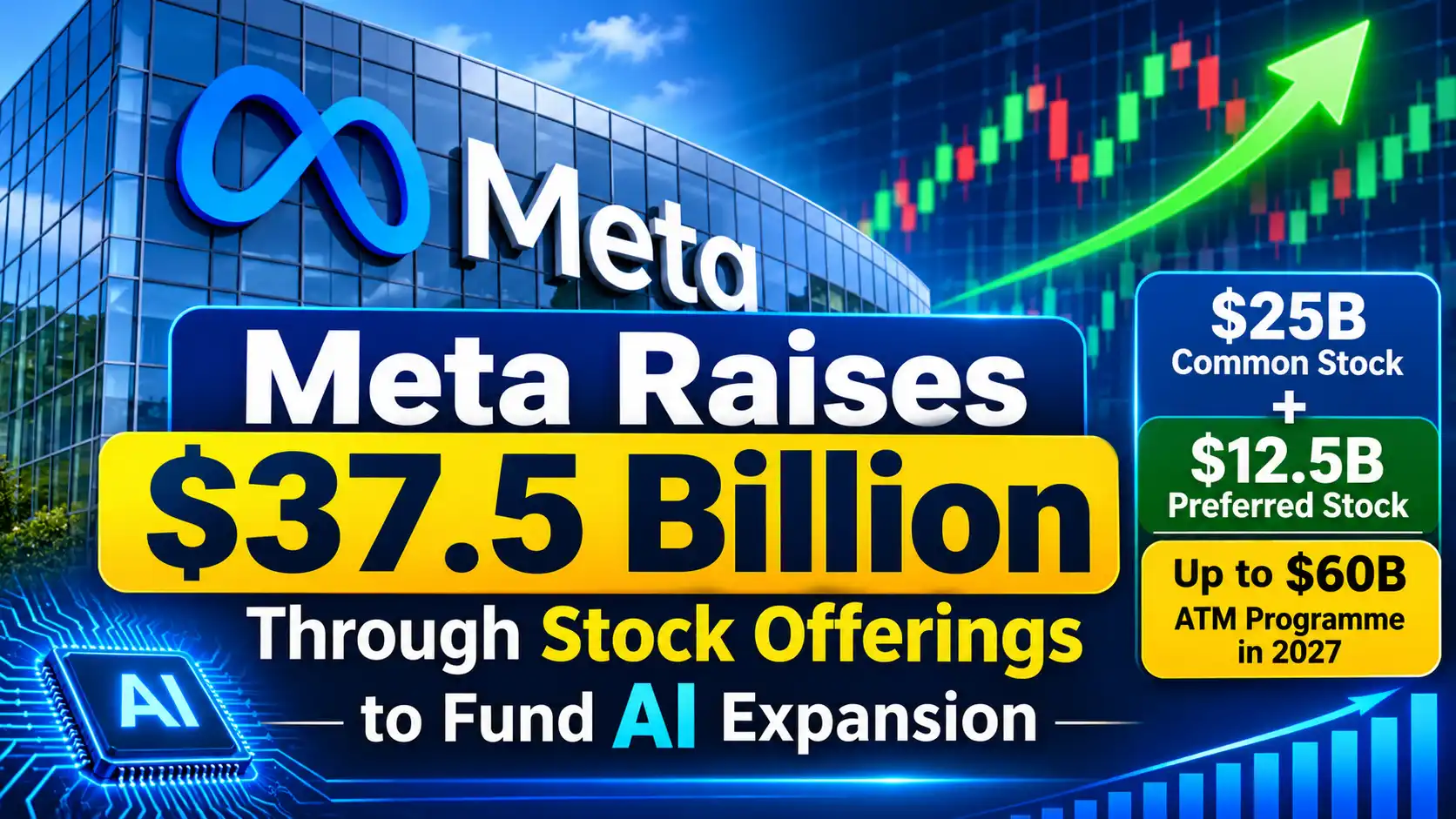
Meta Platforms, Inc., the parent company of Facebook, Instagram and WhatsApp, has announced a major fundraising initiative of approximately $37.5 billion through two separate public stock offerings. The announcement was initially made on October 26, 2026, with the final offering terms announced on October 27, 2026.
The fundraising includes a $25 billion Class A Common Stock offering and a $12.5 billion Mandatory Convertible Preferred Stock offering. Meta also plans to establish a separate $60 billion At-The-Market (ATM) stock offering programme in 2027.
The primary objective behind this capital-raising strategy is to support Meta’s growing investments in Artificial Intelligence (AI), data centres, computing infrastructure and its long-term vision of developing Personal Superintelligence.
This development highlights how major technology companies are raising substantial capital to compete in the rapidly expanding global AI industry.
Key highlights Snapshot
| Particulars | Details |
| Company | Meta Platforms, Inc. |
| Country | United States |
| Stock Exchange | Nasdaq |
| Stock Ticker | META |
| Initial Announcement | October 26, 2026 |
| Final Pricing Announcement | October 27, 2026 |
| Total Public Offerings | Approximately $37.5 Billion |
| Common Stock Offering | $25 Billion |
| Convertible Preferred Stock | $12.5 Billion |
| Additional Planned ATM Programme | Up to $60 Billion |
| Main Purpose | AI and Data Centre Investments |
| Lead Bookrunning Managers | Morgan Stanley and Goldman Sachs |
Company Introduction: What Does Meta Platforms Do?
Meta Platforms, Inc. is an American technology company headquartered in Menlo Park, California. It operates some of the world’s most widely used digital platforms, including Facebook, Instagram, WhatsApp and Messenger.
The company generates most of its revenue through digital advertising. Businesses use Meta’s platforms to reach customers through targeted advertisements.
However, Meta is increasingly expanding beyond its traditional social media business.
The company is investing in several emerging technologies, including:
- Artificial Intelligence and Generative AI.
- Large Language Models (LLMs).
- AI-powered digital assistants.
- Virtual and Augmented Reality.
- Smart Glasses and Wearable Technology.
- Advanced Data Centres and Computing Infrastructure.
Meta is also developing its AI ecosystem through its Llama family of AI models and Meta AI services.
These investments require significant computing resources, advanced semiconductor chips and large-scale data centre infrastructure.
As a result, the company is raising additional capital to support its long-term technology strategy.
Why Is Meta Raising Approximately $37.5 Billion?
Meta is increasing its investment in Artificial Intelligence because it wants to strengthen its position in the global AI market.
Developing advanced AI systems requires substantial financial resources. Companies must invest in specialised processors, servers, networking equipment, electricity, cooling systems and data centres.
Meta’s fundraising strategy is designed to support several important areas.
AI Data Centres
Meta is expanding its data centre infrastructure to handle the enormous computing requirements of advanced AI models. These facilities provide the computing power needed to train and operate AI systems.
Advanced AI Chips
The company needs high-performance processors, including GPUs and specialised AI accelerators, to train and run its AI models efficiently.
AI Model Development
Meta continues to develop more powerful AI models and services. Its investments are intended to improve the capabilities of its AI ecosystem.
Personal Superintelligence
Meta is pursuing its long-term vision of Personal Superintelligence, which aims to develop AI systems capable of providing highly personalised assistance and performing complex tasks.
AI Integration Across Platforms
Meta is integrating AI capabilities into Facebook, Instagram, WhatsApp and other products to improve user experiences and create additional business opportunities.
Therefore, the fundraising is part of Meta’s broader strategy to build the infrastructure and technology required for the next generation of AI services.
Understanding Meta’s Two Public Stock Offerings
Meta’s fundraising announcement initially included two separate securities offerings.
However, on October 27, 2026, the company increased the size of its Common Stock Offering.
The final combined value of the two offerings reached approximately $37.5 billion.
A. Class A Common Stock Offering – $25 Billion
Meta increased its planned Class A Common Stock Offering from $22.5 billion to $25 billion.
The shares were priced at $625 per share.
An important feature of this offering is the use of Forward Sale Agreements.
Under this arrangement, financial institutions enter into agreements to sell shares to investors. Meta expects to receive the proceeds when the forward sale agreements are settled in the future, rather than immediately when the shares are initially sold by the forward sellers.
Morgan Stanley and Goldman Sachs are acting as lead bookrunning managers.
The proceeds will provide Meta with additional financial flexibility to support its business and infrastructure investment plans.
B. Mandatory Convertible Preferred Stock Offering – $12.5 Billion
The second part of the fundraising involves $12.5 billion in Mandatory Convertible Preferred Stock.
Meta offered 250 million depositary shares at $50 each.
Each depositary share represents a 1/20th interest in a share of Meta’s preferred stock.
The offering carries an annual dividend rate of 6.50%.
These preferred shares are expected to convert automatically into Meta’s Class A Common Stock around August 15, 2029, subject to the terms of the securities.
This structure allows Meta to raise substantial capital through preferred securities while setting a future conversion mechanism.
What Is Mandatory Convertible Preferred Stock?
Mandatory Convertible Preferred Stock is a type of financial security that combines certain characteristics of preferred shares and common shares.
To understand it, it is important to know the difference between these two types of shares.
Common Stock
Common shareholders own a portion of the company. Their investment value generally changes with the market price of the shares. They may also receive dividends when declared by the company’s Board.
Preferred Stock
Preferred shareholders generally receive priority over common shareholders for dividend payments, subject to the security’s terms.
Mandatory Convertible Preferred Stock
This type of security is designed to convert into common shares automatically on a specified future date, subject to its contractual conditions.
In Meta’s offering, the preferred stock carries a 6.50% annual dividend rate and is expected to convert around August 15, 2029.
For example, if an investor holds $1,000 worth of these preferred securities, the annual dividend at a 6.50% rate would be $65, subject to the applicable terms and declaration requirements.
After conversion, the investor will hold common shares instead of preferred securities.
This structure allows a company to raise capital now while establishing a future conversion into equity.
Meta’s Additional $60 Billion ATM Offering Programme
Apart from the $37.5 billion public offerings, Meta has also announced plans for a separate At-The-Market (ATM) stock offering programme of up to $60 billion.
This programme is expected to begin in the first quarter of 2027, following the anticipated listing of Meta’s new Class C Common Stock.
Unlike a traditional public offering, an ATM programme allows a company to sell shares gradually through the stock market rather than selling the entire amount in one transaction.
For example, a company may sell shares at different times depending on market conditions and its capital requirements.
This approach provides flexibility because the company can raise funds when it considers market conditions favourable.
However, the proposed $60 billion programme is separate from the completed pricing of the $37.5 billion public offerings. It should not be considered money already raised.
NVIDIA, AMD and Broadcom Show Interest in Meta’s Stock Offering
Another notable aspect of Meta’s fundraising announcement is the participation interest shown by three major semiconductor companies.
NVIDIA, AMD and Broadcom indicated interest in purchasing up to a combined $5 billion of Meta’s Class A Common Stock.
These companies are important participants in the global semiconductor and AI infrastructure industries.
- NVIDIA: Develops GPUs and computing platforms widely used in AI training and inference.
- AMD: Develops processors and accelerators for data centres and AI computing.
- Broadcom: Supplies semiconductor and networking technologies used in advanced computing infrastructure.
Their interest highlights the growing relationship between AI infrastructure providers and major technology companies.
However, these indications of interest were not binding investment commitments. The companies could ultimately invest less than the indicated amount or choose not to invest.
How Could the Fundraising Affect Meta’s Existing Shareholders?
Large stock offerings can create both opportunities and risks for existing shareholders.
Potential Benefits
- Meta receives additional capital to support AI infrastructure development.
- The company can expand its data centre capacity.
- Additional funding may help accelerate the development of AI products and services.
- The preferred stock structure provides another way to raise capital.
- Long-term AI investments could create additional revenue opportunities.
Potential Risks
- Issuing additional common shares can dilute existing shareholders’ ownership percentage.
- The future conversion of preferred stock may increase the number of outstanding common shares.
- Heavy AI infrastructure spending could put pressure on cash flow.
- Returns from AI investments may take time to materialise.
- If AI revenue growth does not meet expectations, the company may face challenges in recovering its investment costs.
Therefore, investors should evaluate Meta’s future revenue growth, capital expenditure, cash flow and shareholder dilution when assessing the impact of this fundraising.
What Does This Mean for the Global AI Industry?
Meta’s fundraising initiative demonstrates that competition in the AI industry is no longer limited to developing better AI models.
Companies must also build the physical infrastructure required to operate advanced AI systems.
Three areas are becoming particularly important.
1. Semiconductor Chips
Advanced GPUs, AI accelerators and specialised processors are essential for training and running sophisticated AI models.
2. Data Centre Infrastructure
Large-scale data centres require servers, networking equipment, electricity and advanced cooling systems.
3. AI Software and Applications
Companies must develop AI models, assistants and applications that can attract users and generate sustainable revenue.
Major technology companies such as Google, Amazon, Microsoft and Meta are investing heavily in these areas.
Meta’s $37.5 billion public offerings and planned $60 billion ATM programme demonstrate the scale of capital required to compete in this market.
What Should Investors Watch Next?
There are several developments investors should monitor following Meta’s fundraising announcement.
- Progress in the development of new AI data centres.
- Growth in Meta’s AI-related revenue and services.
- Future capital expenditure and infrastructure spending.
- The settlement of the Forward Sale Agreements.
- Conversion terms and future impact of the preferred stock.
- Implementation of the proposed $60 billion ATM programme in 2027.
- Whether Meta’s AI investments generate sufficient long-term returns.
These developments will help investors understand whether the company’s large capital investments are translating into sustainable business growth.
Conclusion
Meta Platforms’ approximately $37.5 billion fundraising initiative represents a major capital-raising development in the global technology industry.
Through its $25 billion Common Stock Offering and $12.5 billion Mandatory Convertible Preferred Stock Offering, Meta is securing additional financial resources to support its expanding AI ecosystem.
The company’s separate plan for a $60 billion ATM offering programme also highlights its intention to maintain financial flexibility for future investments.
As competition among technology companies intensifies, access to computing infrastructure, advanced semiconductor chips and large-scale data centres will become increasingly important.
Meta’s fundraising strategy reflects its ambition to strengthen its position in the next generation of Artificial Intelligence.
The long-term success of this investment will ultimately depend on how effectively the company converts its infrastructure spending into innovative products, stronger revenue growth and sustainable returns for shareholders.
Disclaimer: This article is intended for informational and educational purposes only. It does not constitute financial or investment advice.
Official Sources and References
- Meta Platforms – Official Initial Offering Announcement
- U.S. Securities and Exchange Commission (SEC) – Meta Form 8-K Filing.