Imagine losing a tooth and being told that, instead of getting an artificial replacement, you might one day receive a medicine that helps your body grow a new natural tooth.
For millions of people, tooth loss creates problems beyond appearance. It can make chewing difficult, affect speech, and reduce confidence. Today, dental implants, bridges, and dentures are common ways to replace missing teeth. But scientists are exploring another possibility: helping the body develop new teeth.
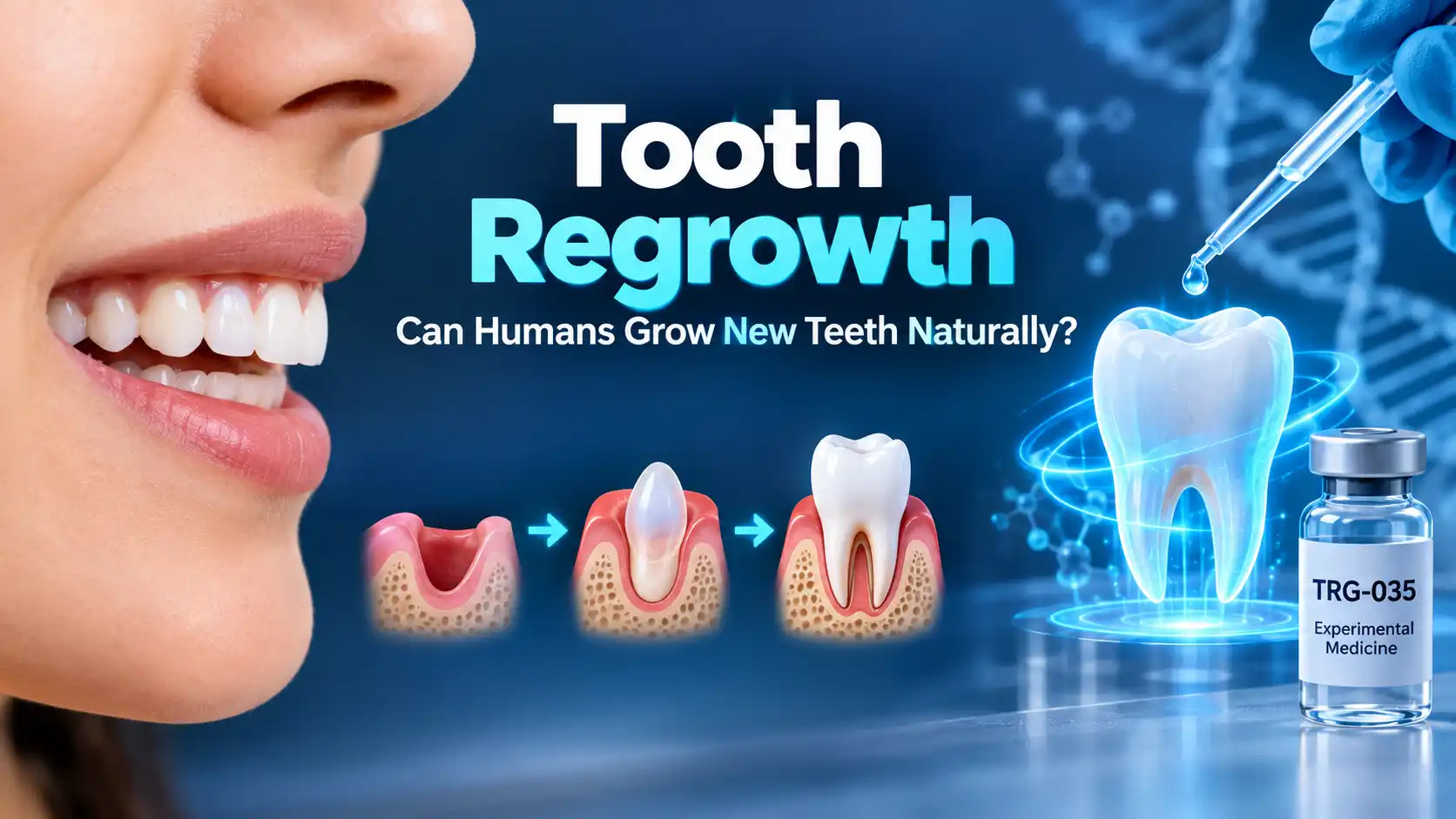
One of the most interesting projects is taking place in Japan. Researchers are developing an experimental medicine called TRG-035, which aims to activate tooth development by blocking a protein known as USAG-1.
The research has progressed from animal experiments to human clinical testing. In August 2026, the Japanese biotechnology company Toregem BioPharma announced that the regulatory investigation of its Phase IIa clinical trial notification had been completed. However, additional review was still required before the next trial could begin.
This is an important scientific development, but it does not mean that anyone can currently take a medicine and grow a replacement tooth.
So, how could this technology work? Could it eventually help adults who have lost teeth because of cavities, gum disease, or accidents? And will it really make dental implants unnecessary?
Let’s understand the science, the research, and the possible future of tooth regeneration in simple language.
Why Can’t Humans Normally Grow New Teeth?
Humans generally develop two sets of teeth during their lives.
First set: Baby teeth
Children usually begin developing baby teeth during infancy. These teeth help them chew food and support speech while their jaws are growing.
Second set: Permanent teeth
As children grow, permanent teeth gradually replace their baby teeth. Most people have 32 permanent teeth, including wisdom teeth, although the number varies.
After the permanent teeth develop, humans generally cannot naturally replace them if they are lost.
For example, imagine a 35-year-old person loses a molar because of severe tooth decay. The gum may heal after extraction, but the body does not normally grow another complete tooth in that space.
Why?
Tooth development depends on a carefully coordinated process involving cells, genes, and molecular signals. Once the process has completed, the body generally does not restart it automatically.
This is why replacing a missing tooth usually requires a dentist to use an artificial or prosthetic solution.
Scientists are now investigating whether some of the biological signals involved in tooth development can be activated again under suitable conditions.
What Is Tooth Regrowth Technology?
Tooth regrowth, also called tooth regeneration, refers to scientific approaches intended to restore missing tooth structures or develop a new tooth using biological processes.
The goal is different from simply placing an artificial tooth in the mouth.
Imagine two possible approaches.
- Dental implant: A dentist places an artificial tooth root into the jawbone and attaches a replacement tooth.
- Biological tooth regeneration: A treatment attempts to stimulate the body’s own tooth-development process so that a natural tooth can form.
The second approach is much more complicated than it might sound.
A complete tooth is not simply a hard white structure. It contains enamel, dentin, pulp, blood vessels, nerves, and roots, and it must connect properly with the surrounding bone and gum tissues.
The new tooth must also emerge in the correct location and fit with the other teeth.
Scientists are studying several methods, including:
- Medicines that influence natural tooth development.
- Stem-cell-based techniques that may help produce tooth-related tissues.
- Tissue engineering, which aims to reconstruct tooth structures in controlled conditions.
- Methods for repairing or regenerating damaged dental tissues.
These approaches are at different stages of research. The Japanese TRG-035 programme focuses on a specific biological mechanism that may help tooth development restart in certain circumstances.
Meet TRG-035: The Japanese Medicine Designed to Regrow Teeth
One of the best-known projects in tooth regeneration is being developed by Toregem BioPharma, a biotechnology company associated with research conducted at Kyoto University and other Japanese institutions.
The experimental medicine is called TRG-035.
It is an antibody-based treatment designed to block USAG-1, a protein involved in regulating tooth development.
Researchers are particularly interested in people who have congenital tooth agenesis. This condition means that some permanent teeth never develop because of developmental or genetic factors.
Some affected people are born without several teeth, which can create difficulties with chewing and may require years of dental treatment.
The research team hopes that by influencing the biological signals that control tooth development, it may be possible to help certain missing teeth develop.
The idea is exciting because the treatment is intended to work with the body’s own biological processes rather than simply inserting an artificial replacement.
However, TRG-035 remains an investigational medicine. Its ability to produce new teeth in humans has not yet been established by publicly available clinical evidence.
How Does the Tooth-Regrowth Medicine Work?
To understand the idea, imagine that tooth development is controlled by a set of biological instructions.
Some signals encourage the process, while other signals help keep it under control. Researchers believe that adjusting this balance may allow tooth development to progress in certain cases.
The USAG-1 protein is one of the molecules involved in this regulation.
Step 1: The body has signals that control tooth development
During early development, different cells communicate through molecular pathways. Two important pathways are called BMP and Wnt.
These pathways help regulate the development of many tissues, including teeth.
Step 2: USAG-1 can limit certain developmental signals
USAG-1 interacts with these signalling systems and can act as a brake on aspects of tooth development.
Think of it like a car with an accelerator and a brake. The accelerator helps the car move, while the brake limits movement when necessary.
In a similar way, biological signals need to remain balanced for a tooth to develop correctly.
Step 3: TRG-035 is designed to block USAG-1
TRG-035 is an antibody intended to neutralize USAG-1.
The research hypothesis is that blocking this protein may allow developmental signals to operate more effectively in suitable circumstances.
Step 4: Tooth development may be encouraged
Animal studies have shown that interfering with USAG-1 can promote tooth development in certain experimental models.
Scientists are now investigating whether this approach can be used safely and effectively in humans.
An important limitation remains: blocking USAG-1 does not guarantee that a new tooth will grow in every person. The result may depend on genetics, the developmental state of the tissues, the timing of treatment, and other biological factors.
This is why human clinical trials are necessary.
What Have Animal Experiments Revealed?
Before a new medicine can be tested in humans, researchers generally study its effects in laboratory systems and animals.
Research into USAG-1 has produced promising results in animal models.
In studies involving mice, researchers found that interfering with USAG-1 could help correct certain tooth-development abnormalities. Later research also explored the potential for additional tooth formation.
The research programme associated with TRG-035 has reported promising findings in animal models, including studies involving mice and other animals.
These findings helped scientists investigate whether the same biological mechanism might eventually be useful in humans.
However, animal experiments cannot establish that a treatment will work in people.
For example, a medicine might encourage tooth development in a mouse but produce a different result in a human because the two species differ in their biology, tooth development, and response to treatment.
Researchers must also determine whether a newly developed tooth has the correct shape, position, roots, and function.
The key point: Animal research provides a scientific reason to continue testing the idea. It is not proof that the treatment already regrows human teeth.
What Is the Current Status of Human Trials in 2026?
The most important question is whether the technology has moved beyond laboratory research.
Yes, the TRG-035 programme has entered human clinical testing, but the development process is still ongoing.
Phase I: Initial human safety testing
The first human study was designed primarily to examine safety, tolerability, and how the medicine behaves in the body.
The registered Japanese Phase I trial involved healthy adult men aged 30 to under 65. It was designed as a randomized, double-blind, placebo-controlled, dose-escalation study, with a target of 30 participants.
The trial registry now lists the study as complete. Toregem has also reported completion of Phase I dosing and progress toward the next stage.
However, detailed clinical results have not been publicly disclosed in a form that establishes that the drug can regrow teeth in humans.
It is important to distinguish completing a safety study from demonstrating that a treatment works.
Phase IIa: The next major step
On August 17, 2026, Toregem BioPharma announced that the Japanese Pharmaceuticals and Medical Devices Agency (PMDA) had completed its investigation of the clinical trial notification for the Phase IIa study.
That is a regulatory milestone, but it does not mean the medicine has received marketing approval.
According to the company’s announcement, institutional review and other required procedures still needed to take place before participant enrolment and administration of the study medicine could begin.
The planned Phase IIa study is intended to investigate the treatment in people with severe congenital tooth agenesis. A clinical update reported plans to study 24 children with this condition.
The objective is to investigate dosing and evaluate the treatment in the intended patient population.
What has actually been proven in humans?
The distinction is important:
- Human clinical testing has taken place.
- The initial study was primarily designed to assess safety.
- The next phase is intended to investigate the treatment in patients with congenital tooth agenesis.
- Publicly available evidence has not yet established that TRG-035 reliably produces new teeth in humans.
The research is progressing, but the central question—whether the medicine can safely and effectively regenerate functional human teeth—still needs convincing clinical evidence.
Who Could Benefit First From This Technology?
The initial target is not everyone who has lost a tooth.
The research programme is focused on people with congenital tooth agenesis, particularly those who are missing multiple permanent teeth because of developmental problems.
Consider this example.
A child grows older, but several permanent teeth never develop. Some baby teeth may remain for longer than expected, while gaps may appear as the child grows.
These missing teeth can affect chewing, appearance, and the development of the jaw. Treatment may require carefully planned dental procedures over many years.
If a medicine could safely stimulate the development of the missing teeth, it might eventually provide a new treatment option for some of these patients.
This is the main reason congenital tooth agenesis is an important early target for the research.
It is also why the findings should not automatically be applied to people who have lost teeth because of accidents, gum disease, or tooth decay.
Those conditions may involve different biological problems.
Could Adults Regrow Teeth Lost Because of Cavities or Accidents?
This is one of the biggest questions surrounding tooth-regrowth research.
Imagine an adult loses a tooth at age 40 because of severe decay. Would a medicine such as TRG-035 make another tooth grow in the same place?
At present, that outcome has not been demonstrated in humans.
There is a biological reason for the uncertainty.
A person who never developed a particular tooth may have a different developmental situation from someone whose fully formed tooth was later extracted.
In the first case, the treatment may be attempting to encourage a developmental process that did not complete properly. In the second case, the original tooth and its supporting structures may already be gone or damaged.
Whether the same medicine can successfully address both situations remains an open research question.
Researchers hope that tooth-regeneration approaches may eventually have wider applications, but evidence from clinical trials will be needed before their use can be recommended for ordinary adult tooth loss.
For now, people who lose teeth because of decay, trauma, or gum disease should continue to seek advice about established treatments from a qualified dentist.
Will Tooth Regrowth Make Dental Implants and Dentures Obsolete?
Not necessarily.
If biological tooth regeneration becomes successful, it could add a new option to dentistry. But it would not automatically eliminate the need for existing treatments.
Dental implants, bridges, and dentures serve different purposes and can be appropriate for different patients.
Consider three situations:
Situation 1: A person is born without several permanent teeth.
A future tooth-regeneration medicine might potentially help eligible patients develop missing teeth.
Situation 2: An adult loses a tooth because of an accident.
It is not yet known whether TRG-035 or a similar medicine could reliably regenerate the lost tooth in this situation.
Situation 3: A person has lost many teeth and has significant jawbone loss.
Even if a regenerative treatment becomes available, the condition of the jawbone, gums, and other oral tissues could affect whether it is suitable.
A dentist would still need to evaluate the patient’s overall oral health and determine the appropriate treatment.
The future may involve a combination of biological regeneration and conventional dentistry rather than one technology replacing everything else.
What Are the Biggest Challenges?
Regrowing a complete, functional tooth is a complicated biological task. Several challenges remain.
Challenge 1: Getting the treatment to work in humans
Animal results are encouraging, but human clinical trials must establish safety and effectiveness.
Challenge 2: Controlling where the tooth grows
A new tooth must emerge in a useful position. Uncontrolled or misplaced growth could create additional dental problems.
Challenge 3: Producing a complete, functional tooth
A tooth needs more than enamel and dentin. Its roots, pulp, supporting tissues, and connection with the jaw must develop correctly.
Challenge 4: Understanding who will benefit
Different genetic and developmental conditions can cause missing teeth. One medicine may not work equally well for every cause.
Challenge 5: Establishing long-term safety
Researchers need to monitor possible side effects and determine whether treatment could cause unwanted changes in tooth development or other tissues.
Challenge 6: Cost and availability
Even if clinical trials succeed, manufacturing, regulatory approval, treatment costs, and access to qualified providers will influence how widely the medicine can be used.
These challenges help explain why a promising scientific discovery does not immediately become a routine treatment.
When Could Tooth-Regrowth Medicine Become Available?
The research team has discussed a long-term goal of bringing the medicine to patients around 2030, subject to successful development.
That date should be treated as a target, not a confirmed launch date.
Before a medicine can become widely available, researchers generally need to establish that it is safe and effective through appropriate clinical trials. Regulators must then assess the evidence before deciding whether to approve it.
The TRG-035 programme still needs further clinical evidence, including evidence of effectiveness in the intended patient population.
If the next stages go well, the technology could eventually create a new option for people with certain types of congenital tooth agenesis.
However, if trials reveal safety concerns or limited effectiveness, the programme may need to change or take longer.
It would therefore be premature to promise that people will be able to regrow lost teeth by a specific year.
Other Approaches to Regenerating Teeth
TRG-035 is not the only area of research in regenerative dentistry.
Scientists are also exploring other ways to repair or regenerate dental tissues.
Stem-cell research
Stem cells can develop into different cell types under appropriate conditions. Researchers are studying whether they could help regenerate dental pulp, dentin, periodontal tissues, or other components of a tooth.
However, producing a complete, correctly shaped tooth that integrates with the jaw remains much more challenging than regenerating a single tissue.
Tissue engineering
Tissue engineering combines cells, biological signals, and supportive materials to help reconstruct living tissues.
In tooth research, scientists are investigating whether engineered tooth structures could eventually develop into functional replacements.
Much of this work remains experimental.
Enamel and dentin repair
Some research focuses on repairing damaged tooth structures rather than growing an entirely new tooth.
These approaches have different goals. Repairing an area of damaged enamel, for example, is not the same as regenerating a complete tooth with roots and living tissues.
In the future, different regenerative techniques may be used for different dental problems.
What Does This Mean for the Future of Dentistry?
Tooth-regeneration research could change how some dental conditions are treated, especially if scientists learn to control tooth development safely and predictably.
Today, much of dentistry focuses on preventing damage, repairing affected tissues, and replacing teeth that cannot be saved.
A successful regenerative medicine could introduce another approach: encouraging the body to develop a natural tooth in carefully selected circumstances.
For patients born without several permanent teeth, this could eventually be particularly valuable.
For people who lose teeth later in life, the possibility is also interesting—but much more evidence is needed before it can be considered a realistic treatment option.
The next few years of clinical research will be important. Researchers will need to demonstrate not only whether new teeth can develop, but also whether those teeth function properly and remain healthy over time.
Is the Era of Naturally Regrown Teeth About to Begin?
Tooth-regrowth medicine is one of the most interesting developments in regenerative dentistry.
Japan’s TRG-035 programme aims to block USAG-1, a protein involved in regulating tooth development. Research in animal models has provided a scientific basis for investigating whether this approach can help certain missing teeth develop.
The programme has also progressed into human clinical testing, and its Phase IIa trial notification passed a regulatory investigation milestone in August 2026. Further review and clinical testing are still necessary.
The most important point is that scientists have not yet established that this medicine can reliably regrow functional teeth in humans.
The first intended applications focus on people with congenital tooth agenesis, rather than everyone who has lost teeth because of cavities, accidents, or gum disease.
If future trials demonstrate safety and effectiveness, the treatment could become an important addition to dentistry. It might offer some patients an alternative to relying entirely on artificial tooth replacements.
But dentists will not disappear. Even if tooth-regeneration medicines become available, people will still need dental care, diagnosis, preventive treatment, and monitoring.
For now, this technology is best understood as a promising research programme—not a proven cure for tooth loss.
The real breakthrough will come when scientists can show that a medicine can safely grow a correctly positioned, functional natural tooth in people who need it.
Sources: Toregem BioPharma, Japan Clinical Trials Registry, Kitano Hospital, Science Advances, Regenerative Therapy, Journal of Oral Biosciences, PubMed.