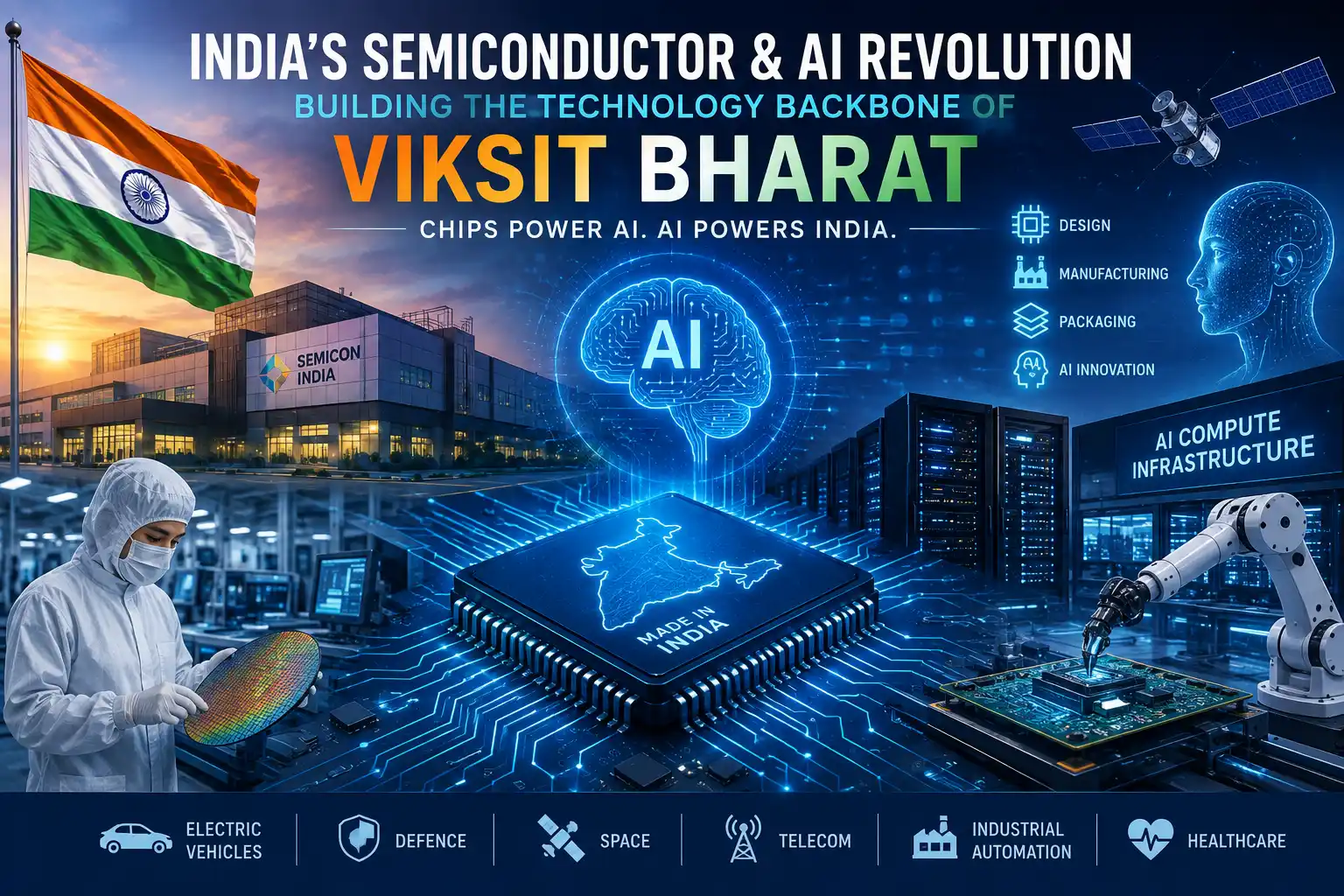
Semiconductors are the foundation of modern technology. Smartphones, electric vehicles, satellites, medical equipment, telecom networks, computers and data centres all depend on chips. At the same time, Artificial Intelligence is rapidly increasing the demand for advanced processors and high-performance computing.
This is creating a powerful connection between semiconductors and AI.
India is now trying to develop capabilities across both sectors—from chip design and semiconductor manufacturing to AI computing infrastructure and indigenous AI models. Government initiatives, private-sector investments and startup activity are gradually creating an integrated technology ecosystem.
As India celebrates its 80th Independence Day in 2026, this convergence could become an important part of the country’s journey toward technological self-reliance and Viksit Bharat.
Why AI and Semiconductors Are Becoming Closely Connected
AI needs enormous computing power. Training and running modern AI models requires specialised processors such as GPUs and AI accelerators, along with high-speed memory and networking infrastructure.
This creates a straightforward relationship:
More AI → More computing → More advanced chips → More semiconductor demand.
But the relationship also works in reverse. AI can help semiconductor companies design chips, identify manufacturing defects, optimise production processes and predict equipment failures.
Therefore, AI is not only creating demand for semiconductors; it is also becoming a tool for improving semiconductor development and manufacturing.
This is why countries around the world are treating AI and semiconductor capabilities as strategically important technologies.
India Wants to Build a Complete Semiconductor Ecosystem
India’s semiconductor ambitions have expanded beyond simply establishing fabrication plants.
The country is attempting to develop an ecosystem covering chip design, fabrication, assembly, testing, packaging, materials, equipment, research and development.
Under the Semicon India Programme, India has approved 12 semiconductor projects across six states, with investment commitments of around ₹1.64 lakh crore. Three facilities had commenced commercial production by July 2026, according to government data.
The objective is to create a semiconductor ecosystem in which manufacturing facilities are supported by suppliers, packaging companies, testing facilities, engineers and technology developers.
This is important because a semiconductor fab cannot operate successfully in isolation.
Major Semiconductor Projects
Several major projects are already helping India build semiconductor manufacturing capabilities.
Tata Electronics is developing a major semiconductor fabrication facility in Dholera, Gujarat, in partnership with Taiwan’s Powerchip Semiconductor Manufacturing Corporation. The project involves an investment of around ₹91,000 crore.
Tata Electronics is also developing a semiconductor packaging facility in Assam.
Micron is developing an assembly, testing and packaging facility in Gujarat, with an investment of more than ₹22,000 crore.
CG Power, along with technology partners including Renesas, is developing another semiconductor facility in Gujarat.
Kaynes Semicon is also developing a semiconductor packaging facility in the state.
Together, these projects show that India’s strategy involves both Indian companies and international technology partnerships.
India’s Biggest Advantage: Semiconductor Design
India is not starting from zero.
The country already has a strong semiconductor design and engineering ecosystem. Global semiconductor companies have operated large design and R&D centres in India for years.
India has a significant share of the world’s semiconductor design workforce, with engineers working on areas such as chip architecture, verification, embedded systems and product development.
The challenge now is to convert this engineering strength into more Indian-owned semiconductor intellectual property and products.
This is where India’s Design Linked Incentive programme becomes important.
Startups Are Moving Toward Chip Development
Government support is helping Indian startups and smaller companies develop semiconductor designs.
By 2026, dozens of semiconductor design projects had received support under the Design Linked Incentive programme, while many startups and MSMEs had received access to advanced electronic-design-automation tools.
Several projects have also reached the tape-out stage.
Tape-out is an important milestone in chip development. It means the final chip design has been prepared for manufacturing.
In simple terms, the process looks like:
Idea → Design → Testing → Tape-out → Manufacturing → Product
Moving more Indian companies through this chain could eventually help the country develop its own semiconductor products.
India Is Building AI Infrastructure at the Same Time
While semiconductor manufacturing is developing, India is also expanding its AI ecosystem.
The IndiaAI Mission, launched with an outlay of around ₹10,372 crore, focuses on areas including AI computing infrastructure, datasets, skills, startups and indigenous AI capabilities.
One important component is access to computing power.
By early 2026, more than 38,000 GPUs had been onboarded for common AI computing facilities, according to government information.
This is significant because computing power is one of the biggest costs for AI startups and researchers.
A company may have a strong AI idea, but training a large model can require thousands of GPUs and enormous amounts of electricity and data-centre capacity.
Making computing resources more accessible can therefore help Indian startups compete more effectively.
India Also Wants Indigenous AI Models
India’s AI strategy is not limited to using AI models developed elsewhere.
The country is supporting the development of indigenous foundational AI models and large language models.
Indian companies and research teams are working on models designed to better understand Indian languages, accents, local data and domestic use cases.
This could be particularly valuable in areas such as government services, education, agriculture, healthcare, financial services and customer support.
India’s linguistic diversity makes local AI models especially important.
The Bigger Opportunity: Indian AI Running on Indian Technology
The most interesting opportunity appears when semiconductor and AI strategies are combined.
Imagine an Indian company developing an AI model for agriculture.
Today, it may rely on foreign processors, cloud infrastructure and AI platforms.
But over time, India could develop more parts of the technology chain:
Indian AI model → Indian software → Indian-designed AI processor → Indian semiconductor manufacturing → Indian packaging → Indian data centre.
India does not necessarily need to produce every component domestically. However, increasing domestic capabilities across critical layers can reduce supply-chain risks and allow Indian companies to capture more economic value.
Semiconductors Will Impact More Than Smartphones
The semiconductor industry has applications across almost every major technology sector.
Electric Vehicles: EVs use chips for battery management, motor control, power electronics, infotainment and advanced driver-assistance systems.
Defence: Modern defence systems depend on processors, sensors, communications, radar and electronic systems.
Space: Satellites require specialised electronics and processors that can operate reliably under demanding conditions.
Telecom: 5G and future communication networks require large numbers of advanced semiconductor components.
Manufacturing: Robotics, industrial automation and smart factories depend on sensors and processors.
Therefore, a stronger semiconductor ecosystem could have a multiplier effect across India’s broader economy.
AI Can Also Improve Semiconductor Manufacturing
There is another important connection.
AI itself can be used inside semiconductor factories.
Manufacturers can use AI to analyse production data, identify defects, predict equipment failures and improve manufacturing yields.
Even a small improvement in semiconductor yield can have a significant financial impact because chip manufacturing involves extremely expensive equipment and materials.
This creates a cycle:
Better chips → Better AI infrastructure → Better AI → Better semiconductor manufacturing.
Challenges India Still Needs to Overcome
India’s opportunity is significant, but becoming a global semiconductor and AI leader will not be easy.
Semiconductor manufacturing is extremely complex and capital-intensive. Advanced facilities require billions of dollars and highly specialised technology.
India also faces intense competition from established semiconductor hubs such as Taiwan, South Korea, Japan, China and the United States.
Supply chains are another challenge. Even if chips are manufactured in India, equipment, materials and specialised technologies may still need to be imported.
India will also need to develop a much larger pool of specialised semiconductor manufacturing and AI talent.
Therefore, the real measure of success will not simply be the number of projects announced. It will be whether these projects become commercially competitive businesses producing globally relevant technology.
What This Means for Viksit Bharat
India’s technology journey has traditionally been strongly associated with software and IT services.
The next stage could be much broader:
Software → AI → Electronics → Chips → Deep Technology → Advanced Manufacturing
If India successfully connects these capabilities, it could capture more value from the global technology economy.
The semiconductor industry can provide the hardware foundation, while AI can provide the intelligence layer.
Together, they can support industries ranging from electric vehicles and telecom to defence, space, healthcare and advanced manufacturing.
Outcome
India’s semiconductor and AI strategies should not be viewed as two separate technology initiatives. They are increasingly becoming parts of the same long-term economic and strategic vision.
Semiconductors provide the computing foundation, while AI provides the intelligence that runs on that foundation.
India is now investing in both sides—from chip design, fabrication and packaging to GPUs, AI infrastructure and indigenous AI models.
There are still major challenges ahead, particularly around technology, capital, talent and global competition. But the direction is clear.
India wants to move beyond being primarily a consumer of advanced technology and become a designer, developer and manufacturer of critical technologies.
As the country marks its 80th Independence Day in 2026, the convergence of semiconductors and AI could become one of the most important pillars of India’s next phase of technological and industrial development—and a significant step toward the vision of Viksit Bharat.
Source: PIB