The global race for technological leadership continues to intensify, and supercomputing has become one of the most important battlegrounds. For years, the United States dominated the world’s fastest supercomputer rankings. However, China has now achieved a major breakthrough by reclaiming the top position.
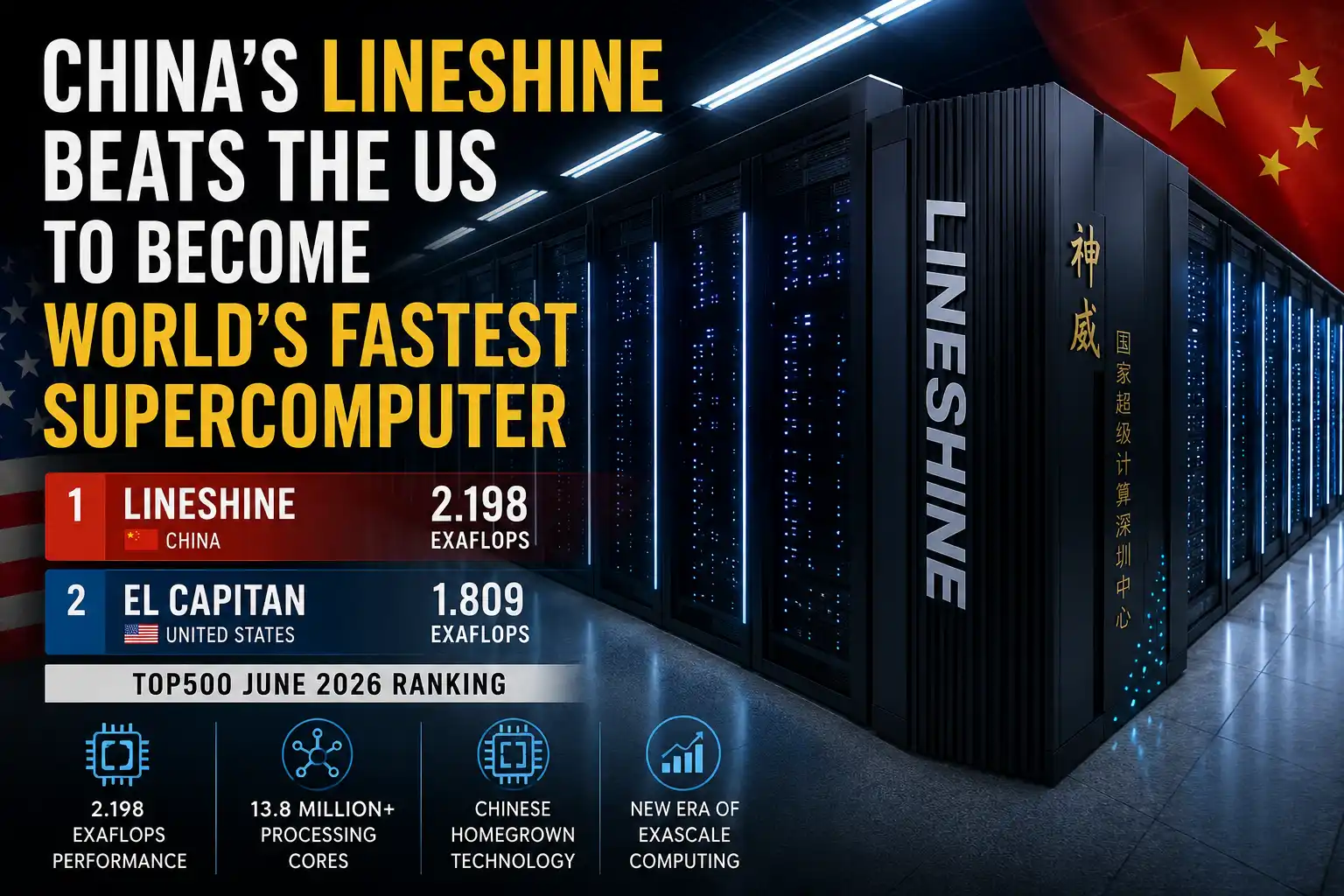
According to the June 2026 TOP500 ranking, China’s new supercomputer LineShine has become the world’s fastest supercomputer, surpassing the United States’ El Capitan. This marks China’s return to the No. 1 spot after nearly nine years and highlights the country’s growing technological capabilities.
What Is the TOP500 Ranking?
The TOP500 is the official ranking of the world’s 500 most powerful supercomputers. Published twice a year since 1993, it is considered the most respected benchmark in the high-performance computing (HPC) industry.
The ranking measures a supercomputer’s performance using the High Performance Linpack (HPL) benchmark, which evaluates how quickly a machine can perform complex mathematical calculations.
What Is LineShine?
LineShine is an advanced supercomputer installed at the National Supercomputing Centre in Shenzhen, China.
Key Specifications
- Performance: 2.198 Exaflops
- Approximately 13.8 million processing cores
- Built entirely using Chinese-developed technologies
- CPU-based architecture
- Powered by LingKun processors
- Uses LingQi interconnect technology
- Runs on the Kylin Operating System
This achievement demonstrates China’s ability to develop world-class computing infrastructure using domestic technology.
What Does Exaflop Mean?
An Exaflop represents:
1,000,000,000,000,000,000 (10¹⁸) calculations per second
With a performance of 2.198 Exaflops, LineShine can perform more than two quintillion calculations every second.
To put this into perspective, it would take ordinary computers many years to complete calculations that LineShine can finish in just a few seconds.
How Did LineShine Surpass El Capitan?
According to the June 2026 TOP500 list:
| Rank | Supercomputer | Country | Performance |
| 1 | LineShine | China | 2.198 Exaflops |
| 2 | El Capitan | United States | 1.809 Exaflops |
LineShine delivered roughly 20% higher performance than El Capitan, allowing China to reclaim the top position in global supercomputing.
Why Is This Achievement Important?
1. China’s Return After Nine Years
China last held the No. 1 position in 2017 with the Sunway TaihuLight supercomputer. Since then, the United States had maintained its leadership.
With LineShine, China has once again become the global leader in supercomputing performance.
2. Success Without US Chips
One of the most significant aspects of LineShine is that it was built without relying on advanced processors from Nvidia, AMD, or Intel.
Instead, it uses Chinese-developed processors and networking technologies, demonstrating the country’s growing self-reliance in advanced computing.
3. Strength of Domestic Innovation
LineShine showcases China’s progress in developing its own processors, software, interconnect technologies, and computing infrastructure.
The project highlights how domestic innovation is helping China reduce dependence on foreign technology amid ongoing export restrictions.
Is LineShine Also the Best AI Supercomputer?
Not necessarily.
Although LineShine is currently the world’s fastest supercomputer based on traditional HPC benchmarks, AI workloads are often optimized for GPU-based systems.
Most modern AI models are trained using specialized graphics processors, while LineShine is primarily designed for scientific computing and large-scale simulations.
As a result, being the fastest supercomputer does not automatically mean being the most powerful AI system.
What Will LineShine Be Used For?
LineShine is expected to support a wide range of applications, including:
- Weather forecasting
- Climate modeling
- Space research
- Nuclear simulations
- Biomedical research
- Advanced engineering design
- Scientific simulations
- Large-scale data analysis
These applications require enormous computing power and can benefit significantly from exascale performance.
Impact on Global Technology Competition
LineShine’s achievement is more than just a technological milestone.
It also represents a significant development in the ongoing technology competition between China and the United States. Over the past several years, the US has imposed restrictions on advanced AI chips and semiconductor technologies destined for China.
Despite these challenges, China has demonstrated that it can continue advancing in high-performance computing through domestic innovation and investment.
This achievement is likely to intensify competition in areas such as supercomputing, artificial intelligence, semiconductors, and advanced research infrastructure.
Outcome
China’s LineShine becoming the world’s fastest supercomputer marks a major victory for the country’s technology sector. By surpassing the United States’ El Capitan, China has returned to the top of the global supercomputing rankings after nearly a decade.
The achievement highlights China’s growing technological independence and its ability to build cutting-edge computing systems using domestic technologies. While the United States remains a major leader in AI and semiconductor innovation, LineShine has demonstrated that the race for technological dominance is far from over.
As competition between the world’s largest economies continues, advancements in supercomputing are expected to play an increasingly important role in shaping the future of science, industry, and national competitiveness.
Source: top500 list