Artificial Intelligence (AI) is rapidly transforming the way businesses operate, and Meta has taken another major step in this direction. The company has introduced its new Meta Business Agent, an AI-powered assistant designed not only to answer customer questions but also to automate several important business functions.
According to Meta CEO Mark Zuckerberg, the long-term vision is to create AI agents that can help businesses manage a significant portion of their daily operations. The announcement was made during Meta’s Conversations 2026 event, where the company outlined its growing ambitions in enterprise AI.
What Is Meta Business Agent?
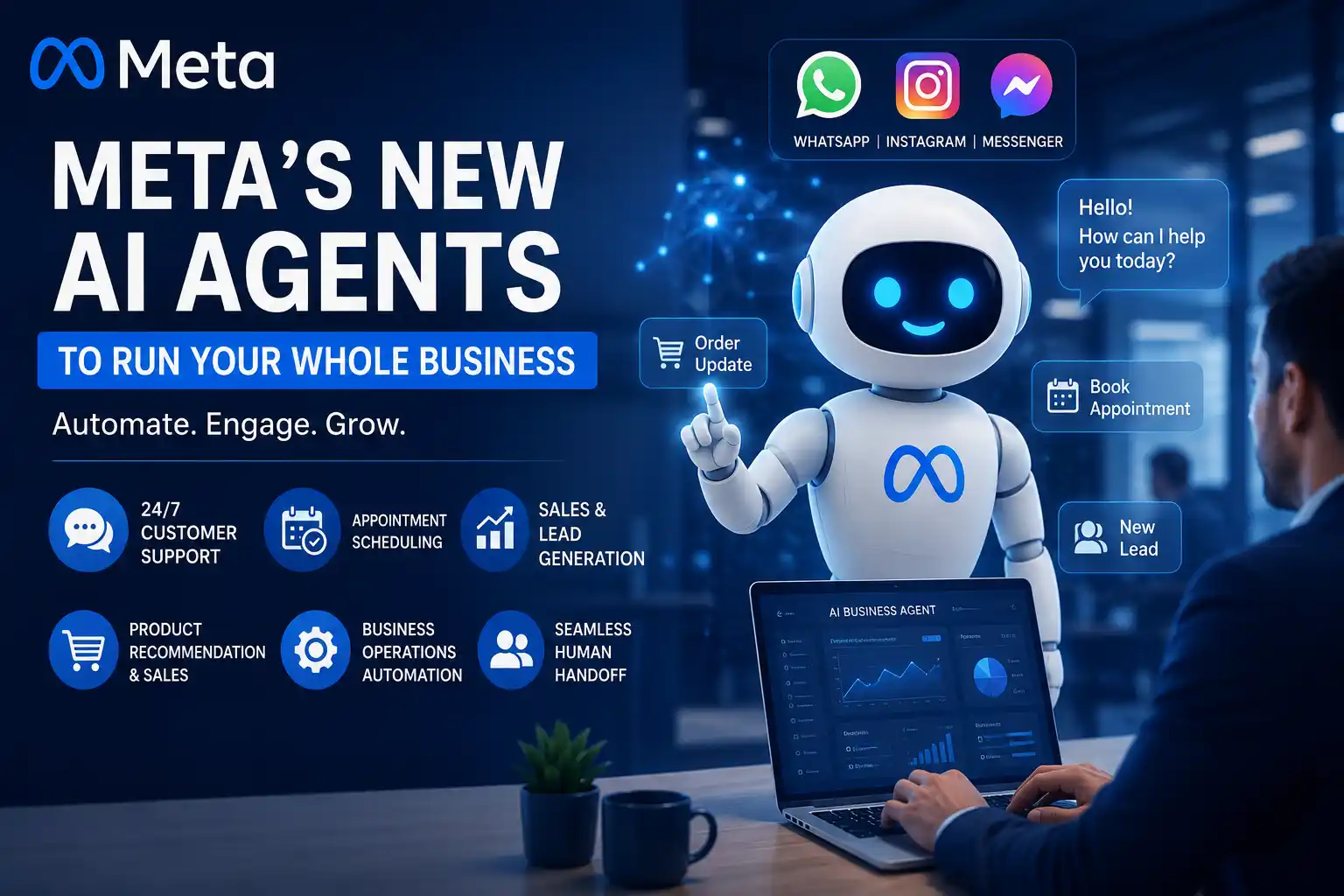
Meta Business Agent is an AI-powered digital assistant that can interact with customers across WhatsApp, Instagram, and Messenger. It is designed to handle customer inquiries, schedule appointments, qualify leads, and even assist with sales processes.
Meta says businesses can set up the agent within minutes and customize it to match their brand voice, products, and services.
What Can the AI Agent Do?
1. 24/7 Customer Support
The AI agent can provide around-the-clock customer service by:
- Answering product-related questions
- Providing order updates
- Handling frequently asked questions
- Responding to customer complaints
This can help businesses reduce the workload on customer support teams while improving response times.
2. Appointment Scheduling
The AI agent can automate routine scheduling tasks, including:
- Booking appointments
- Managing calendars
- Scheduling meetings
- Sending reminders
This reduces manual work and improves operational efficiency.
3. Sales and Lead Generation
Meta’s AI agent goes beyond customer support and can assist with sales activities by:
- Identifying potential customers
- Recommending products
- Qualifying leads
- Guiding customers through the buying process
In many cases, it can function like a digital sales representative.
What Is Meta’s Long-Term Goal?
Mark Zuckerberg believes that in the future, every business will have its own AI agent, much like every business today has a website or an email address.
Meta envisions AI agents that can:
- Manage customer interactions
- Support marketing campaigns
- Drive sales
- Automate routine business operations
For small businesses, these agents could eventually act as a virtual team that operates continuously without requiring large staffing resources.
Integration With Business Tools
Meta is not positioning its AI agent as a simple chatbot. The company is building a broader enterprise platform capable of integrating with popular business software and e-commerce tools.
Potential integrations include platforms such as:
- Shopify
- Zendesk
- CRM and customer service tools
These integrations allow the AI agent to access business data and provide more accurate, context-aware assistance.
Why Is Meta Entering This Market?
Meta currently generates most of its revenue from advertising. However, AI represents a major new growth opportunity.
The company plans to monetize these AI business tools through:
- Premium subscriptions
- Usage-based pricing
- Enterprise AI services
If widely adopted, AI business agents could become a significant new revenue stream for Meta.
Benefits for Small Businesses
Lower Operating Costs
Businesses may reduce spending on repetitive support and administrative tasks.
24/7 Availability
Customers can receive assistance at any time without waiting for business hours.
Increased Sales Opportunities
The AI agent can recommend products and guide customers toward purchases.
Easy Setup
Meta says businesses can deploy these AI agents without requiring advanced technical skills or coding expertise.
Could AI Impact Jobs?
One of the biggest concerns surrounding AI agents is their potential impact on employment.
These systems can automate tasks such as:
- Customer support
- Appointment management
- Basic sales assistance
- Routine marketing activities
However, complex problem-solving, strategic planning, and high-value customer interactions still require human involvement. Meta has emphasized that AI agents can transfer conversations to human representatives whenever necessary.
Challenges and Risks
Data Privacy and Security
Businesses will need to provide AI systems with access to customer and operational data, making security and privacy critical concerns.
AI Errors
Like other AI systems, business agents may occasionally provide incorrect information or misunderstand customer requests.
Regulatory Uncertainty
Governments around the world are developing new AI regulations that could affect how businesses deploy and use AI-powered agents.
Analysis
Meta’s latest move represents more than just the launch of another AI tool. It signals the company’s ambition to become a major player in the enterprise AI market.
Meta has a significant advantage because it already owns platforms used by millions of businesses worldwide, including:
- Messenger
By embedding AI directly into these platforms, Meta can make adoption easier than many competitors.
The company is also entering a highly competitive market where firms such as OpenAI, Microsoft, Google, and Anthropic are investing heavily in AI-powered business solutions.
The success of Meta’s strategy will depend on how effectively these AI agents can deliver measurable business value while maintaining accuracy, reliability, and customer trust.
Outcome
Meta’s new Business Agent marks an important step in the evolution of AI-powered business automation. Rather than functioning as a simple chatbot, it aims to support customer service, appointment scheduling, lead generation, and sales activities from a single platform.
While AI is not yet capable of fully running an entire business, Meta’s vision suggests that AI agents could become a standard business tool in the coming years. If adoption continues to grow, these systems may significantly change how small and medium-sized businesses operate, communicate with customers, and scale their operations.