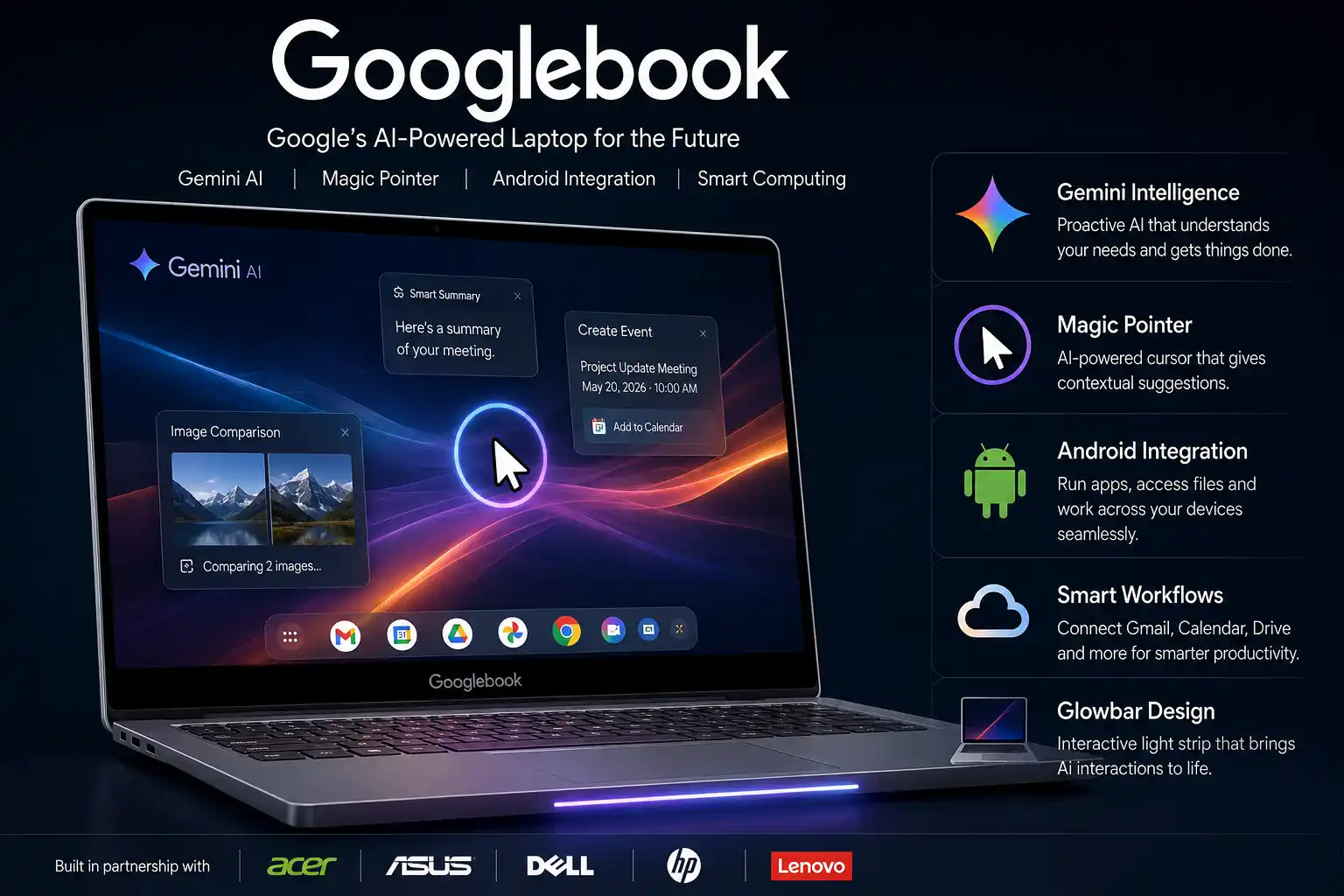
Recently, Google introduced its new AI-powered laptop category called “Googlebook.” This is not just another laptop launch but is being seen as a major shift in Google’s future computing strategy.
Googlebook is designed mainly around Gemini AI and is being considered the next evolution of Chromebooks. Experts believe Google is now preparing to directly compete with Apple MacBook and Microsoft Copilot+ PCs.
What Is Googlebook?
Googlebook is Google’s new laptop category that combines Android, ChromeOS, and Gemini AI into a single platform.
Until now, Chromebooks were mainly browser-based laptops, but Googlebook is being built for an AI-first computing experience. Instead of focusing only on a traditional operating system, Google is now emphasizing “intelligent computing.”
Googlebook is expected to offer:
- AI-powered features
- Android integration
- Smart workflows
- Cross-device connectivity
- Context-aware assistance
These features could significantly improve productivity and automation.
The Biggest Highlight – Gemini Intelligence
The central feature of Googlebook is Gemini Intelligence.
Google wants laptops to go beyond simply following commands. The company aims to create devices that understand user needs and provide proactive assistance. That is why Gemini has been deeply integrated into the system.
Examples include:
- Suggesting meetings when a date appears in an email
- Creating AI visualizations by comparing images
- Automatically organizing travel plans
- Connecting Gmail, Calendar, and Drive data together
This could make workflows much smarter and more efficient.
What Is Magic Pointer?
One of the most talked-about features of Googlebook is the Magic Pointer.
This is an AI-powered cursor that understands the content displayed on the screen and provides contextual suggestions accordingly.
For example:
- Hovering over an image could trigger Gemini to provide related information
- Moving the cursor over a date could instantly create a calendar event
- Selecting two images could generate AI-based comparisons or combinations
Tech experts are calling it one of the biggest changes to the traditional computer cursor experience.
Deep Android and Laptop Integration
Googlebook is expected to feature very deep Android ecosystem integration.
Users may be able to:
- Run phone apps directly on laptops
- Access phone files seamlessly from laptops
- Use cross-device workflows easily
This could significantly reduce the gap between Android phones and laptops.
Many analysts believe Google is trying to create a seamless ecosystem experience similar to Apple’s ecosystem.
What Will Happen to ChromeOS?
After the Googlebook announcement, one major question emerged: Will Chromebooks disappear?
Google clarified that:
- Existing Chromebooks will continue receiving updates
- Some Chromebooks may migrate to the new platform in the future
- However, Google’s long-term focus now appears to be centered more on the Googlebook platform
This suggests ChromeOS is not disappearing completely, but Google’s future strategy is moving toward AI-centric computing.
Which Companies Will Launch Googlebook Devices?
Google itself is not manufacturing the hardware directly.
The company is reportedly partnering with major laptop manufacturers such as:
- Acer
- ASUS
- Dell
- HP
- Lenovo
This indicates Google is planning a large-scale global expansion for the platform.
What Is the Glowbar Design?
Googlebook is also expected to feature a new visual element called the Glowbar.
This appears to be a light strip on the laptop lid that may visually represent Gemini AI interactions. Google has not yet revealed all its functionalities.
The Glowbar could help Googlebook stand out visually from other laptops.
Why Is Googlebook Important?
Googlebook is more than just a product launch. It represents a major strategic shift for Google.
1. Entry Into the AI PC Market
Microsoft already offers Copilot+ PCs, while Apple is developing advanced AI-powered MacBooks. Google is now entering this competition aggressively.
2. Expansion of the Android Ecosystem
Google wants Android to expand beyond smartphones into laptops and AI computing.
3. Solving Chromebook Limitations
Chromebooks were often viewed as low-end education devices. Googlebook appears to target the premium computing segment.
4. Making Gemini Mainstream
Google wants Gemini to evolve from a chatbot into a full computing platform.
What Concerns Are Experts Raising?
Some analysts believe Googlebook still lacks clear differentiation.
Critics argue that:
- Many features could already have been added to Chromebooks
- The market is already crowded with Apple and Microsoft products
- Users need a strong reason to adopt a completely new platform
However, the combination of AI integration and Android ecosystem support may help Googlebook stand out.
Can Googlebook Challenge the Apple MacBook?
This could become one of the biggest technology rivalries in the coming years.
If Google succeeds in offering:
- A strong AI experience
- Affordable pricing
- Better Android integration
- Premium hardware quality
then Googlebook could rapidly gain popularity in both education and professional markets.
However, its success will depend on factors such as:
- Performance
- Battery life
- App optimization
- Real-world AI usefulness
Outcome
Googlebook shows that future laptops may evolve from traditional hardware devices into intelligent AI assistants.
Google is moving beyond the conventional operating system model and focusing heavily on “AI-first computing.” Through Gemini, Android integration, and smart workflows, the company is trying to reshape the future of the laptop industry.
If Googlebook successfully delivers on its promises, it could significantly change the global computing landscape over the next few years.
Source: Google announcements, Media reports and industry updates.