Until a few years ago, money was mostly in the form of notes and coins. Whether it was buying groceries, paying bills, or sending money to someone, cash was essential.
However, technology has completely changed the way we transact. Mobile phones, the internet, and digital platforms have made sending and receiving money faster, easier, and more secure.
The world is now moving toward a cashless economy. This means most transactions between people and businesses will happen digitally, without the need for physical cash.
At the center of this change is digital currency. It is not just a technology; it is a digital version of government-issued money that can be stored in a wallet and used anywhere.
What is Digital Currency?
Digital currency is money that exists in digital form rather than as physical notes or coins.
Simply put:
- You cannot touch it physically
- But it can be used through mobile apps, wallets, or digital platforms
Digital currency is mainly of two types:
- Central Bank Digital Currency (CBDC) – issued by governments
- Private Digital Currency – like Bitcoin or Ethereum
This article focuses on government-backed digital currency (CBDC) and its benefits.
What is Central Bank Digital Currency (CBDC)?
CBDC is a digital currency issued by the central bank of a country.
Examples:
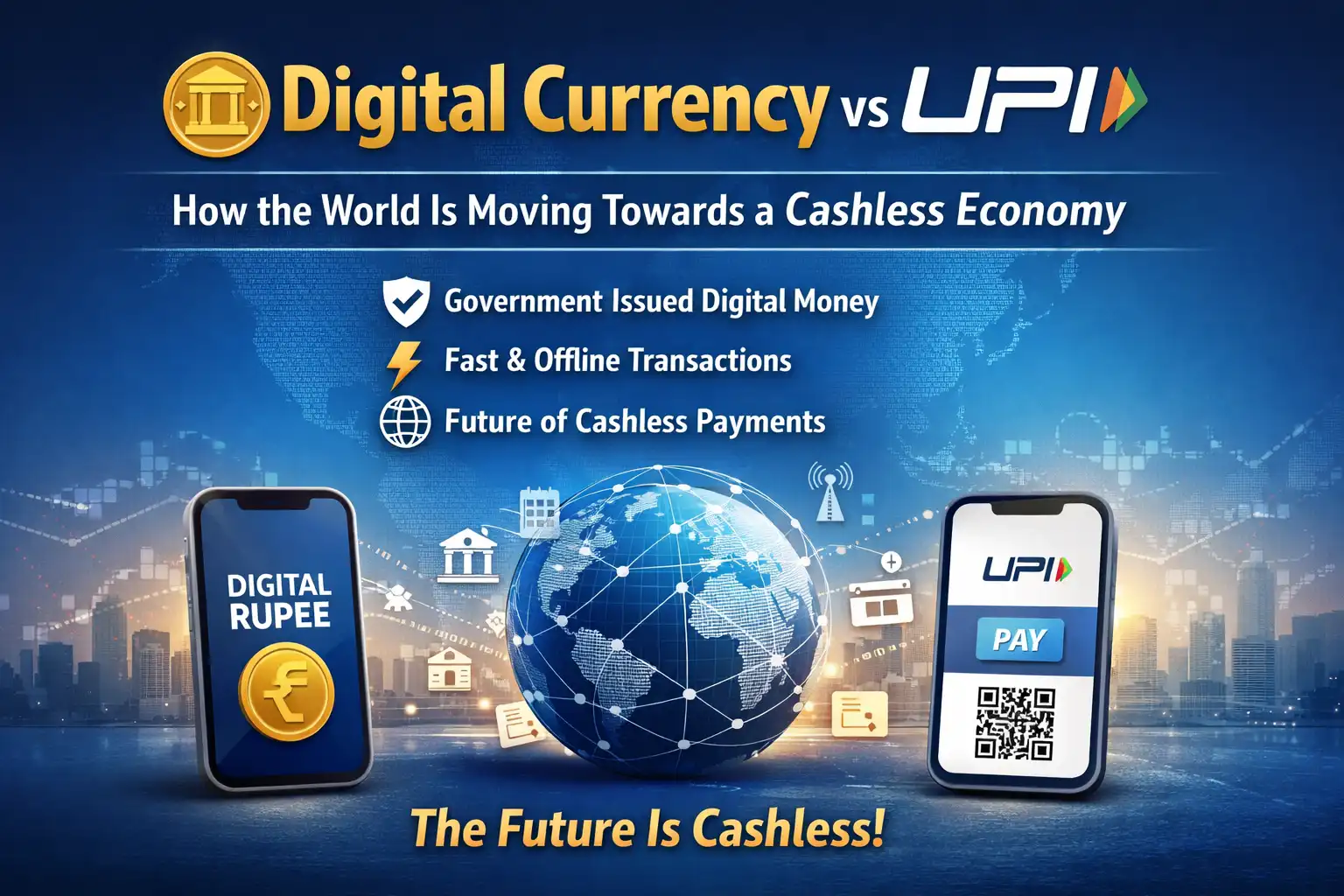
- India: Digital Rupee (e₹)
- China: Digital Yuan
- Europe and the USA are also developing their own digital currencies
In simple terms:
CBDC = digital form of cash
➡️ Issued by the government
➡️ Legal tender
➡️ Safe and reliable
Digital Rupee in India
India is already a leader in digital payments.
Key Points:
- RBI has launched a Digital Rupee Wallet pilot
- Testing is ongoing in select banks and cities
- Both retail and wholesale models are being explored
Strong foundation in India:
- UPI and mobile banking
- Aadhaar and Jan Dhan accounts
- Rapid internet expansion
India is therefore well-positioned for a cashless economy.
💳 Difference Between Online Payments (NEFT / RTGS / UPI) and Digital Currency
What are online payments?
NEFT, RTGS, and UPI are bank-based systems to transfer money.
- NEFT: Transfers may take a few hours
- RTGS: Real-time transfer for large amounts
- UPI: Instant payments via mobile for small or large transactions
How is digital currency different?
- No bank required
- Online payments need a bank account
- Digital currency can be stored directly in a wallet
- Government control and legal tender
- UPI/NEFT transactions are bank-dependent
- CBDC is issued by the government and is legal tender
- Transaction speed and cost
- UPI/NEFT may have limits or fees
- Digital currency can be faster and cheaper
- Offline transactions
- Digital wallets may support offline payments
- UPI/NEFT require internet and bank network
Simple summary:
UPI = bank-based digital facility
Digital Currency = government-backed money, independent of banks
👤 How Money Comes Into a Digital Wallet
1️⃣ Bank Account Top-Up
- Users can transfer money from a bank account to a digital wallet
- The money is converted into digital currency in the wallet
2️⃣ Cash to Digital Currency
- For users without a bank account
- Cash can be deposited at government agents, bank counters, or authorized centers
- Equivalent digital currency is credited to the wallet
3️⃣ Peer-to-Peer Transfer
- From one digital wallet to another
- Via QR code scan or wallet ID
- No bank required
4️⃣ Direct Government or Company Payment
- Subsidies, pensions, scholarships, salaries
- Credited directly to the digital wallet
5️⃣ Withdrawing Money
- Digital currency can be transferred back to a bank account
- Or exchanged for cash at authorized centers
Summary:
- Bank account = optional
- Wallet = stores and transacts digital rupees
- Money comes directly from government/central bank
🔑 Benefits of Digital Currency
- Government-backed and secure
- Money is always safe and trustworthy
- Fast and low-cost transactions
- Works for large and small payments efficiently
- Offline transactions possible
- Can work without internet in remote areas
- Transparency
- Reduces tax evasion and black money
- Direct government payments
- Subsidies and pensions straight into wallets
- Business-friendly
- Easy payments through QR codes, POS, and mobile apps
- Bank-independent transactions in the future
- Gradually reduces dependency on traditional banks
⚠️ Challenges and Risks
- Cybersecurity
- Strong protection is needed for wallets and CBDC networks
- Digital fraud
- Fake wallets and scams may arise
- Technology access
- Remote and internet-deprived areas may face difficulties
- Adoption and change
- People will take time to shift from cash
Future Outlook
In the next 5–10 years:
- Widespread adoption of CBDC
- Direct government payments into wallets
- Reduced bank dependency
- Faster, cheaper, and more transparent transactions
- Cash will be limited to emergencies and rural areas
Outcome
Digital currency and a cashless economy are no longer a distant idea — they are becoming a reality.
- Convenient, fast, and secure
- Works alongside UPI and bank systems
- Direct government payments possible
- Bank-independent transactions becoming feasible
Countries like India, with strong digital infrastructure, are likely to accelerate their journey towards a cashless economy.
The real question now is not whether digital currency will arrive, but how ready we are to adopt it.