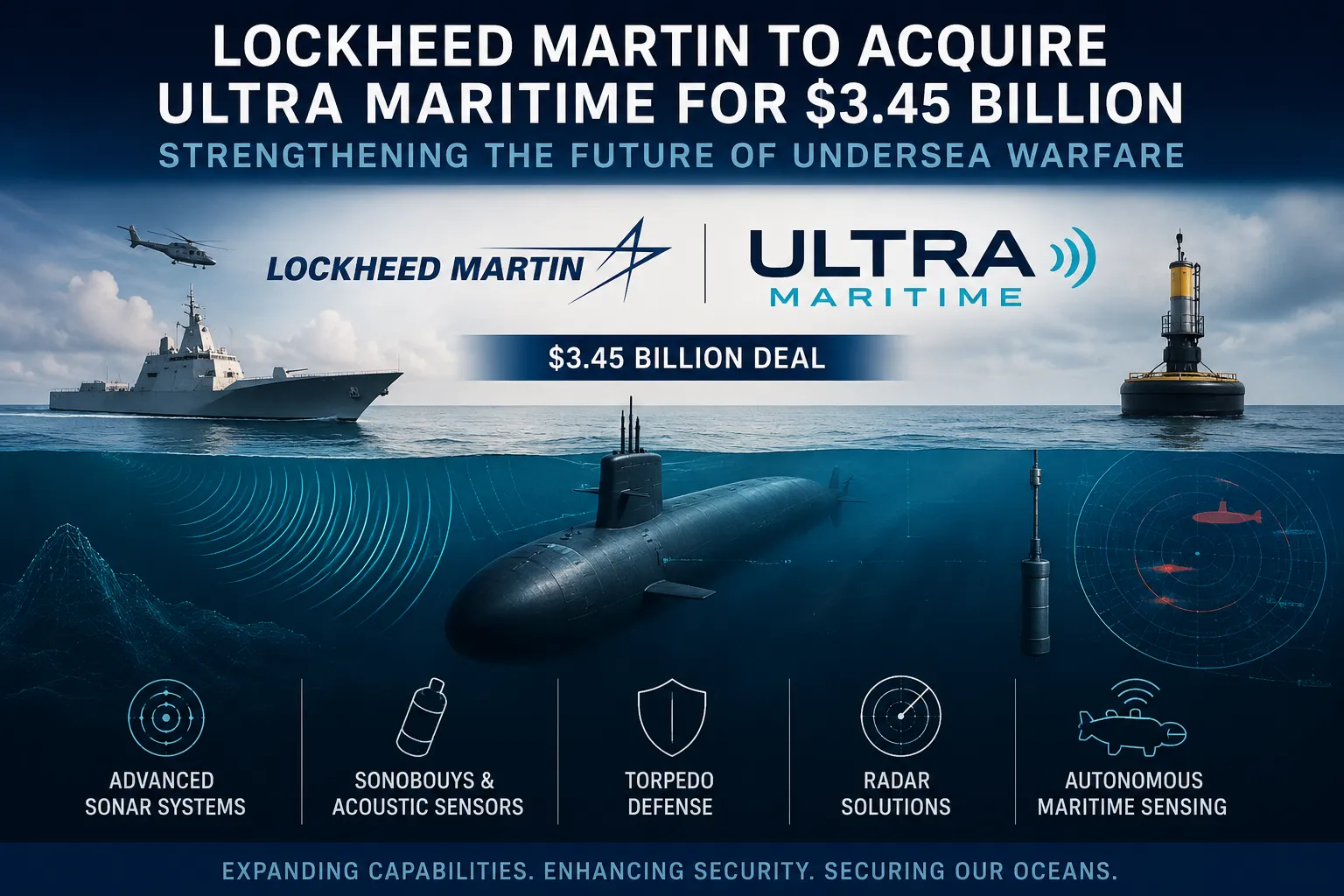
Lockheed Martin has agreed to acquire Ultra Maritime, a specialist in undersea and anti-submarine warfare technology, for $3.45 billion. The deal will bring Ultra Maritime’s sonar, sonobuoy, torpedo-defense, radar and autonomous maritime sensing capabilities into Lockheed Martin’s portfolio.
The acquisition is strategically important because modern naval warfare is increasingly moving below the surface. Submarines are becoming quieter, unmanned underwater vehicles are expanding, and navies need better systems to detect, track and defend against underwater threats.
For Lockheed Martin, the deal is therefore not simply about adding another defense business. It is about strengthening its position in one of the fastest-developing areas of naval defense: undersea warfare and anti-submarine warfare (ASW).
M&A Deal Snapshot
| Deal Detail | Information |
| Announcement Date | July 6, 2026 |
| Acquirer | Lockheed Martin |
| Target | Ultra Maritime |
| Seller/Owner | Cobham Ultra / Advent International |
| Deal Type | Acquisition |
| Deal Value | $3.45 billion |
| Industry | Defense & Aerospace |
| Target Focus | Undersea & Anti-Submarine Warfare |
| Acquirer Exchange | NYSE |
| Acquirer Ticker | LMT |
| Post-Closing Business | Lockheed Martin Rotary and Mission Systems |
| Status | Announced; closing pending |
Lockheed Martin Signs $3.45 Billion Ultra Maritime Deal
On July 6, 2026, Lockheed Martin announced that it had signed a definitive agreement to acquire Ultra Maritime from Cobham Ultra, an Advent International portfolio company, for approximately $3.45 billion.
After the transaction closes, Ultra Maritime will become part of Lockheed Martin’s Rotary and Mission Systems (RMS) business area.
Lockheed Martin said Ultra Maritime’s international presence and its exportable anti-submarine warfare technologies will complement and expand Lockheed’s existing sonar capabilities across next-generation maritime platforms.
As of August 14, 2026, the transaction should be described as an announced acquisition rather than a completed acquisition, because no official closing announcement was found in the latest company information reviewed.
Lockheed Martin: Company Introduction
Lockheed Martin is one of the world’s largest defense and aerospace companies and is listed on the New York Stock Exchange under the ticker LMT.
The company develops military and aerospace technologies across areas such as:
- Fighter aircraft
- Missile systems
- Air and missile defense
- Space systems
- Radar and sensors
- Naval systems
- Autonomous technologies
- Command and control systems
Its Rotary and Mission Systems business is particularly relevant to this acquisition because it already works on naval platforms, sensors, combat systems and other mission-critical defense technologies.
In 2025, the RMS business generated approximately $17.3 billion in revenue and employed around 35,000 people globally, according to Reuters.
Ultra Maritime: Company Introduction
Ultra Maritime is a defense technology company focused mainly on undersea warfare and anti-submarine warfare.
In simple terms, the company develops technologies that help navies answer three important questions:
- Where is an enemy submarine?
- What is happening underwater?
- How can a ship or submarine protect itself from an underwater attack?
Its technology portfolio includes:
- Sonar systems
- Sonobuoys
- Towed sonar arrays
- Hull-mounted sonar
- Torpedo-defense systems
- Radar solutions
- Autonomous maritime sensing technologies
Ultra Maritime has operations and manufacturing facilities across countries including the United States, United Kingdom, Canada and Australia.
Who Owns Ultra Maritime Before the Acquisition?
Before the Lockheed Martin transaction, Ultra Maritime was part of Cobham Ultra, which is backed by private-equity firm Advent International.
Advent acquired Ultra Maritime in 2022 and subsequently invested heavily in the business.
According to Advent, it invested approximately $170 million over the past three years in product development, engineering and manufacturing capabilities.
The objective was to increase production capacity, improve delivery times and develop next-generation undersea technologies.
This is important because Lockheed Martin is not acquiring a business in exactly the same condition that Advent originally bought. The business has undergone significant investment and operational development before being sold.
What Exactly Is Lockheed Martin Buying?
Lockheed Martin is acquiring the Ultra Maritime business, including its technology portfolio, engineering capabilities, manufacturing operations and customer relationships.
The most strategically important assets are its undersea sensing and anti-submarine warfare technologies.
1. Sonar Technology
Sonar is one of the most important technologies in submarine warfare.
It uses sound waves underwater to detect and track objects.
For example, a naval vessel can use sonar to identify whether something underwater could be a submarine.
Ultra Maritime produces different types of sonar technologies, including hull-mounted and towed sonar systems.
Its hull-mounted sonar arrays are designed to provide continuous underwater detection and tracking.
2. Sonobuoys
Sonobuoys are small sensor systems that can be deployed into the ocean to detect underwater sounds.
They are particularly important for aircraft conducting anti-submarine warfare missions.
Once deployed, they can collect acoustic information that helps military forces locate and track submarines.
Ultra Maritime has been developing next-generation sonobuoy technology, including multistatic active receive systems. In June 2026, the company announced the first deployment of one of its next-generation multistatic active receive sonobuoys in the UK.
3. Torpedo Defense
A submarine is not the only underwater threat.
Torpedoes can also threaten naval ships and submarines.
Ultra Maritime develops systems designed to detect and counter these threats.
In 2026, the company highlighted its layered torpedo-defense capabilities and received U.S. Navy-related development work for next-generation acoustic countermeasure technology.
4. Autonomous Maritime Sensing
This is one of the most interesting parts of the acquisition.
Future naval warfare is expected to use more unmanned underwater vehicles and autonomous sensing systems.
Ultra Maritime has been developing autonomous maritime sensing capabilities and has worked with defense technology companies on next-generation anti-submarine warfare concepts.
This gives Lockheed Martin an opportunity to combine Ultra Maritime’s underwater sensing technology with its own broader autonomous and defense platforms.
Why Does Lockheed Martin Want Ultra Maritime?
The main reason is undersea warfare.
Lockheed Martin already has significant defense capabilities, but acquiring Ultra Maritime gives it deeper expertise in a specialized area.
The acquisition can be understood through four major strategic objectives.
1. Strengthening Anti-Submarine Warfare
Detecting modern submarines is becoming increasingly difficult because advanced submarines can operate quietly and remain hidden underwater.
That makes sophisticated sonar and acoustic sensing extremely valuable.
Ultra Maritime gives Lockheed Martin additional expertise in exactly this area.
2. Expanding Sonar Capabilities
Lockheed Martin already has sonar capabilities.
Ultra Maritime adds additional sonar technologies, including:
- Hull-mounted sonar
- Towed sonar arrays
- Sonobuoys
- Acoustic sensing
- Torpedo countermeasures
The combination could allow Lockheed Martin to offer a broader undersea warfare solution to naval customers.
3. Increasing Exposure to Autonomous Underwater Warfare
Naval warfare is increasingly moving toward unmanned systems.
Instead of relying only on large crewed ships and submarines, future forces are likely to use networks of:
- Unmanned underwater vehicles
- Autonomous sensors
- Unmanned surface vessels
- Airborne surveillance systems
- Distributed sonar networks
Ultra Maritime’s sensing technology could become an important component of this larger ecosystem.
4. Supporting U.S. and Allied Navies
Ultra Maritime already has an international footprint.
Its technologies are used or developed for naval customers across countries such as the United States, United Kingdom, Canada and Australia.
These countries are also part of the broader Five Eyes security partnership.
For Lockheed Martin, this international footprint can provide additional opportunities to supply integrated maritime defense solutions to allied countries.
Ultra Maritime’s Recent Technology Developments Make the Deal More Interesting
The acquisition comes after a period of technological development at Ultra Maritime.
For example, in July 2026, Ultra Maritime announced a successful demonstration of its Sea Spear counter-unmanned-undersea-vehicle capability during the U.S. Navy’s Lanternfish 2026 exercise.
This is significant because underwater drones are becoming an increasingly important part of modern naval warfare.
The ability to detect and counter unmanned underwater vehicles could become an important future defense market.
Ultra Maritime’s Revenue Growth
Another reason the business attracted strategic interest is its growth.
Industry reporting cited by the Financial Times estimated that Ultra Maritime’s revenue could rise from approximately $494 million in 2023 to around $784 million in 2026.
That represents substantial growth over a relatively short period.
Advent’s investment also helped increase manufacturing capacity and accelerate product development.
This means Lockheed Martin is acquiring not only technology but also a business that has been expanding its operational capabilities.
The Deal Looks Expensive — But Why?
At first glance, $3.45 billion is a significant amount for a company whose 2026 revenue is estimated at around $784 million.
However, defense acquisitions are not valued only on current revenue.
Strategic technology, long-term military contracts, intellectual property, customer relationships, production capabilities and future defense spending can all influence the valuation.
The acquisition price is roughly 4.4 times estimated 2026 revenue, based on the $784 million revenue estimate.
That is not necessarily cheap, but Lockheed Martin is buying capabilities that could be strategically important for decades.
What Does Lockheed Martin Get Strategically?
The biggest benefit is the combination of technology + customers + manufacturing + defense programs.
Lockheed Martin can potentially combine:
Ultra Maritime’s
- Sonar
- Sonobuoys
- Acoustic sensors
- Torpedo defense
- Underwater sensing
with its own:
- Naval systems
- Combat systems
- Missiles
- Sensors
- Aircraft
- Autonomous technologies
- Command and control systems
This could allow Lockheed Martin to build more integrated maritime defense solutions instead of selling individual technologies.
Why Undersea Warfare Is Becoming More Important
The world’s oceans contain critical military and economic infrastructure.
Submarines remain important strategic assets, while underwater drones and autonomous systems are becoming more capable.
At the same time, countries are investing more heavily in protecting:
- Naval fleets
- Submarine forces
- Undersea communication cables
- Energy infrastructure
- Ports
- Strategic maritime routes
This is creating greater demand for underwater surveillance and detection technologies.
The broader defense industry is responding to this trend through acquisitions and investments in maritime technology.
For example, in July 2026, Thales also announced a major acquisition involving Exail Technologies, another maritime technology company. Together, the deals demonstrate how major defense companies are increasing their focus on maritime and undersea capabilities.
What Happens After the Acquisition?
Once the transaction closes, Ultra Maritime is expected to become part of Lockheed Martin’s Rotary and Mission Systems business.
This should give Lockheed Martin direct control over Ultra Maritime’s technology, engineering and manufacturing operations.
The key question will then be how effectively Lockheed integrates the business without disrupting existing customer relationships and production programs.
Lockheed Martin will also need to manage regulatory and other customary closing requirements before the transaction can be completed.
Impact on Lockheed Martin
Positive Impact
The acquisition could provide Lockheed Martin with:
- Stronger undersea warfare capabilities
- Broader sonar technology
- More anti-submarine warfare expertise
- Additional international naval relationships
- Greater exposure to autonomous underwater systems
- More technology for future naval platforms
It also strengthens the company’s position in a specialized defense market where technological barriers to entry are high.
Potential Challenges
The acquisition also has risks.
First, Lockheed Martin needs to successfully integrate Ultra Maritime.
Second, defense programs can have long development cycles and complex procurement processes.
Third, the $3.45 billion purchase price means Lockheed needs to generate enough future growth and strategic value from the business to justify the investment.
Finally, defense acquisitions involving sensitive technologies can face regulatory and national-security scrutiny.
Impact on Ultra Maritime
For Ultra Maritime, joining Lockheed Martin could provide access to a much larger defense ecosystem.
The company could potentially benefit from:
- Greater financial resources
- Larger manufacturing capabilities
- Lockheed Martin’s global customer network
- Integration with larger defense platforms
- More investment in research and development
For employees and customers, the major question will be how much operational independence Ultra Maritime maintains after integration.
Impact on the Defense Industry
This acquisition is bigger than just one company buying another.
It reflects a broader trend in the defense industry.
Defense companies are increasingly looking for specialized technology businesses that can provide capabilities in areas such as:
- Autonomous systems
- Artificial intelligence
- Cybersecurity
- Undersea warfare
- Sensors
- Drones
- Electronic warfare
The Lockheed Martin–Ultra Maritime transaction fits directly into this trend.
The core transaction details come from Lockheed Martin and Advent’s July 6 announcements.
Is This a Strategic Acquisition?
Yes.
This looks more like a capability-driven acquisition than a simple revenue-expansion deal.
Lockheed Martin is paying $3.45 billion to gain specialized expertise in an area where future military demand is likely to remain strong.
The most valuable part of Ultra Maritime may not be its current revenue. The bigger value is its combination of underwater sensing, sonar, anti-submarine warfare and autonomous maritime technology.
The acquisition also fits Lockheed Martin’s existing defense portfolio, which could create opportunities for cross-selling and technology integration.
In simple words:
Lockheed Martin already has the large defense platform. Ultra Maritime adds specialized underwater eyes and ears.
That combination could become increasingly important as naval warfare moves toward a network of crewed and unmanned systems.
Outcome
Lockheed Martin’s $3.45 billion acquisition of Ultra Maritime is a major move into advanced undersea warfare.
Ultra Maritime brings specialized sonar, sonobuoys, torpedo-defense systems, radar and autonomous maritime sensing capabilities. Lockheed Martin, meanwhile, provides the scale, defense platforms and global customer network needed to potentially expand these technologies.
The most important opportunity is the growing role of underwater sensing and autonomous maritime systems.
If the acquisition closes successfully and the two businesses are integrated effectively, Lockheed Martin could emerge with a significantly stronger position in anti-submarine warfare and next-generation undersea defense.
Source: Lockheed Martin, Ultra Maritime/Advent International and Reuters.