Critical minerals are becoming increasingly important for electric vehicles, batteries, renewable energy, electronics, defense systems and even AI infrastructure. But finding these minerals is only one part of the supply chain. They also need to be processed and refined before companies can use them.
This is where Nth Cycle is trying to build its business.
Nth Cycle is a U.S.-based critical-mineral refining company that has developed a technology called OYSTER for processing materials containing metals such as nickel, cobalt, copper and rare earth elements. The company wants to build more refining capacity in the U.S. and other Western markets.
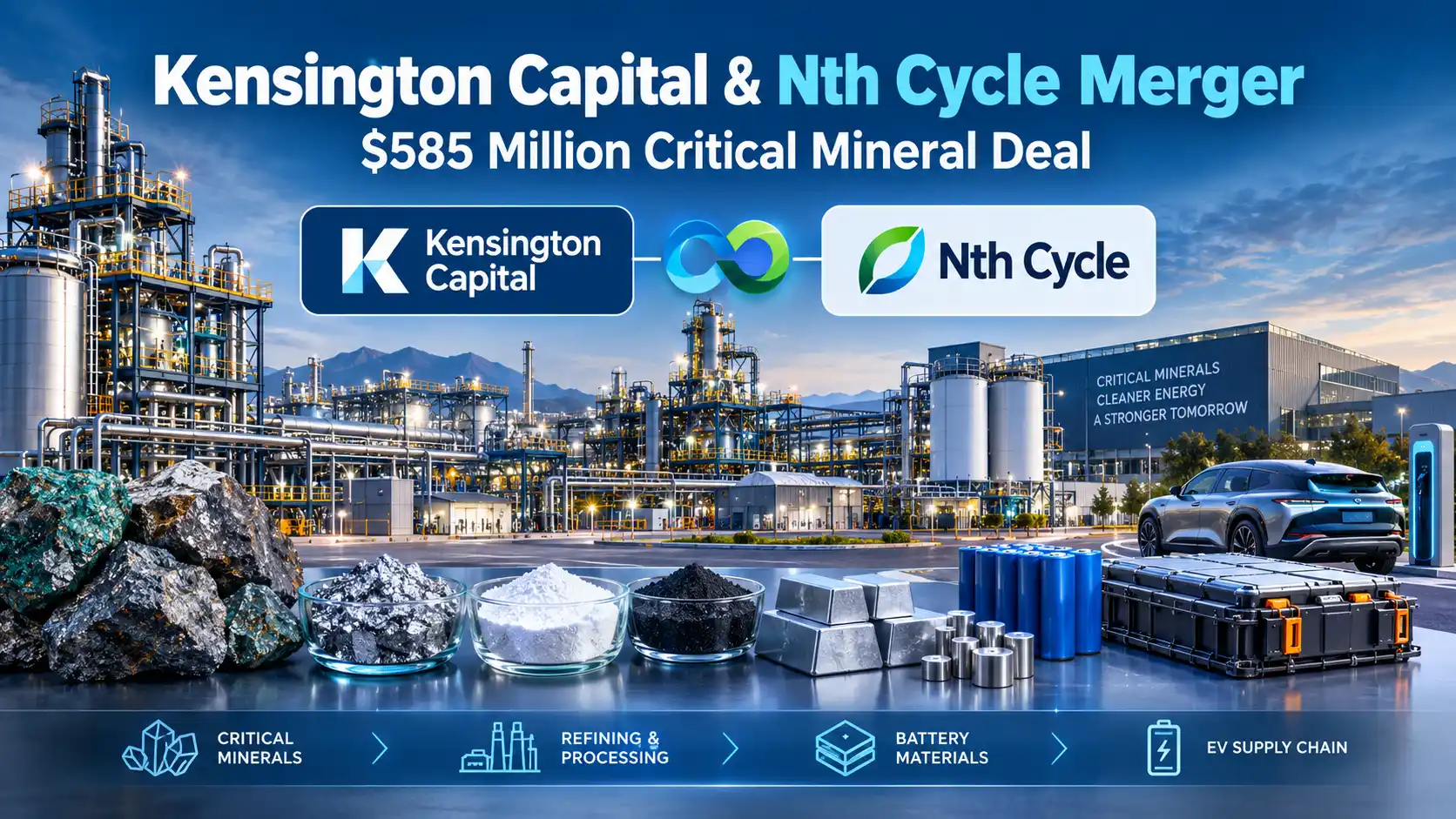
Now, Nth Cycle is taking an important step toward becoming a publicly traded company. The company has agreed to combine with Kensington Capital Acquisition Corp. VI, a SPAC listed on the New York Stock Exchange.
The proposed transaction values Nth Cycle at an implied enterprise value of approximately $585 million. If the deal is completed, the combined company is expected to be named Nth Cycle Holdings, Inc. and its shares are expected to trade on the NYSE under the ticker NTH.
The transaction is expected to close in the fourth quarter of 2026, subject to shareholder approvals, regulatory review and other closing conditions.
Nth Cycle Moves Closer to Becoming a Public Company
The Kensington and Nth Cycle transaction was announced in July 2026.
On August 7, 2026, the companies announced that they had confidentially submitted a draft Form S-4 registration statement to the U.S. Securities and Exchange Commission (SEC).
This is an important step because the S-4 process is part of the regulatory and shareholder-approval process required for the proposed business combination. Kensington shareholders will ultimately be asked to vote on the transaction.
The deal has not yet been completed. The companies currently expect closing in Q4 2026, provided the required conditions are satisfied.
Deal Snapshot
| Detail | Information |
| Acquirer / SPAC | Kensington Capital Acquisition Corp. VI |
| Target | Nth Cycle, Inc. |
| Deal Type | SPAC Business Combination / Merger |
| Announcement Date | July 22, 2026 |
| Implied Enterprise Value | Approximately $585 million |
| Expected New Company | Nth Cycle Holdings, Inc. |
| Expected Stock Exchange | NYSE |
| Target Industry | Critical Mineral Refining / Metals & Mining |
| Expected Ticker | NTH |
| Acquirer / SPAC Exchange | NYSE |
| Acquirer / SPAC Ticker | KCAC |
| Potential Trust Proceeds | Up to $230 million, subject to redemptions |
| Potential PIPE Financing | Up to $100 million |
| PIPE Committed at Announcement | $40 million |
| Expected Closing | Q4 2026 |
The $585 million figure represents the proposed transaction’s implied enterprise value. It should not be interpreted as $585 million of cash being paid directly to Nth Cycle.
What Is the Kensington Capital and Nth Cycle Merger?
In simple terms, Nth Cycle wants to become a public company without going through a traditional IPO.
It is doing this through a business combination with Kensington Capital Acquisition Corp. VI.
Kensington is a Special Purpose Acquisition Company, or SPAC. A SPAC raises money in the public market and later uses that structure to combine with a private company.
In this case, the private company is Nth Cycle.
Under the proposed transaction, Kensington will eventually change its name to Nth Cycle Holdings, Inc. The combined company’s common stock is expected to trade on the NYSE under the symbol NTH.
Company Introduction
What Is Nth Cycle?
Nth Cycle is a critical-mineral refining company founded in 2017.
The company focuses on the part of the mineral supply chain that comes after mining or collection of mineral-containing materials.
For example, minerals can be present in:
- Mined materials
- Battery recycling materials
- Industrial scrap
- Black mass from used batteries
- Other mineral-containing feedstocks
These materials still need to be processed before the metals can be used in industrial applications.
Nth Cycle has developed its electroextraction technology and OYSTER system to perform this refining process.
The company’s main focus areas include rare earth elements, copper and battery materials.
What Is Kensington Capital Acquisition Corp. VI?
Kensington Capital Acquisition Corp. VI is a SPAC.
Unlike a normal operating company, a SPAC is created mainly to raise capital and later complete a business combination with a private company.
Kensington entered into the Business Combination Agreement with Nth Cycle on July 21, 2026.
Under the agreement, Kensington is expected to change its corporate structure and eventually become Nth Cycle Holdings, Inc. after the transaction closes.
Why Does Nth Cycle Want to Go Public?
Going public can give Nth Cycle access to additional capital and a public-market platform to support its expansion. This is particularly relevant because the company wants to build more critical-mineral refining capacity.
Nth Cycle says its technology is designed to make refining facilities:
- Smaller
- More modular
- Faster to deploy
- Less capital intensive
- Capable of processing different feedstocks
The company says its system can reduce capital intensity by upwards of 70% compared with conventional refining approaches. This is a company-reported figure rather than an independent performance guarantee.
What Is Nth Cycle’s OYSTER Technology?
One of the most important parts of the company is its OYSTER system.
OYSTER is based on Nth Cycle’s proprietary electroextraction platform.
In simple language, the technology is designed to take materials containing valuable metals and separate and refine those metals into usable products.
The company is targeting metals including:
- Nickel
- Cobalt
- Copper
- Lithium
- Rare earth elements
These materials are important for batteries, electric vehicles, power infrastructure, electronics, defense and other industries.
Nth Cycle’s strategy is to use a modular system rather than relying only on very large traditional centralized refineries.
Why Critical-Mineral Refining Is Important
A mineral may exist naturally in large quantities, but that does not mean manufacturers can immediately use it.
There are several steps between a mineral resource and a finished industrial material.
Basic Supply Chain
Mining / Recycling → Processing → Refining → Industrial Material → Manufacturing
Refining is therefore a key part of the supply chain.
This has become especially important as countries try to reduce their dependence on foreign processing and create more domestic supply chains for critical materials.
Nth Cycle is specifically targeting this refining and processing gap.
Which Minerals Does Nth Cycle Target?
1. Battery Materials
Nth Cycle is working with battery-related materials including nickel and cobalt.
These materials are important for batteries used in electric vehicles and energy-storage systems.
The company also works with lithium-related materials.
2. Copper
Copper is becoming increasingly important because of rising demand for electricity infrastructure.
Copper is widely used in:
- Power grids
- Electric vehicles
- Data centers
- Electrical equipment
- Renewable-energy infrastructure
The growth of AI data centers is also increasing demand for electricity infrastructure, which indirectly supports the importance of copper supply chains.
3. Rare Earth Elements
Rare earth elements are used in areas such as:
- Permanent magnets
- Electric motors
- Electronics
- Defense systems
- Advanced industrial equipment
Nth Cycle is also developing its rare-earth business through partnerships.
In May 2026, the company announced a development and licensing agreement with Ionic Rare Earths focused on rare-earth refining.
How Much Is the Kensington-Nth Cycle Deal Worth?
The proposed transaction gives Nth Cycle an implied enterprise value of approximately $585 million.
However, there is an important point to understand. The $585 million is not simply the amount of money that Kensington will pay Nth Cycle. Enterprise value is a broader measure that takes into account the value of the business and its capital structure.
The transaction value assumes no redemptions by Kensington shareholders and includes estimated transaction expenses.
How Much Capital Could Nth Cycle Receive?
The proposed transaction includes two major potential sources of funding.
Kensington Trust
The combined company is expected to have access to up to $230 million from Kensington’s trust, although the final amount can be affected by shareholder redemptions.
PIPE Financing
The transaction also includes a proposed common-stock PIPE of up to $100 million.
At the time of the transaction announcement, $40 million had already been committed by new and existing investors.
This financing could help Nth Cycle expand its refining operations.
Nth Cycle’s Commercial Operations
Nth Cycle is not only developing refining technology. The company has already moved its technology toward commercial operations.
Its OYSTER system has been developed for processing materials such as battery-related feedstocks and industrial scrap.
The company’s goal is to create a network of smaller refining facilities that can be located closer to sources of feedstock and customers.
This is different from the traditional model of relying only on large centralized refining facilities.
$1.1 Billion Trafigura Offtake Agreement
One of the most important commercial developments for Nth Cycle came in March 2026.
Nth Cycle announced a 10-year offtake agreement with Trafigura valued at approximately $1.1 billion.
An offtake agreement means that a buyer agrees to purchase future production under an agreed commercial arrangement.
According to Nth Cycle, the agreement covers production involving:
- Nickel
- Lithium
- Recycled battery materials
The agreement gives Nth Cycle a potential long-term commercial customer as it expands its refining activities.
U.S. Government Support Could Also Help Expansion
Another important part of Nth Cycle’s growth plan is government support for domestic critical-mineral supply chains. The company has been pursuing projects designed to increase U.S. refining capacity.
This is important because governments in the U.S. and other Western countries are increasingly focused on building domestic and allied supply chains for critical minerals. Nth Cycle’s business model fits into this broader trend because the company is focused specifically on the refining stage of the supply chain.
What Will Happen After the Merger?
If the transaction receives all required approvals and closes, several changes are expected.
Current Structure
Kensington Capital Acquisition Corp. VI
↓
After Closing
Nth Cycle Holdings, Inc.
↓
Expected Listing
NYSE: NTH
The transaction documents state that Kensington will domesticate from a Cayman Islands company into a Delaware corporation before closing.
What Is the Expected Timeline?
The companies announced the business combination in July 2026. In August, they announced the confidential submission of the draft S-4 registration statement.
The next stages include:
- SEC review
- Registration statement process
- Shareholder approval
- Satisfaction of closing conditions
- Completion of the business combination
- Public listing of the combined company
The companies currently expect the transaction to close in Q4 2026.
Why This Deal Matters for the EV and AI Industries
At first glance, this may look like a normal SPAC transaction. But Nth Cycle operates in an area connected to several major technology trends.
Electric Vehicles: EV batteries require large quantities of critical materials.
Energy Storage: Large-scale batteries also require processed mineral materials.
AI Infrastructure: AI data centers require huge amounts of electricity and supporting infrastructure, increasing the importance of materials such as copper.
Defense: Rare earth elements and other critical minerals are important for advanced defense technologies.
This means Nth Cycle is targeting a market that connects several major industrial trends.
What Are the Main Opportunities?
The main opportunity for Nth Cycle is to successfully scale its refining technology. The company is attempting to build a different model for critical-mineral processing based on modular facilities.
If the technology can be deployed successfully across multiple locations, the company could potentially build a broader refining network.
The proposed public listing could also give Nth Cycle access to public capital markets to support this expansion.
However, these are future possibilities and depend on successful execution.
Key Risks to Watch
The merger also comes with several risks.
1. Merger Is Not Completed Yet
The Kensington-Nth Cycle transaction is still a proposed business combination.
It requires shareholder approval and other closing conditions before it can be completed.
2. Shareholder Redemptions
The potential $230 million from Kensington’s trust is subject to shareholder redemptions.
Higher redemptions could reduce the cash available to the combined company.
3. Scaling Risk
Developing a technology is one thing; deploying it across multiple commercial facilities is another.
Nth Cycle will need to demonstrate that its technology can operate reliably and economically at larger scale.
4. Commodity Prices
The economics of mineral refining can be affected by prices for nickel, lithium, cobalt, copper and rare earth materials.
5. Capital Requirements
Building refining facilities requires significant capital.
The company will need sufficient financing to execute its expansion plans.
Kensington and Nth Cycle Merger: What Investors Should Understand
The most important point is that this is not simply a $585 million acquisition.
It is a proposed SPAC business combination that is designed to take Nth Cycle public.
The transaction could give Nth Cycle access to significant capital while providing Kensington with an operating business focused on critical-mineral refining.
The company is targeting three major areas:
Critical minerals + domestic refining + recycling
Its OYSTER technology is central to the business strategy, while the Trafigura offtake agreement and potential government-supported projects could provide additional commercial opportunities.
The key issue going forward will be execution: whether Nth Cycle can successfully scale its refining technology, secure sufficient feedstock and financing, and turn its commercial agreements and projects into sustainable operations.
If the transaction closes as planned, Nth Cycle Holdings is expected to begin trading on the NYSE under the ticker NTH.
Conclusion
The Kensington Capital and Nth Cycle transaction is part of a larger push to build more secure critical-mineral supply chains in the United States and other Western markets.
Nth Cycle is trying to solve an important problem: minerals are valuable only after they can be processed into usable industrial materials.
Through its OYSTER refining technology, the company is targeting battery materials, copper and rare earth elements. At the same time, the proposed Kensington transaction could provide the company with access to public-market capital for future expansion.
Source: Nth Cycle official announcements and U.S. SEC filings.