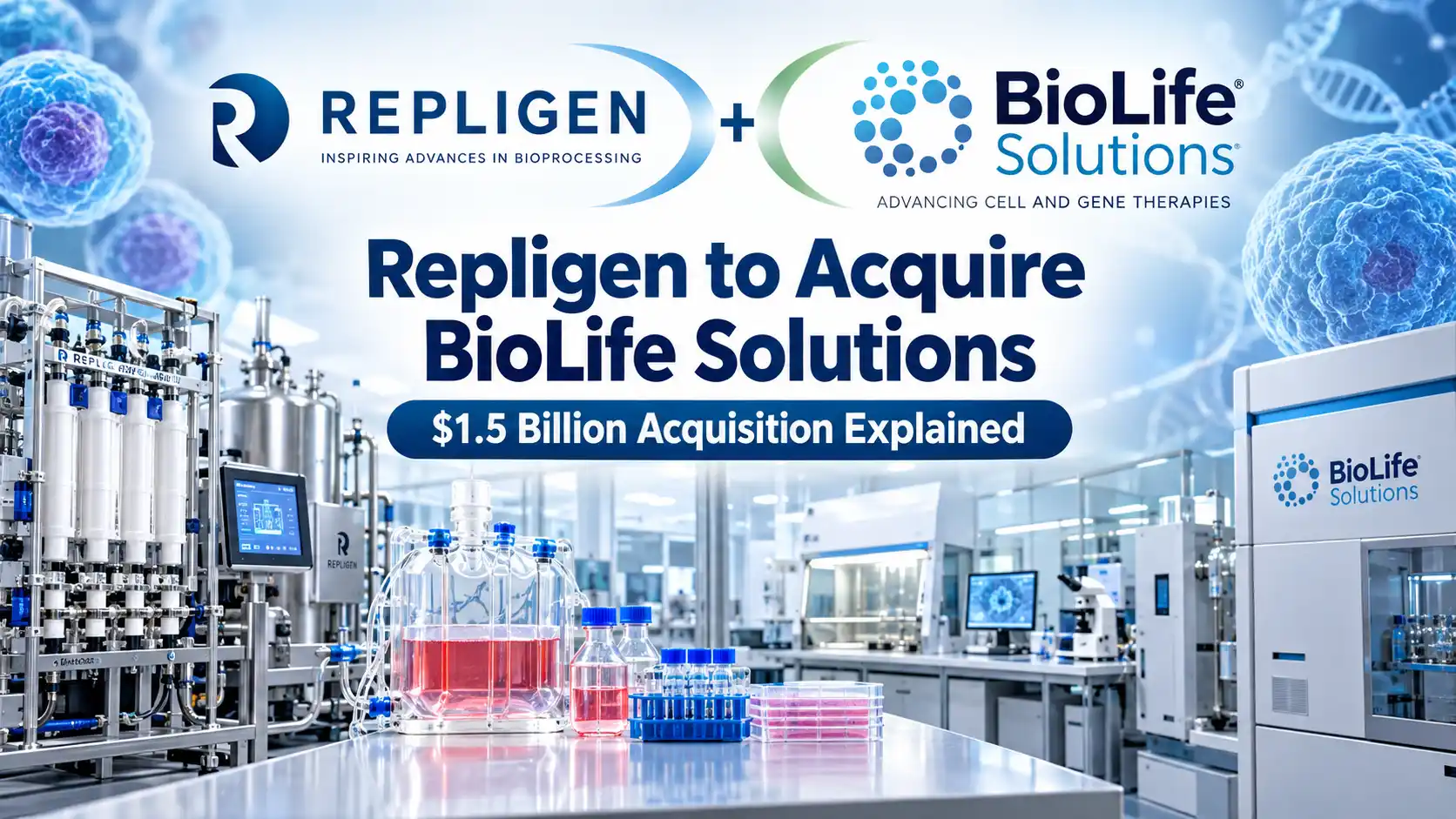
Repligen Corporation has agreed to acquire BioLife Solutions in a cash-and-stock transaction with an approximate $1.5 billion enterprise value.
The agreement was announced on July 22, 2026. Under the deal, BioLife shareholders are set to receive $11.25 in cash plus 0.1442 Repligen shares for each BioLife share, representing a stated transaction value of $31 per BioLife share at announcement.
The latest important development came on September 3, 2026, when the Hart-Scott-Rodino antitrust waiting period expired. This removes one major regulatory condition, but the acquisition still requires other closing conditions, including approval by BioLife shareholders.
BioLife has scheduled its special shareholder meeting for October 5, 2026, at 9:00 a.m. ET, where shareholders will vote on the merger proposal.
Deal Snapshot
| Deal Detail | Information |
| Acquirer | Repligen Corporation |
| Target | BioLife Solutions, Inc. |
| Announcement Date | July 22, 2026 |
| Deal Type | Acquisition / Merger |
| Approx. Enterprise Value | $1.5 billion |
| Offer per BioLife Share | $11.25 cash + 0.1442 Repligen shares |
| Stated Value per Share | $31.00 |
| Cash Component | 36% |
| Stock Component | 64% |
| Acquirer Ticker | NASDAQ: RGEN |
| Target Ticker | NASDAQ: BLFS |
| Expected Closing | Q4 2026, subject to conditions |
| HSR Waiting Period | Expired September 3, 2026 |
| BioLife Shareholder Vote | October 5, 2026 |
The 64% stock / 36% cash mix and approximately $1.5 billion enterprise value come from the companies’ announced transaction terms.
Why Is Repligen Acquiring BioLife Solutions?
The main reason is cell and gene therapy.
Repligen is already a major supplier of technologies used in biopharmaceutical manufacturing. BioLife, meanwhile, has products that help maintain the quality and viability of biological materials, particularly cells used in cell and gene therapy workflows.
By combining the two businesses, Repligen is seeking to expand its presence in the growing cell-therapy market and offer customers a broader set of products.
Repligen specifically highlighted BioLife’s biopreservation media business, including its CryoStor platform, as an important part of the transaction. The company said CryoStor supports 18 commercially approved therapies and is used in a majority of U.S. commercially sponsored cell-based therapy trials.
What Does BioLife Solutions Do?
BioLife Solutions develops products and services designed to help customers preserve and process biological materials used in cell and gene therapies.
In simple terms, cell and gene therapies involve living biological material. These cells need to remain healthy and functional during collection, processing, storage and transportation.
BioLife’s products are designed to help protect that cellular material throughout these stages.
Its portfolio includes biopreservation media and other cell-processing tools. The company’s website describes its mission around protecting cell integrity so that cell and gene therapies can be developed and delivered successfully.
What Does Repligen Do?
Repligen is a life-sciences company focused primarily on technologies used in bioprocessing and biological drug manufacturing.
Its major areas include:
- Filtration
- Fluid management
- Chromatography
- Process analytics
- Proteins
Its customers include biopharmaceutical companies and contract development and manufacturing organizations, or CDMOs. Repligen’s headquarters are in Waltham, Massachusetts, with manufacturing and operating locations in the U.S. and several European countries.
So, broadly:
Repligen → technologies used in biologics manufacturing
BioLife → technologies that help protect and process cells used in cell and gene therapies
This makes the businesses strategically complementary.
How Much Will BioLife Shareholders Receive?
The transaction has a mixed consideration structure.
For each BioLife share, shareholders are expected to receive:
$11.25 in cash + 0.1442 Repligen shares
The companies announced this as equivalent to $31 per BioLife share based on the transaction terms at announcement.
Importantly, because part of the consideration is Repligen stock, the final economic value of the stock component can move with Repligen’s share price.
The SEC-filed merger documents confirm the same $11.25 cash plus 0.1442 Repligen-share consideration.
$1.5 Billion Deal: Where Does the Money Come From?
The transaction is structured primarily as a stock transaction, with the announced consideration consisting of approximately:
- 64% Repligen common stock
- 36% cash
Repligen said the cash portion would be funded with cash on hand.
The company also said it expected to have more than $300 million of pro forma cash and cash equivalents after the transaction, according to its announcement.
Expected Synergies From the Acquisition
One important part of the deal is the expected cost savings.
Repligen estimates:
- At least $20 million of synergies in Year 1
- At least $30 million in Year 2
The company expects these benefits primarily from areas such as:
- Eliminating duplicated public-company costs
- General and administrative efficiencies
- Manufacturing optimization
- Supply-chain optimization
Repligen also expects opportunities for cross-selling the companies’ products to their respective customer bases, although its initial financial assumptions use only modest revenue synergies.
Why Cell and Gene Therapy Is Important
Cell and gene therapy is an important growth area within the pharmaceutical industry.
Unlike traditional medicines, many cell therapies depend on living cells remaining viable and functional throughout manufacturing and transportation.
That creates demand for specialized products that can:
- Collect biological material
- Process cells
- Preserve cells
- Store cells
- Transport biological material
- Prepare material for therapy manufacturing
BioLife’s products are positioned within these steps.
Repligen therefore sees BioLife as a way to expand its exposure to this part of the biopharmaceutical market.
What Happens After the Acquisition?
The transaction is structured as a two-step merger.
First, one of Repligen’s wholly owned merger subsidiaries would merge with BioLife, with BioLife becoming a wholly owned subsidiary of Repligen.
A second merger would then complete the restructuring under the agreement.
In simple terms, the ultimate result is intended to be:
BioLife Solutions → wholly owned business of Repligen
BioLife shareholders would receive the agreed cash and Repligen stock consideration in connection with the merger.
Current Regulatory Status
This is an important update for the article because the deal is not yet closed.
The U.S. Hart-Scott-Rodino antitrust waiting period expired at 11:59 p.m. ET on September 3, 2026. That satisfies one important regulatory condition.
However, other closing conditions remain. Most importantly, BioLife shareholders still need to adopt the merger agreement.
Next Major Date
October 5, 2026 — BioLife shareholder special meeting
At the meeting, shareholders will vote on the merger proposal and related matters.
Therefore, the correct description at present is:
Repligen has agreed to acquire BioLife Solutions, but the acquisition has not yet closed.
What Could This Deal Mean for Repligen?
From a business perspective, the acquisition could broaden Repligen’s product portfolio in cell therapy.
The company expects the transaction to contribute to:
- Revenue growth
- Adjusted-margin expansion
- Adjusted EPS growth
- Additional recurring consumables revenue
- Greater presence in cell therapy
- Broader customer relationships
Repligen said it expects the transaction to add at least $0.05 to adjusted EPS in year one and at least $0.25 in year two, according to its announcement. These are company projections, not guaranteed outcomes.
What Could Be the Main Challenges?
Although the companies have outlined expected benefits, several risks remain.
1. Deal Completion Risk
The transaction still requires BioLife shareholder approval and satisfaction of other closing conditions.
2. Integration Risk
Combining two companies can create challenges around employees, manufacturing, systems, sales operations and corporate functions.
3. Synergy Risk
The $20 million and $30 million synergy figures are management expectations. Actual savings could be different.
4. Stock Dilution
Because Repligen is using its own shares as part of the consideration, new Repligen shares will be issued. The companies themselves identify potential dilution as one of the transaction risks.
5. Cell-Therapy Market Risk
The expected benefits depend partly on continued growth in cell and gene therapy. Changes in clinical development, regulatory approvals, competition or market adoption could affect the expected opportunity.
What Makes This Acquisition Significant?
The deal is more than simply adding another company to Repligen’s portfolio.
The strategic connection is primarily between bioprocessing + cell therapy.
Repligen already has technologies used during biological drug manufacturing. BioLife brings products focused on preserving and processing cells, especially for cell and gene therapy.
That means the combined company could potentially provide customers with a wider range of technologies across the therapy-development and manufacturing workflow.
Another important point is BioLife’s recurring consumables business. Repligen specifically highlighted the high-margin and recurring nature of this business as an attraction of the transaction.
However, the $1.5 billion valuation and expected synergies should be viewed in the context of the deal still being pending. The September 3 antitrust milestone reduces one regulatory hurdle, but the October 5 shareholder vote and other closing conditions remain.
Bottom Line
Repligen’s proposed $1.5 billion acquisition of BioLife Solutions is aimed at strengthening Repligen’s position in the cell and gene therapy market.
BioLife brings biopreservation media and cell-processing technologies, while Repligen contributes a broader bioprocessing platform and global commercial reach.
The deal was announced in July 2026, and the U.S. HSR antitrust waiting period expired on September 3, 2026. The next major milestone is the BioLife shareholder vote on October 5, 2026. The transaction is currently expected to close in Q4 2026, assuming the remaining conditions are satisfied.
Source: Repligen investor relations and SEC merger filings.