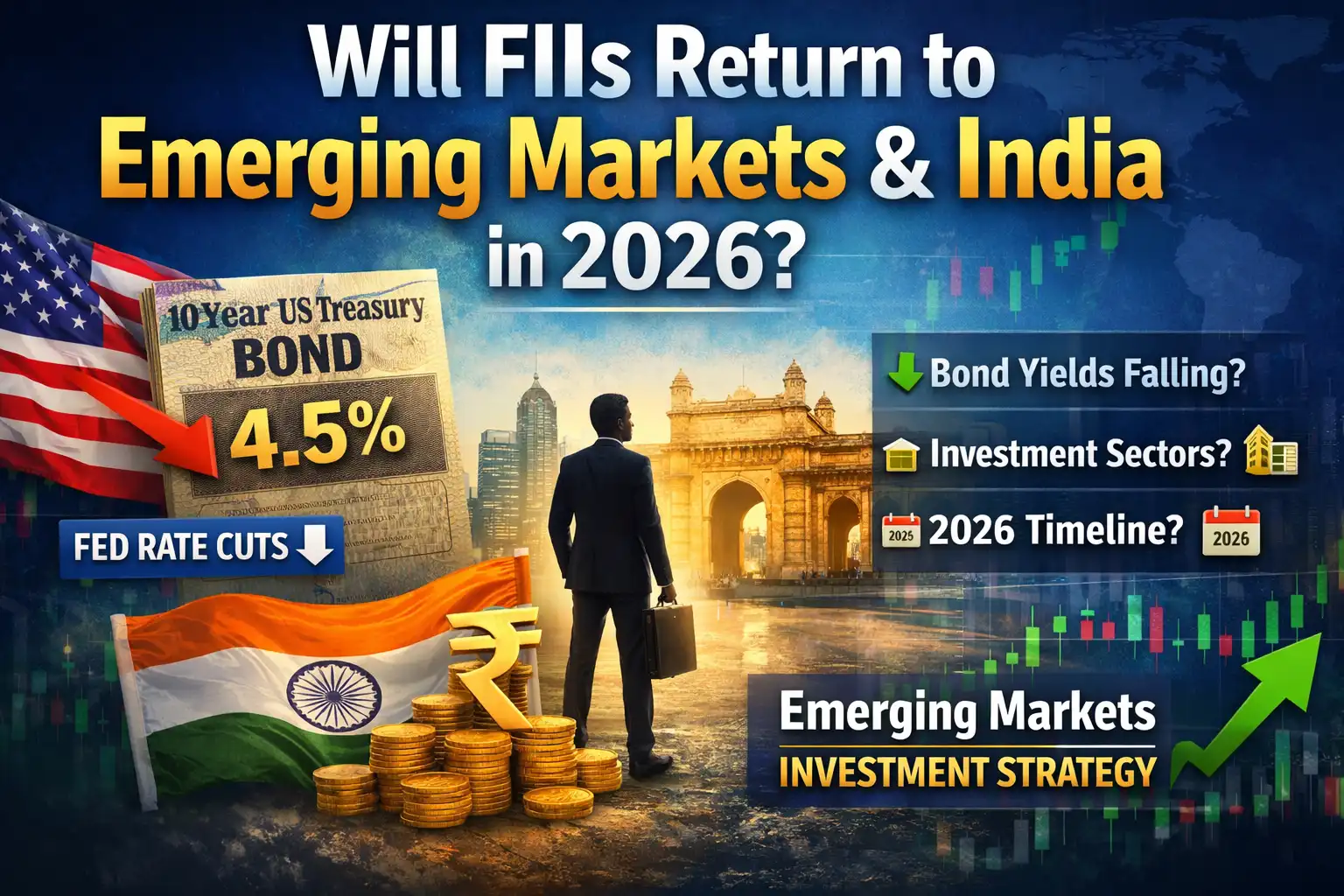
Over the last few years, one question has dominated discussions among Indian investors, analysts, and market watchers: “When will Foreign Institutional Investors (FIIs) return to the Indian stock market?”
Despite India’s strong economic growth, stable banking system, and long-term structural story, FIIs have remained cautious. Even after the US Federal Reserve began cutting interest rates, large and consistent FII inflows have not returned. This has confused many investors, especially retail participants, who assume that Fed rate cuts automatically mean FII buying in emerging markets like India.
But history shows that FIIs do not react to rate cuts alone. Their decisions depend on a combination of US bond yields, inflation expectations, currency stability, risk appetite, and relative returns across global markets.
This article brings together global data trends, historical patterns, and market logic to answer four key questions:
- Why do FIIs exit and re-enter Indian markets?
- What role do US bond yields play?
- Can FIIs return in early 2026 (Jan–Feb)?
- Which sectors and market caps will benefit first?
Who Are FIIs and Why Do They Matter?
FIIs are global investors such as:
- Pension funds
- Sovereign wealth funds
- Global mutual funds
- Hedge funds
They manage large pools of global capital and allocate money based on risk-adjusted returns, not emotions or short-term news.
When FIIs invest in India:
- Liquidity improves
- Valuations expand
- Large caps rally first
- Broader market confidence rises
When they exit:
- Volatility increases
- Mid & small caps underperform
- Currency pressure rises
FII Inflows and Outflows: Historical Pattern
FIIs are highly cyclical. Their movement depends more on global conditions than domestic headlines.
Illustrative FII Equity Flow Pattern (India)
| Period | FII Activity | Global Reason |
| 2010–2012 | Inflows | Low US rates, QE |
| 2013 | Outflows | Taper tantrum |
| 2014–2017 | Strong inflows | Stable yields, growth |
| 2018 | Outflows | Fed tightening |
| 2020–2021 | Heavy inflows | Zero rates, QE |
| 2022–2023 | Massive outflows | Rate hikes, high yields |
| 2024–2025 | Selective flows | Yield uncertainty |
Key Insight:
FIIs leave India not because India is weak, but because other markets become more attractive on a risk-free basis.
The Real Driver: US Bond Yields (Not Just Fed Rates)
Most investors focus on Fed policy rates, but FIIs focus on US Treasury bond yields, especially the 10-year yield.
Why?
Because US government bonds are:
- Risk-free
- Dollar-denominated
- Highly liquid
If US bonds offer attractive real returns, FIIs do not need to take extra risk in emerging markets.
Fed Rate Cuts vs Bond Yields: Why the Confusion Exists
The Fed controls short-term rates, but bond yields are decided by the market.
Even after rate cuts:
- Inflation expectations
- Fiscal deficit
- Government borrowing
- Economic growth
can keep bond yields high.
Understanding the Yield Threshold for FIIs
| US 10Y Yield Level | FII Behaviour |
| Above 4% | Exit / Avoid EM |
| 3.75–4% | Wait & Watch |
| 3.25–3.5% | Gradual EM inflows |
| Below 3% | Strong EM rally |
Critical Point:
FIIs typically return to India only when US 10Y yields fall below ~3.5%.
Why FIIs Haven’t Returned Yet (Even After Rate Cuts)
Despite multiple Fed cuts:
- US bond yields remain elevated
- Inflation is sticky
- US economy is resilient
- Dollar remains strong
This combination means FIIs still earn attractive real returns in the US itself, without taking currency or political risk.
Can FIIs Return in Jan–Feb 2026?
Short Answer: Partially, but not decisively.
Detailed Explanation:
For a full-scale FII return, three conditions must align:
- US bond yields fall meaningfully
- Inflation trends clearly downward
- Dollar weakens against EM currencies
By early 2026:
- Fed may have cut rates further
- But yields may still hover near 3.7–3.9%
- This is not low enough for aggressive EM allocation
Expected Scenario:
| Timeframe | FII Behaviour |
| Jan–Feb 2026 | Tactical / selective buying |
| Mid-2026 | Broad-based inflows begin |
| Late-2026 | Full risk-on cycle possible |
Why FIIs Return Slowly (Step-by-Step)
FIIs never invest all at once.
Typical FII Return Cycle:
- Large Caps First
- Banks
- IT
- Energy
- Index heavyweights
- Then Mid Caps
- Capital goods
- Industrials
- Infrastructure
- Small Caps Last
- Only when liquidity is abundant
- Valuations normalize
Will FIIs Invest in Small & Mid Caps?
Small Caps:
- Only after sustained large-cap inflows
- Only when valuations correct
- Only when volatility is low
Mid Caps:
- Preferred during early recovery phase
- Benefited by domestic + global growth
Conclusion:
Small caps will not be the first choice for FIIs when they return.
Sectoral Preference: Where Will FII Money Go?
Likely Beneficiaries:
| Sector | Reason |
| Banking & Financials | Credit growth, liquidity |
| IT Services | Dollar revenue, global clients |
| Energy & Utilities | Cash flows, stability |
| Capital Goods | Capex revival |
| Infrastructure | Long-term visibility |
Example to Understand FII Thinking
Imagine two choices:
- US bond yield: 4% risk-free
- Indian equity: 12% expected return with currency + volatility risk
FIIs will ask:
“Is the extra return worth the extra risk?”
If US yield falls to 3%:
- Risk-reward shifts
- EM equity becomes attractive again
That is the real trigger, not just rate cuts
What the Market Is Expecting Now
Currently, markets are pricing:
- More gradual Fed cuts
- Slower yield decline
- No sudden liquidity wave
This explains:
- Range-bound indices
- Stock-specific rallies
- Selective FII participation
How Much More Time Will It Take?
Realistically:
- 6–9 months after bond yields decisively break below 3.5%
- Sustained trend, not one-month dip
That places the strongest probability in mid to late 2026.
Final Conclusion: The Big Picture
FIIs will return to the Indian market—but not on headlines, not on rate cuts alone, and not overnight.
They return when:
- US bond yields lose their dominance
- Global risk appetite improves
- India offers superior risk-adjusted returns
Key Takeaway:
“Fed rate cuts open the door,
but falling bond yields decide when FIIs walk in.”
For investors, this period is not about chasing flows, but about preparing portfolios before the cycle turns.
Disclaimer
This analysis is based on publicly available market data, historical trends, and research. It is intended solely for educational and informational purposes and does not constitute financial, investment, or trading advice. Readers should consult a certified financial advisor or professional before making any investment decisions. The author or publisher is not responsible for any profit or loss resulting from decisions made based on this content.