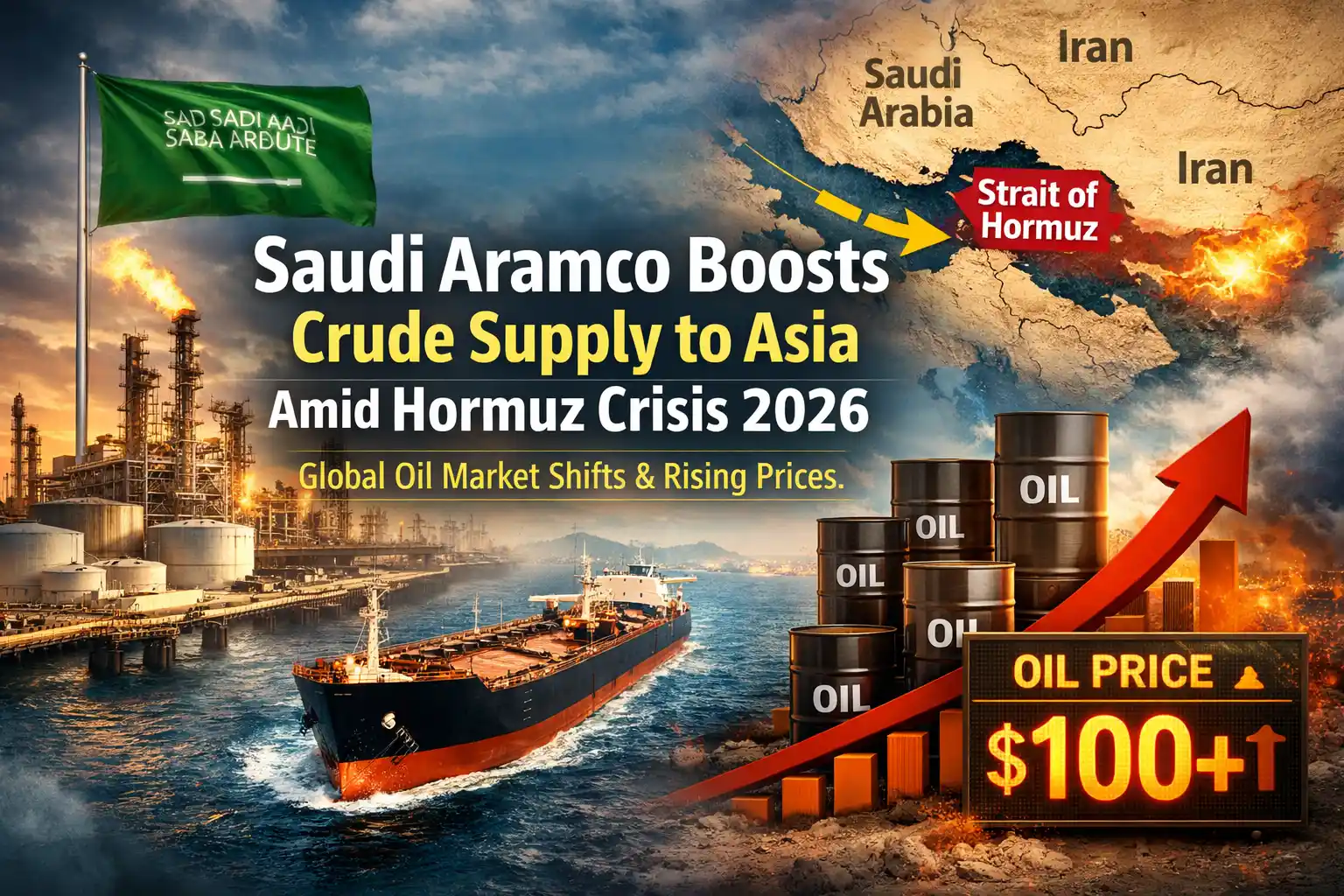
The global oil market in March 2026 is facing one of the most severe disruptions in recent history. At the center of this crisis is the Strait of Hormuz, a critical chokepoint responsible for transporting nearly 20% of the world’s total oil supply.
Due to escalating geopolitical tensions in the Middle East, tanker movement through this route has sharply declined, creating a major global supply shock.
In response, Saudi Aramco has taken a strategic step by increasing crude oil exports to Asia through alternative routes, particularly via the Red Sea.
This move is not just operational—it represents a major shift in global oil trade dynamics.
Latest Developments
Recent data highlights the scale of Saudi Arabia’s response:
- Red Sea exports are expected to reach 3.8 million barrels per day (bpd) in March 2026
- Previous export levels were around 1.3–1.4 million bpd, showing a massive increase
- Around 70 oil tankers are scheduled for loading this month
- Global oil prices have crossed $100 per barrel
- Gulf producers have cut output by over 10 million bpd combined
In simple terms:
Supply is falling while demand remains strong—leading to rising prices and market instability
Root Cause: Strait of Hormuz Crisis
The Strait of Hormuz is the most important oil transit route globally:
- Handles approximately 20 million barrels per day
- Supplies major Asian economies like China, India, Japan, and South Korea
In March 2026, tanker traffic dropped drastically, creating:
- Severe supply shortages
- Delays in oil shipments
- Panic in global energy markets
Saudi Aramco’s Strategy Explained
1. Shift to Red Sea Route
Saudi Arabia is redirecting oil exports through the Red Sea using the East-West pipeline, which connects eastern oil fields to western ports like Yanbu.
Key Details:
- Pipeline capacity: up to 7 million bpd
- Current effective export capacity: around 5 million bpd
Export Growth:
- January: ~1.3 million bpd
- February: ~1.4 million bpd
- March: up to 3.8 million bpd
This shift allows Saudi Arabia to bypass high-risk zones and maintain global supply.
2. Asia Given Top Priority
Asia remains the largest consumer of crude oil globally.
- Around 80%+ of oil passing through Hormuz is consumed in Asia
Key Importers:
- China
- India
- Japan
- South Korea
Strategy:
- Protect long-term contracts
- Ensure supply stability
- Avoid economic slowdown in key markets
3. Dual Supply Strategy
Saudi Aramco has introduced a flexible supply model:
- Red Sea route → safer but limited
- Gulf route → higher capacity but risky
Buyers can choose based on cost and risk preferences
This strategy helps maintain customer confidence while managing uncertainty.
4. Technology to Increase Efficiency
To boost pipeline performance, Saudi Aramco is using:
- Drag Reducing Agents (DRA)
Benefits:
- Improves oil flow speed
- Increases throughput without new infrastructure
5. Production Cuts Despite Export Increase
Interestingly, Saudi Arabia has also reduced production by around 2 million bpd.
Reasons:
- Limited export capacity
- Storage constraints
- Logistical challenges
Key Insight:
Production capacity does not always equal export capacity
Supply vs Demand Analysis
Supply-Side Challenges
- Hormuz disruption affecting ~20% of global supply
- Production cuts across Gulf countries
- Infrastructure and security risks
Result:
Global oil supply is under significant pressure
Demand-Side Strength
Despite the crisis, demand remains strong due to:
- Industrial growth
- Transportation needs
- Petrochemical demand
Asia continues to drive global oil consumption
Oil Price Impact
- Oil prices have crossed $100 per barrel
- Peak levels have reached around $120+ during the crisis
Possible Scenarios:
- Prices may rise to $150–$200 if disruptions continue
Economic Impact:
- Higher fuel prices
- Increased inflation
- Pressure on global economic growth
- Volatility in stock markets
Impact on Asian Economies
India
- Increased import bills
- Fuel supply prioritization
Japan
- Expanding strategic oil reserves
China
- Diversifying supply routes
Common trend:
Energy security has become a top priority across Asia
Key Challenges for Saudi Aramco
1. Infrastructure Limitations
- Red Sea route cannot fully replace Hormuz
- Export capacity still limited compared to normal conditions
2. Security Risks
- Threat of drone or missile attacks
- Vulnerability of oil facilities
3. Price Volatility
- High prices may reduce demand
- Market uncertainty remains high
4. Geopolitical Risks
- Ongoing regional conflict
- Potential escalation affecting supply chains
Future Outlook
Short-Term (2026)
- Tight supply conditions
- High and volatile oil prices
- Continued reliance on Middle Eastern oil
Long-Term Trends
- Development of alternative routes
- Increased use of strategic oil reserves
- Acceleration of renewable energy adoption
Final Conclusion
Saudi Aramco’s decision to boost crude supply to Asia is a strategic response to a major global energy crisis.
Key Takeaways:
- The Hormuz crisis has disrupted global oil supply
- Saudi Arabia is using Red Sea routes to maintain exports
- Asia remains the top priority market
- Oil prices are rising due to supply constraints
Simple understanding:
Saudi Aramco is currently acting as a stabilizing force in a disrupted global oil market—but the situation remains uncertain and evolving.