
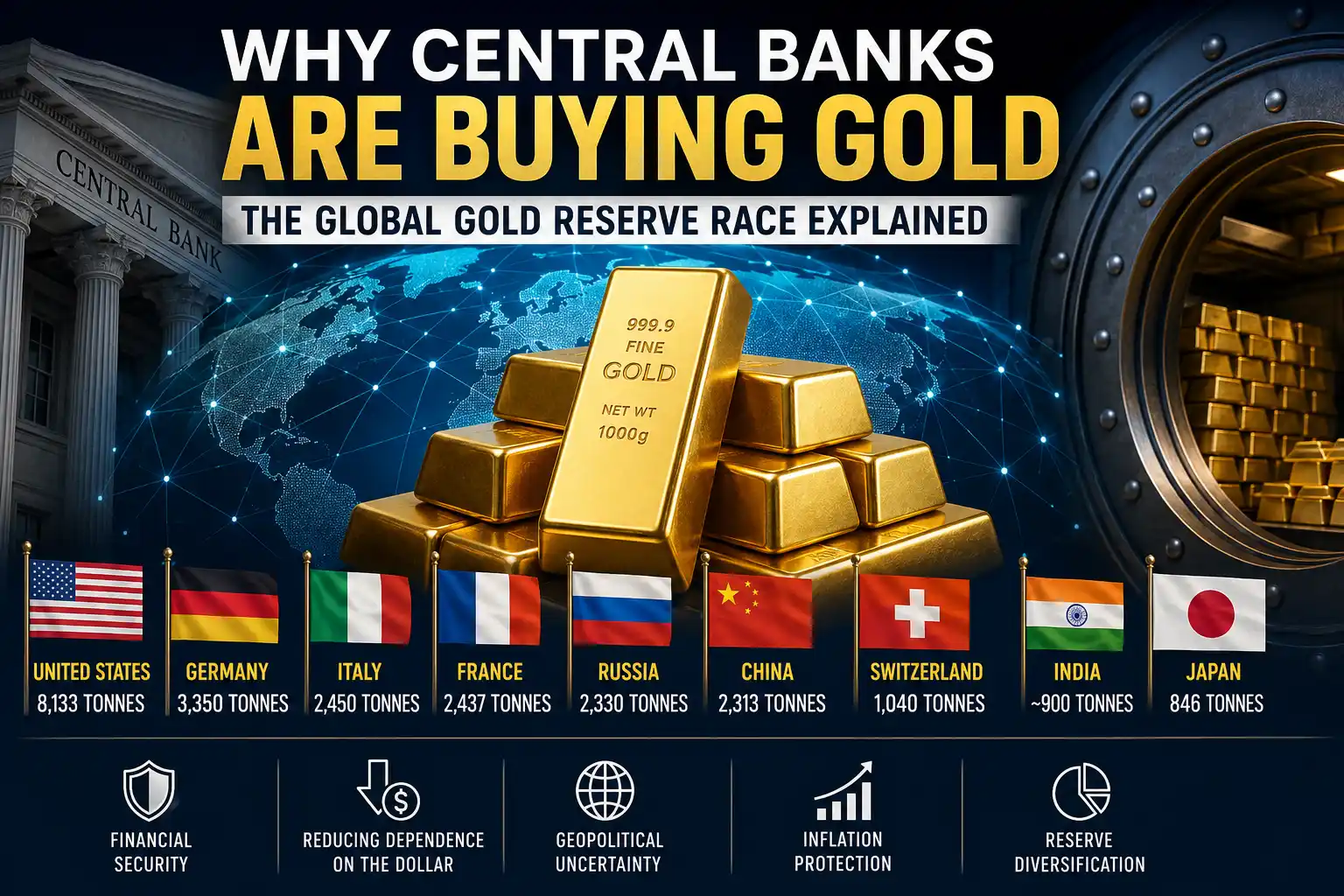
Many developments in the global economy happen quietly, away from public attention, yet their impact can shape financial markets and economic policies for years. One such trend is becoming increasingly important today—central banks around the world are buying gold at a record pace.
A few years ago, the U.S. dollar was widely regarded as the undisputed safe reserve asset. However, the picture is gradually changing. Countries such as the United States, China, India, Russia, Germany, and Poland are steadily increasing their gold reserves. Many central banks are adding new gold bars to their vaults month after month.
The key question is: Why are the world’s largest central banks showing such strong confidence in gold? Is it simply an investment decision, or is there a larger economic and geopolitical strategy behind it?
Let’s explore the complete picture.
What Is a Gold Reserve?
A gold reserve is the amount of gold held by a country’s central bank as part of its official foreign exchange reserves.
Gold reserves help strengthen a country’s financial stability, support confidence in its currency, and provide protection during times of economic uncertainty. In many cases, gold acts as a financial safety net during crises.
Which Countries Have the Largest Gold Reserves?
The United States continues to hold the world’s largest gold reserve. It is followed by Germany, Italy, France, Russia, and China.
| Rank | Country | Gold Reserves (Tonnes) |
| 1 | United States | 8,133 |
| 2 | Germany | 3,350 |
| 3 | Italy | 2,450 |
| 4 | France | 2,437 |
| 5 | Russia | 2,330 |
| 6 | China | 2,313 |
| 7 | Switzerland | 1,040 |
| 8 | India | Around 900 |
| 9 | Japan | 846 |
(Source: World Gold Council (WGC), Gold Reserves by Country (Latest Available Data)
This ranking shows that both developed and emerging economies consider gold an essential part of their long-term financial strategy.
Why Does the United States Still Rank Number One?
The United States holds more than 8,133 tonnes of gold, far more than any other country.
Most of this gold was accumulated over several decades and is stored in highly secure facilities such as Fort Knox and other government vaults.
Although the U.S. has not been aggressively buying gold in recent years, its enormous gold reserve continues to support confidence in the country’s financial strength.
Analysis
America’s economic power is based not only on gold but also on the U.S. dollar and the Treasury market. However, its massive gold holdings remain an important pillar of global confidence in the country’s financial system.
Why Is China’s Strategy So Important?
China has been steadily increasing its gold reserves over the past several years.
Many analysts believe that China is not simply buying gold—it is preparing for a future global financial system that may be less dependent on the U.S. dollar.
China’s Key Objectives
- Reduce dependence on the U.S. dollar
- Strengthen the international role of the Chinese yuan
- Diversify foreign exchange reserves
- Protect against geopolitical risks
Analysis
Although China still holds significantly less gold than the United States, its pace of accumulation has attracted global attention. If this trend continues, China could become one of the most influential gold-holding nations in the coming decades.
What Has Russia Taught the World?
Russia began aggressively increasing its gold reserves after 2014.
Following economic sanctions and restrictions on parts of its foreign currency reserves, Russia demonstrated the strategic value of gold. Unlike foreign currency assets, gold is a reserve asset that cannot easily be frozen by another country.
Analysis
Russia’s experience has become a powerful lesson for many nations. As a result, several emerging economies are now placing greater emphasis on building their own gold reserves.
Why Is India Increasing Its Gold Reserves?
The Reserve Bank of India (RBI) has consistently added gold to its reserves over the past few years.
India’s gold reserves have now reached approximately 900 tonnes, representing substantial growth compared to a decade ago.
RBI’s Strategy
- Strengthen foreign exchange reserves
- Reduce dependence on the U.S. dollar
- Protect against global economic uncertainty
- Improve long-term financial stability
Analysis
India is one of the world’s fastest-growing major economies. As the country’s economic influence expands, the RBI is likely to continue strengthening its reserve portfolio through additional gold purchases.
Why Has Poland Become One of the Largest Gold Buyers?
When discussing gold reserves, most attention is focused on countries such as the United States, China, and India. However, Poland has emerged as one of the most aggressive gold buyers in recent years.
The country purchased more than 100 tonnes of gold within a single year, significantly increasing its overall reserves.
Analysis
Poland demonstrates that the trend toward higher gold reserves is not limited to large economies. Medium-sized nations are also using gold to enhance financial security and reduce strategic risks.
Why Are Central Banks Buying Gold?
1. To Reduce Dependence on the U.S. Dollar
Many countries want to diversify their reserve assets rather than relying heavily on a single currency.
2. To Protect Against Geopolitical Risks
Wars, economic sanctions, and trade tensions have increased significantly in recent years. Gold is widely viewed as a safe-haven asset during uncertain times.
3. To Hedge Against Inflation
Over long periods, gold has historically preserved purchasing power and provided protection against inflation.
4. To Diversify Reserve Portfolios
Central banks seek to reduce risk by holding a mix of assets, including dollars, euros, government bonds, and gold.
Is the World Moving Toward De-Dollarization?
This has become one of the most widely debated topics in global finance.
While the U.S. dollar remains the world’s dominant reserve currency, many countries are increasing the share of gold in their reserve portfolios. This suggests that the global financial system may gradually become more multipolar.
Gold is unlikely to replace the dollar completely, but it is increasingly becoming an important alternative reserve asset for central banks.
What Does This Mean for Investors?
When central banks around the world continue to buy gold, it is about much more than rising gold prices.
It signals that governments and monetary authorities are preparing for potential financial risks and seeking greater stability in their reserve holdings.
For this reason, many analysts believe that gold will continue to play a more important role in the global financial system over the coming years.
Outcome
The growing gold purchases by central banks are not simply routine investment decisions. They represent a broader shift in the global financial landscape.
The United States remains the largest holder of gold reserves, but countries such as China, India, Russia, and Poland are rapidly increasing their holdings. This trend highlights the growing importance of gold as a tool for economic security, financial independence, and strategic strength.
If global uncertainties continue to rise in the years ahead, central banks may accelerate their gold-buying activities even further. In that scenario, gold reserves will represent far more than stored wealth—they will symbolize financial resilience, national security, and long-term economic confidence.