When a new investor enters the stock market, one of the first pieces of advice they hear is:
“Always use a stop loss, it will control your risk.”
This sounds simple and logical. Because of this, many people believe that once they set a stop loss, their risk is fully under control.
But the reality is a bit different…
A stop loss is just a tool, not a complete risk management solution.
In this article, we will understand the real role of a stop loss, where it fails, and how true risk management actually works.
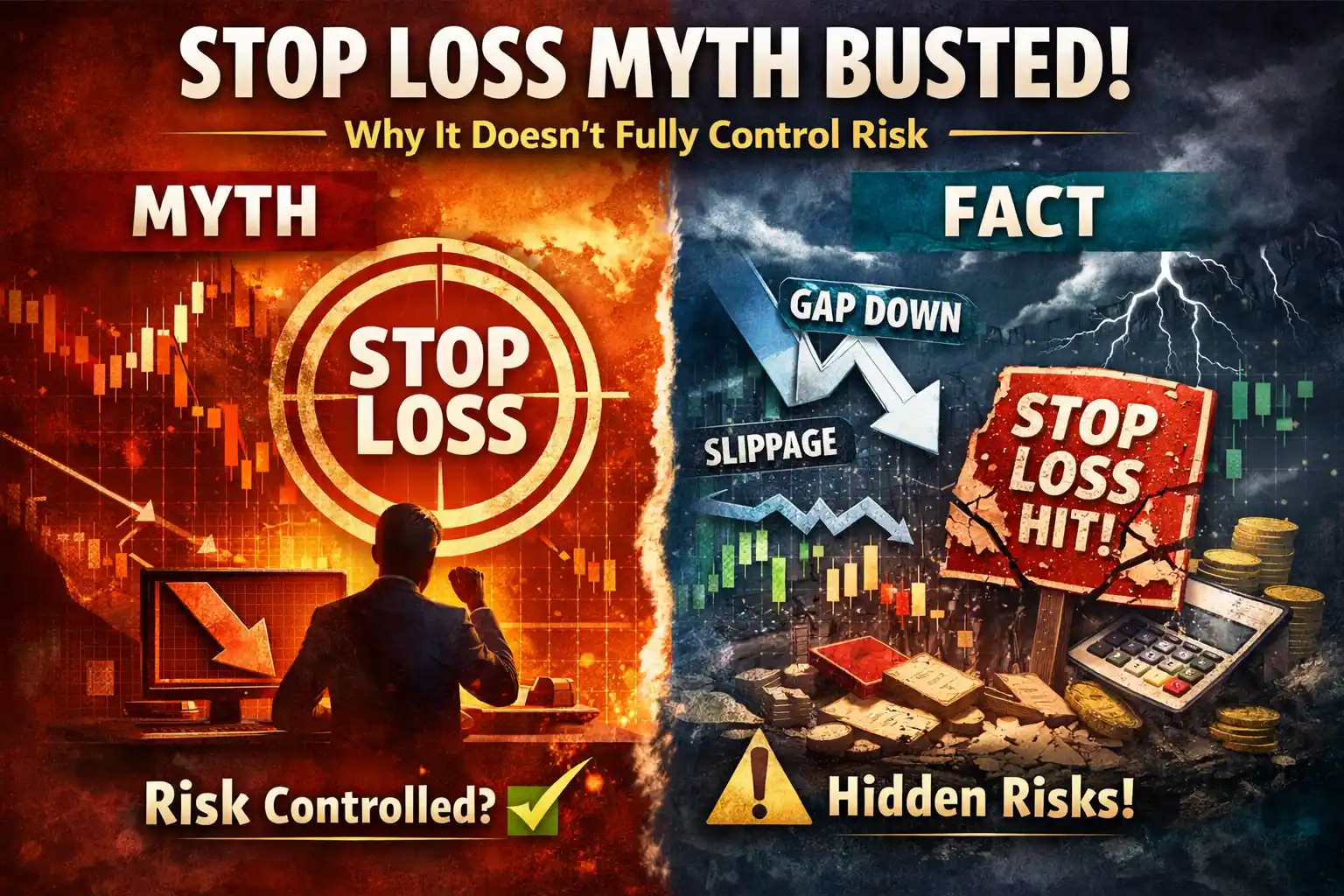
Myth: Setting a Stop Loss Controls Risk
Many traders and investors believe that:
- They enter a trade
- Set a stop loss
- And their risk is fixed
They assume that if the price moves against them, the stop loss will trigger and limit the loss.
However, the stock market does not always behave so perfectly.
Fact: Stop Loss Provides Only Partial Protection
The reality is that a stop loss reduces risk, but it does not eliminate it.
In some situations, a stop loss:
- does not execute at the expected level
- or results in a larger-than-expected loss
This is why relying only on a stop loss can be risky.
How Does a Stop Loss Work?
A stop loss is a pre-decided price level where you exit your position.
Example:
- You buy a stock at ₹500
- Set a stop loss at ₹450
If the price falls to ₹450, your position is automatically exited.
The purpose is: to limit losses
Problem 1: Gap Down Risk (The Biggest Danger)
Sometimes, stocks open significantly lower than the previous closing price (gap down).
Example:
- Your stop loss: ₹450
- Previous close: ₹500
- Next day open: ₹420
In this case, your order will not execute at ₹450, but around ₹420.
This means your loss is higher than expected.
Problem 2: Slippage (Execution Reality)
In real markets, orders are not always executed at the exact price.
This is known as slippage.
Example:
- Stop loss: ₹450
- Execution: ₹447 or ₹445
This may seem small, but with large quantities, it can lead to significant losses.
Problem 3: Stop Loss Hunting (Market Behavior)
Sometimes, the market moves in a way that:
- temporarily hits your stop loss
- and then reverses upward
This causes traders to exit early.
Example:
- Your stop loss: ₹450
- Price falls to ₹448 → stop loss triggered
- Then stock rises to ₹520
You are out of the trade and miss the profit.
Problem 4: Wrong Position Size Makes Stop Loss Ineffective
If your position size is too large, even a stop loss cannot prevent big losses.
Example:
- Capital: ₹1,00,000
- You invest ₹90,000 in one stock
- 10% stop loss hits
Loss = ₹9,000 (which is quite large)
This shows that not just stop loss, but position sizing is equally important.
What Is Real Risk Management?
Smart investors and traders do not rely only on stop loss.
They use multiple layers of risk management:
1️⃣ Position Sizing
- Decide how much capital to allocate per trade
- Many follow the 1–2% risk rule
This is one of the most powerful risk control tools
2️⃣ Diversification
- Avoid putting all money into a single stock
- Spread investments across sectors
3️⃣ Risk-Reward Ratio
- Evaluate potential profit vs loss before entering
- Example: 1:2 or 1:3 ratio
4️⃣ Proper Stop Loss Placement
- Avoid random stop loss levels
- Use logical or technical levels
Simple Example: Smart vs Normal Investor
Normal Investor:
- Random entry
- Uses stop loss
- Takes large position
Result: Risk is not controlled
Smart Investor:
- Uses proper position sizing
- Sets logical stop loss
- Evaluates risk-reward
Result: Stable long-term growth
Important Lesson
In the stock market:
A stop loss is like a helmet, not the entire safety gear
If you depend only on a stop loss, you are not fully managing your risk.
Outcome
The belief that “setting a stop loss completely controls risk” is a common myth.
In reality, while a stop loss helps limit losses, factors like:
- gap down
- slippage
- incorrect position sizing
can still lead to higher-than-expected losses.
Successful investors understand that:
Real risk management = position sizing + diversification + discipline + stop loss
Therefore, if you want to survive and grow in the market long term, focus not just on stop loss, but on a complete risk management system. 🚀