While investing in the stock market, people often hear a common statement: “The more data you analyze, the better your investment decision will be.”
Because of this belief, many investors start examining everything about a company—financial statements, ratios, research reports, analyst opinions, news updates, and technical charts.
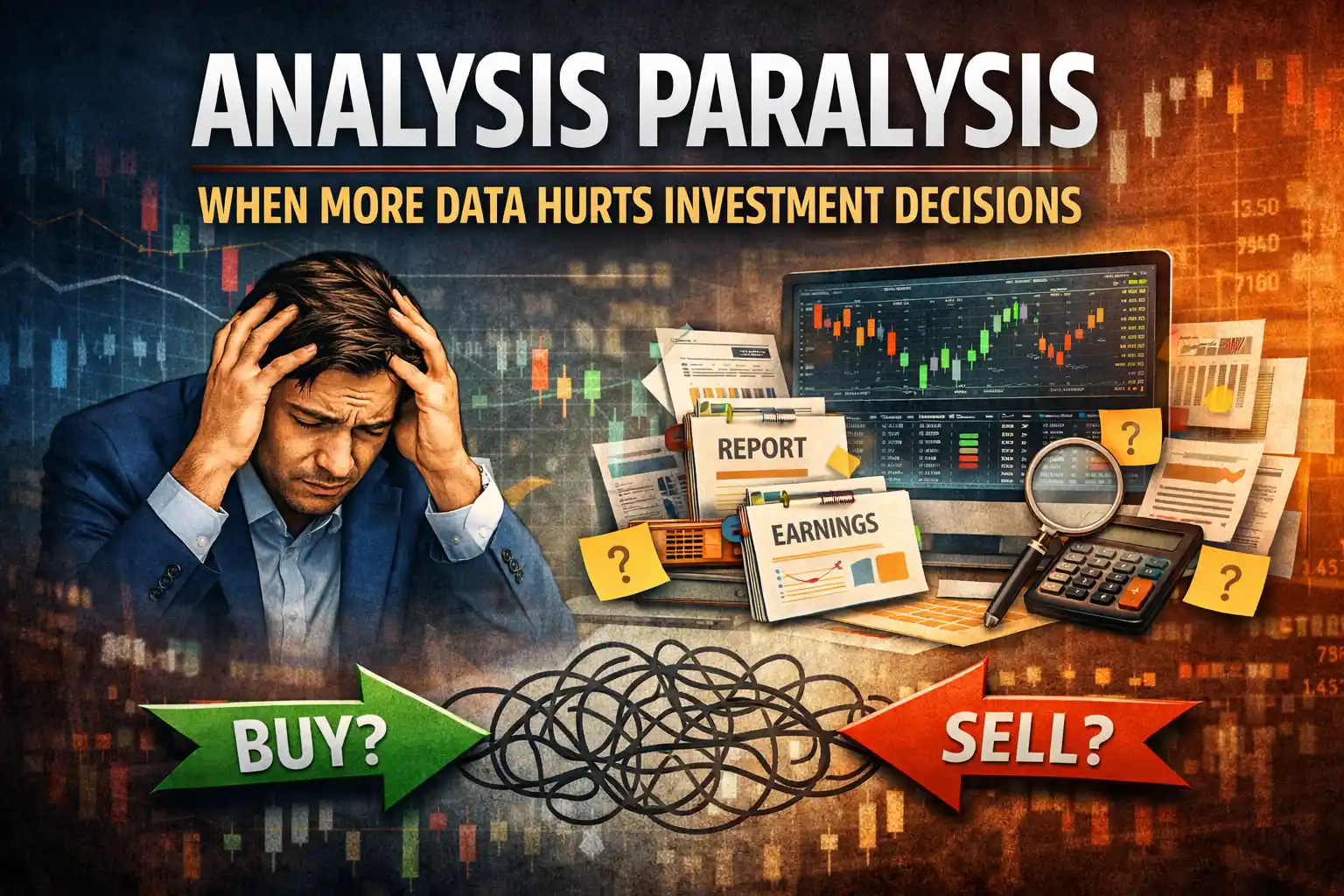
However, an interesting reality is that sometimes too much data itself becomes a problem for investors. Even after gathering a large amount of information, making a final decision becomes difficult. In finance and psychology, this situation is called “Decision Paralysis” or “Analysis Paralysis.”
In this article, we will understand whether having more data truly leads to better investment decisions, or whether it can sometimes create confusion and delay important opportunities.
Myth: More Data Means a Better Investment Decision
Many investors believe that if they collect maximum information, they will be able to make the perfect decision.
That is why they try to analyze almost everything, such as:
- Revenue growth
- Profit growth
- PE ratio
- PB ratio
- Debt levels
- Cash flow
- Industry trends
- Management commentary
- Global market news
- Technical indicators
While reviewing all these factors, investors often spend so much time analyzing information that the actual investment decision gets delayed.
Fact: Over-Analysis Can Lead to Decision Paralysis
The reality is that not every piece of data is equally important. When investors try to evaluate every small detail, their focus becomes unclear.
This leads to three common problems:
- Delay in making decisions
- Increased confusion
- Missing good opportunities
This situation is known as analysis paralysis.
What Is Analysis Paralysis?
Analysis paralysis is a situation where an investor:
- performs excessive research
- waits for every signal to be perfectly confirmed
- keeps waiting for the perfect entry point
As a result, the investor struggles to make a final decision.
In the stock market, timing and opportunity are important. If an investor keeps analyzing endlessly, they may miss several attractive opportunities.
Example: How Opportunities Can Be Missed
Suppose an investor finds a company that appears strong with good profit growth and a solid business model.
However, the investor keeps thinking:
- Let me wait for one more quarterly result
- Let me analyze more industry data
- Let me also check global market trends
During this process, 6–8 months pass by.
Meanwhile, the stock price moves from:
- ₹500 to ₹900.
Now the investor feels that the stock has become too expensive, and decides not to invest.
In this way, over-analysis may lead to missed opportunities.
When Does Too Much Data Become a Problem?
Data is useful in the stock market, but when the amount of information becomes excessive, problems begin to appear.
1. Conflicting Signals
Sometimes different indicators send different signals.
For example:
- Fundamentals look strong
- Technical charts appear weak
In such cases, investors often become confused.
2. Searching for the Perfect Decision
Some investors want their decision to be 100% perfect.
But in the stock market, certainty never exists.
Waiting for the perfect moment can result in losing valuable opportunities.
3. Information Overload
In the digital era, investors receive information from many sources such as:
- financial news portals
- social media platforms
- analyst reports
- YouTube analysis channels
When there is too much information, clarity can actually decrease.
How Smart Investors Use Data
Experienced investors do not try to analyze every single piece of information.
Instead, they focus on a few important factors.
For example:
- Is the business model strong?
- Is revenue and profit growth stable?
- Is the company’s debt level manageable?
- Is the management trustworthy?
Focusing on these core factors often leads to more effective decision-making.
A Simple Investment Framework
To reduce confusion, investors can follow a simple framework:
- Understand the business
- Check financial growth
- Analyze debt and cash flow
- Evaluate whether the valuation is reasonable
If these core aspects are strong, excessive data may not be necessary.
An Important Lesson for Investors
Success in the stock market does not come from collecting unlimited data, but from focusing on the right data.
If investors:
- analyze every piece of information
- react to every news update
- wait endlessly for the perfect entry
then making a timely decision becomes difficult.
Outcome
The belief that “more data always leads to better investment decisions” is a popular myth, but it is not always true.
In reality, over-analysis can confuse investors and delay decision-making. This situation is commonly known as analysis paralysis.
Successful investors do not follow every piece of information. Instead, they focus on the most important factors and make practical decisions.
Therefore, a smart approach in the stock market is to use data wisely, without allowing excessive information to weaken your ability to take action.