
Artificial Intelligence (AI) continues to reshape the global technology industry, and Microsoft has once again emerged as one of its biggest beneficiaries. The company’s fourth-quarter results for fiscal year 2026 demonstrate how strategic investments in AI, cloud computing, and enterprise software are translating into strong financial performance.
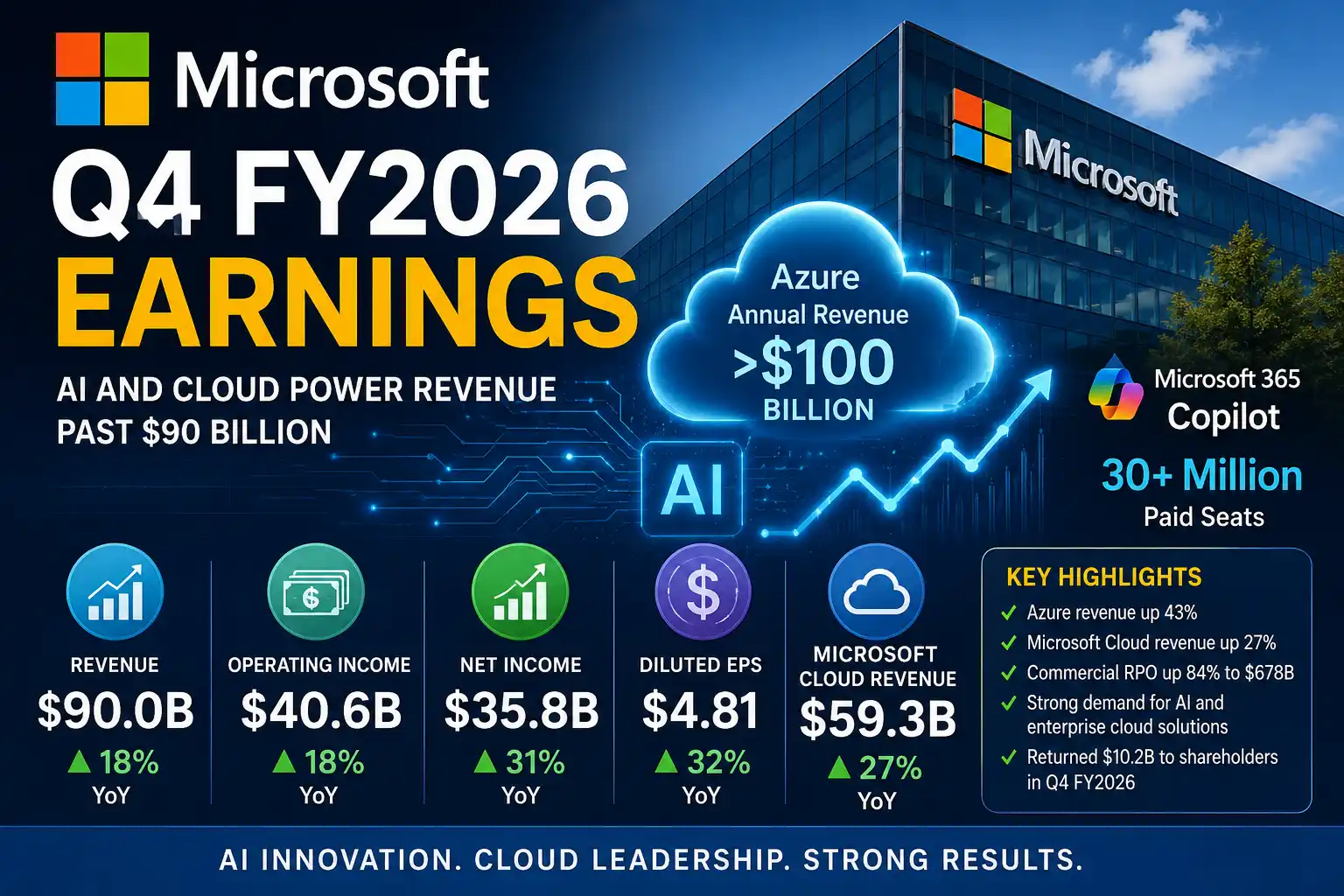
Released on July 29, 2026, Microsoft’s Q4 FY2026 earnings exceeded market expectations, with $90.0 billion in revenue, $35.8 billion in net income, and $4.81 diluted earnings per share (EPS). Strong demand for Azure Cloud, Microsoft 365 Copilot, and enterprise AI solutions played a major role in driving growth. The results also highlight Microsoft’s ability to maintain profitability while investing heavily in AI infrastructure.
Let’s take a closer look at Microsoft’s latest quarterly performance, compare it with the previous quarter, and examine the key drivers behind its continued success.
Microsoft Company Overview
Founded in 1975, Microsoft Corporation is one of the world’s largest technology companies. It develops software, cloud services, AI solutions, enterprise applications, gaming platforms, and productivity tools. Its major products include Windows, Microsoft 365, Azure, GitHub, LinkedIn, Dynamics 365, Xbox, and Microsoft Copilot.
Over the past few years, Microsoft has transformed itself into an AI-first company by integrating artificial intelligence across nearly every product and service. This strategy has positioned the company as a global leader in enterprise AI and cloud computing.
Microsoft Q4 FY2026 Financial Highlights
| Metric | Q4 FY2026 | Year-over-Year Growth |
| Revenue | $90.0 Billion | +18% |
| Operating Income | $40.6 Billion | +18% |
| Net Income | $35.8 Billion | +31% |
| Diluted EPS | $4.81 | +32% |
| Microsoft Cloud Revenue | $59.3 Billion | +27% |
The results reflect strong growth across Microsoft’s core businesses, with cloud and AI continuing to generate significant momentum.
Comparison with the Previous Quarter
Microsoft also delivered strong results in Q3 FY2026, but Q4 showed further improvement across several financial metrics.
Key Improvements
- Quarterly revenue reached a record $90 billion, reflecting sustained enterprise demand.
- Operating income continued to increase despite significant investments in AI infrastructure.
- Net income and earnings per share improved, demonstrating Microsoft’s strong profitability.
- Microsoft Cloud revenue continued to accelerate, driven by Azure and AI-powered services.
The company’s ability to grow both revenue and earnings while expanding AI investments highlights the strength of its business model.
AI Business Continues to Drive Growth
Artificial Intelligence remained Microsoft’s biggest growth catalyst during the quarter.
Azure Reaches a Historic Milestone
CEO Satya Nadella announced that Azure’s annual revenue exceeded $100 billion for the first time, marking a significant milestone for Microsoft’s cloud business.
Azure’s growth was supported by:
- Enterprise AI applications
- Generative AI services
- Cloud migration projects
- Large Language Models (LLMs)
- AI infrastructure deployments
Organizations worldwide continue to adopt Azure as their preferred platform for AI development and cloud computing.
Microsoft 365 Copilot Sees Strong Enterprise Adoption
One of Microsoft’s biggest achievements during the quarter was the rapid adoption of Microsoft 365 Copilot.
The company reported that paid Copilot seats have surpassed 30 million, highlighting growing demand for AI-powered workplace productivity.
Businesses are increasingly using Copilot for:
- Document creation
- Email drafting
- Data analysis
- Software development
- Meeting summaries
- Workflow automation
This rapid adoption is creating a new recurring revenue stream for Microsoft.
Microsoft Cloud Revenue Continues to Expand
Microsoft Cloud generated $59.3 billion in quarterly revenue, representing 27% year-over-year growth.
Growth was driven by:
- Microsoft Azure
- Microsoft 365
- Dynamics 365
- GitHub
- Microsoft Security solutions
The continued expansion of enterprise cloud adoption remains one of Microsoft’s strongest competitive advantages.
Why Did Profit Grow Faster Than Revenue?
While revenue increased by 18%, net income jumped 31%, indicating improved operational efficiency and higher profitability.
Several factors contributed to this performance:
- Approximately $3.2 billion in gains related to Microsoft’s investment in Anthropic.
- Lower-than-expected expenses associated with the voluntary retirement program.
- These gains were partially offset by impairment and severance charges within the Xbox business.
Even after adjusting for these one-time items, Microsoft’s core business remained exceptionally strong.
What Did Management Say?
Satya Nadella, Chairman and CEO: Satya Nadella emphasized that Microsoft’s AI strategy is delivering measurable business results rather than remaining an experimental technology.
He highlighted:
- Azure surpassing $100 billion in annual revenue.
- Microsoft 365 Copilot exceeding 30 million paid seats.
- Strong enterprise demand for AI infrastructure and cloud services.
According to Nadella, Microsoft is focused on helping every organization become an AI-powered business.
Amy Hood, Executive Vice President and CFO: Amy Hood stated that Microsoft finished fiscal year 2026 with another quarter of strong execution.
She noted that:
- Microsoft Cloud revenue reached $59.3 billion.
- Cloud revenue grew 27% year over year.
- The company continues to invest aggressively in AI while maintaining healthy profitability and cash generation.
Key Takeaways for Investors
Microsoft’s latest earnings provide several important insights:
- AI investments are now generating meaningful financial returns.
- Azure remains one of the fastest-growing enterprise cloud platforms.
- Microsoft 365 Copilot is becoming a standard productivity tool for businesses.
- The company’s diversified revenue base continues to support stable earnings growth.
- Microsoft’s strong balance sheet enables continued investment in AI infrastructure without sacrificing profitability.
Risks to Watch
Although Microsoft delivered outstanding results, investors should continue monitoring several risks:
- Rising capital expenditure on AI infrastructure and data centers.
- Increasing competition from Amazon Web Services (AWS) and Google Cloud.
- Higher demand for AI chips and computing capacity.
- Ongoing regulatory and antitrust scrutiny.
Despite these challenges, Microsoft’s financial position remains exceptionally strong.
Outlook
Going forward, investors will closely watch:
- Whether Azure can maintain its strong growth trajectory.
- Continued adoption of Microsoft 365 Copilot.
- AI-related revenue contributions.
- Future cloud margin expansion.
- Microsoft’s next-quarter guidance and AI infrastructure investments.
The company’s long-term growth outlook remains closely tied to global enterprise AI adoption.
Conclusion
Microsoft’s Q4 FY2026 earnings reaffirm its position as one of the world’s leading technology companies and a major beneficiary of the AI revolution.
With $90.0 billion in revenue, $35.8 billion in net income, $40.6 billion in operating income, $4.81 diluted EPS, and $59.3 billion in Microsoft Cloud revenue, the company delivered another outstanding quarter.
Azure’s record performance, the rapid adoption of Microsoft 365 Copilot, and Microsoft’s continued leadership in enterprise AI demonstrate that the company’s long-term strategy is producing tangible results. As businesses worldwide continue investing in AI and cloud technologies, Microsoft appears well-positioned to maintain its leadership and deliver sustainable growth in the years ahead.
Source: Microsoft press