
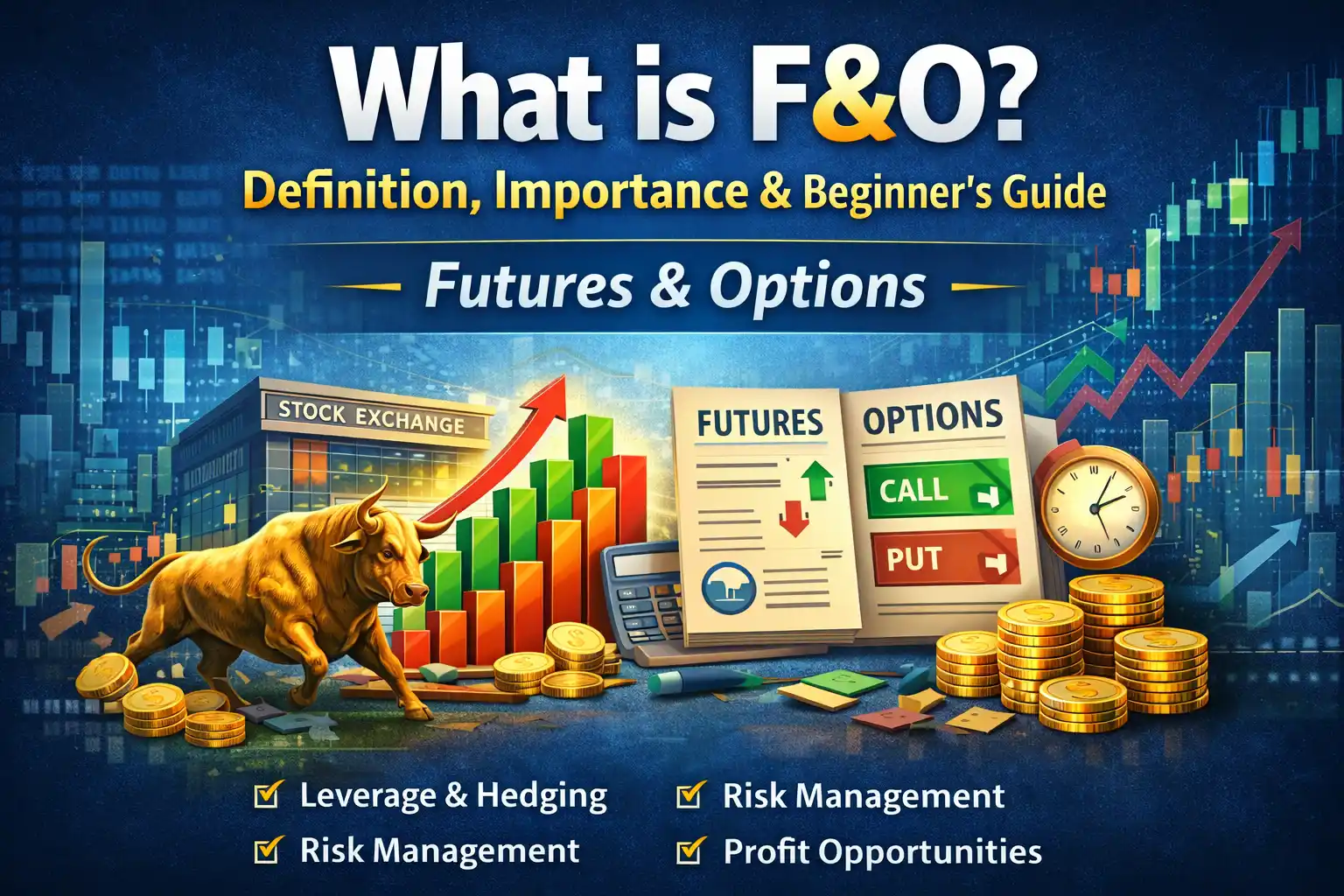
The Stock Market’s Hidden Superpower
Many beginners think the stock market is only about buying and selling shares. They assume profits are only possible when stock prices rise. However, experienced traders know that profits can be made whether the market goes up or down, and this is where F&O (Futures & Options) comes into play.
The real power of F&O trading lies in its ability to:
- Provide leverage, allowing large exposure with small capital,
- Help manage and hedge risk, protecting your portfolio,
- Offer profit opportunities in any market condition.
This makes F&O trading a powerful tool in the stock market, which may seem complex initially but becomes highly profitable and strategic once understood step-by-step.
F&O – Definition
The full form of F&O is:
- Futures – An obligatory contract to buy or sell an asset in the future
- Options – The right, but not obligation, to buy or sell an asset
In simple terms:
F&O are financial contracts whose value depends on the price of an underlying asset, such as stocks, indices, commodities, or currencies.
F&O gives traders and investors advanced tools for trading, hedging, and speculation, allowing them to utilize leverage and flexibility in the market.
Example:
Suppose Reliance shares are trading at ₹2,500 today.
- If you buy a Futures contract at ₹2,500 for one month → you will profit if the price rises, and incur a loss if it falls.
- If you buy a Call Option at ₹2,500 strike price → you have the right to profit from price increases, while your maximum risk is limited to the premium paid.
Key Difference:
- Futures → Mandatory contract, full exposure risk
- Options → Right to exercise, limited risk for the buyer
Futures – Detailed Explanation
A Futures contract is an agreement to buy or sell a specific quantity of an asset at a predetermined price on a future date.
Key Features:
- Obligation: Both buyer and seller must fulfill the contract on expiry. Profit or loss will be realized regardless of market movement.
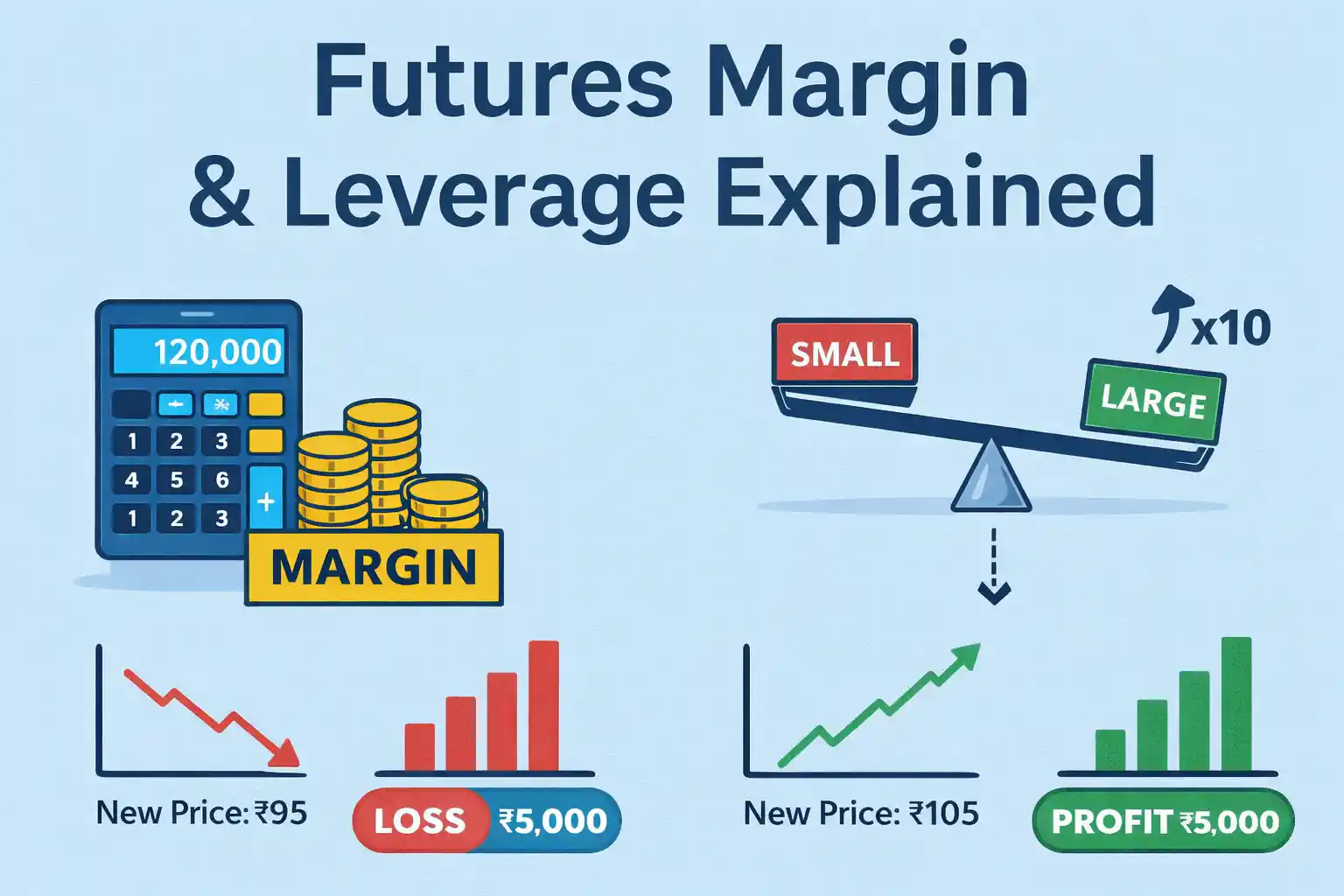
- Leverage: Only a margin is required to enter the contract, giving exposure to a large position. This magnifies both potential profits and losses.
- Speculation & Hedging: Traders predict price movements to make profits (speculation), while investors protect existing holdings (hedging).
Example:
Buying a Nifty 50 futures contract at 20,000.
- If the market rises to 21,000 → Profit = (21,000 – 20,000) × lot size × leverage
- If the market falls to 19,500 → Loss = (20,000 – 19,500) × lot size × leverage
Types of Futures:
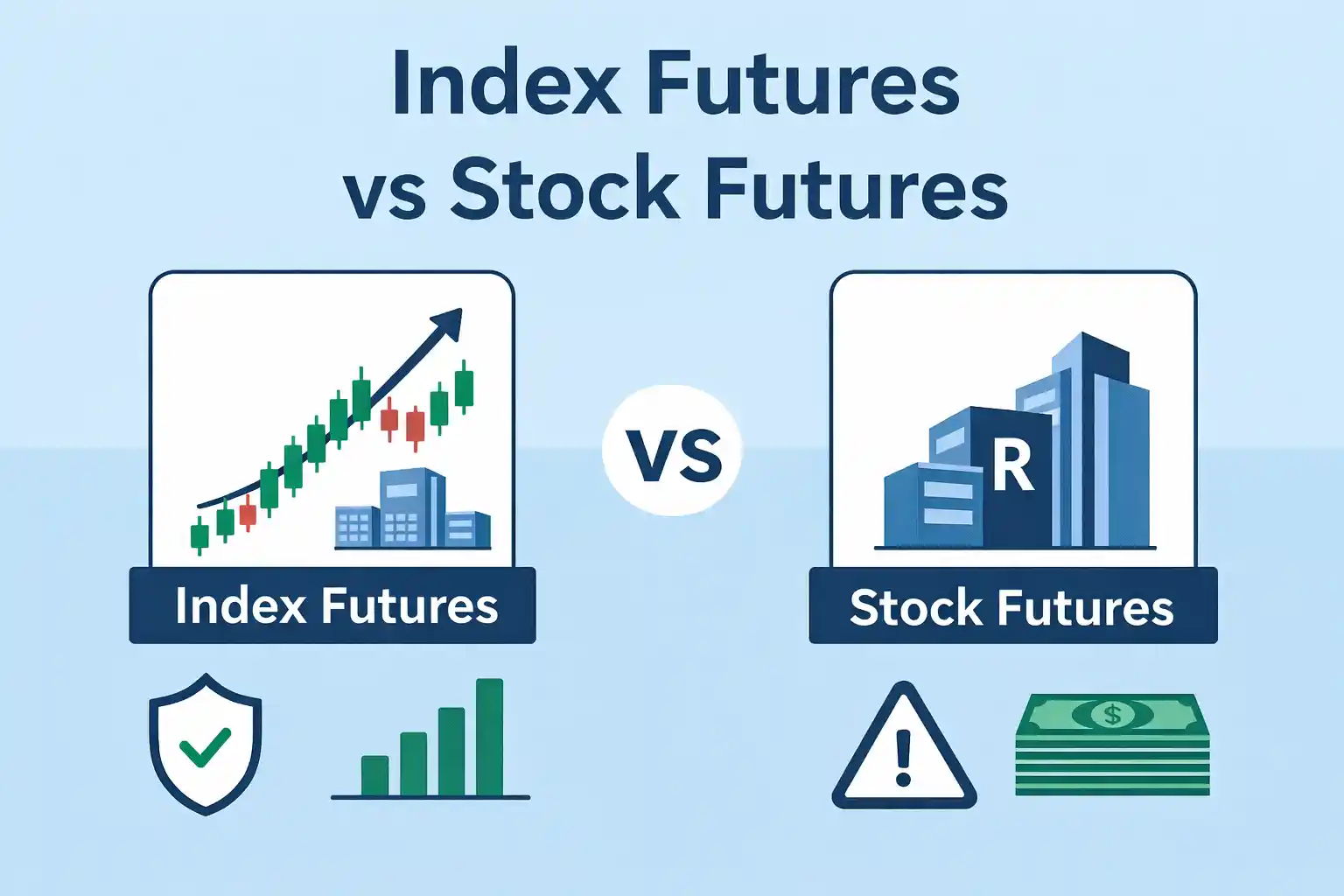
- Stock Futures: Based on individual company shares
- Index Futures: Based on market indices like Nifty or Sensex
- Commodity Futures: Based on commodities like Gold, Silver, Oil
Futures trading carries high risk and high reward, so proper margin management is crucial for beginners.
Options – Detailed Explanation
An Options contract gives the buyer the right to buy (Call) or sell (Put) an asset, but not the obligation. Options are relatively safer for beginners as risk is limited, but strategies can be more complex.
Key Features:
- Premium: Buyers pay an upfront premium, which is the maximum risk.
- Limited Risk: Loss is restricted to the premium, even if the market moves against the position.
- Flexibility: Options can be used for hedging, speculation, or trading based on volatility.
Types of Options:
- Call Option: Right to buy at strike price
- Put Option: Right to sell at strike price
- American Option: Can be exercised anytime before expiry
- European Option: Can only be exercised on expiry date
Example:
Reliance Call Option, strike price ₹2,500, premium ₹50
- Price rises to 2,600 → Profit = (2,600 – 2,500 – 50) × lot size
- Price drops to 2,450 → Loss = Premium ₹50
Options are valuable for both beginners and advanced traders because they provide risk control and strategic earning opportunities.
Importance of F&O
F&O play a crucial role in the stock market and are useful for both beginners and professionals:
- Profit in Any Market: Whether prices rise or fall, F&O trading allows potential earnings. Futures offer full exposure, while options limit the risk.
- Hedging Risk: Investors can protect their portfolios from market declines using F&O.
- Leverage: Small capital can control large positions, but margin and careful planning are required.
- Price Discovery: Activity in F&O markets helps understand the fair value and sentiment of the underlying asset.
Real-Life Scenario:
- You hold 100 Reliance shares → Market falls
- Buying a Put Option reduces potential losses
- Buying a Futures contract allows you to profit if prices rise
Advantages of F&O
- Profit Opportunities: Potential earnings in both rising and falling markets
- Risk Management: Controls losses in existing portfolios or shares
- Leverage: Small investment, large market exposure
- Strategic Flexibility: Used for hedging, speculation, and advanced strategies
- Market Insight: Improves understanding of price movements and market behavior
F&O Use Cases
- Speculation: Predict market direction for short-term profit
- Hedging: Protect existing portfolios or shares
- Arbitrage (Advanced): Take advantage of price differences across markets
Outcome
F&O are powerful financial tools offering profit, risk control, and market insight. While they may seem complex initially, step-by-step understanding and practice make them highly effective.
Summary:
- Futures: Obligatory contracts with high risk and high reward
- Options: Flexible contracts with limited risk and strategic opportunities
Understanding F&O is the second step after learning the basics of the stock market, providing clarity on definitions, importance, and real-life applications.
































































)
