Millions of people around the world have lost their eyesight due to diseases, accidents, or damage to the nerves responsible for vision. Some people are born blind, while others lose their ability to see after spending many years experiencing the world through their eyes. For many of these individuals, medicines, glasses, and conventional eye surgeries cannot restore their vision. However, medical science is now exploring a remarkable possibility: using electronic chips to send visual information directly to the human brain.
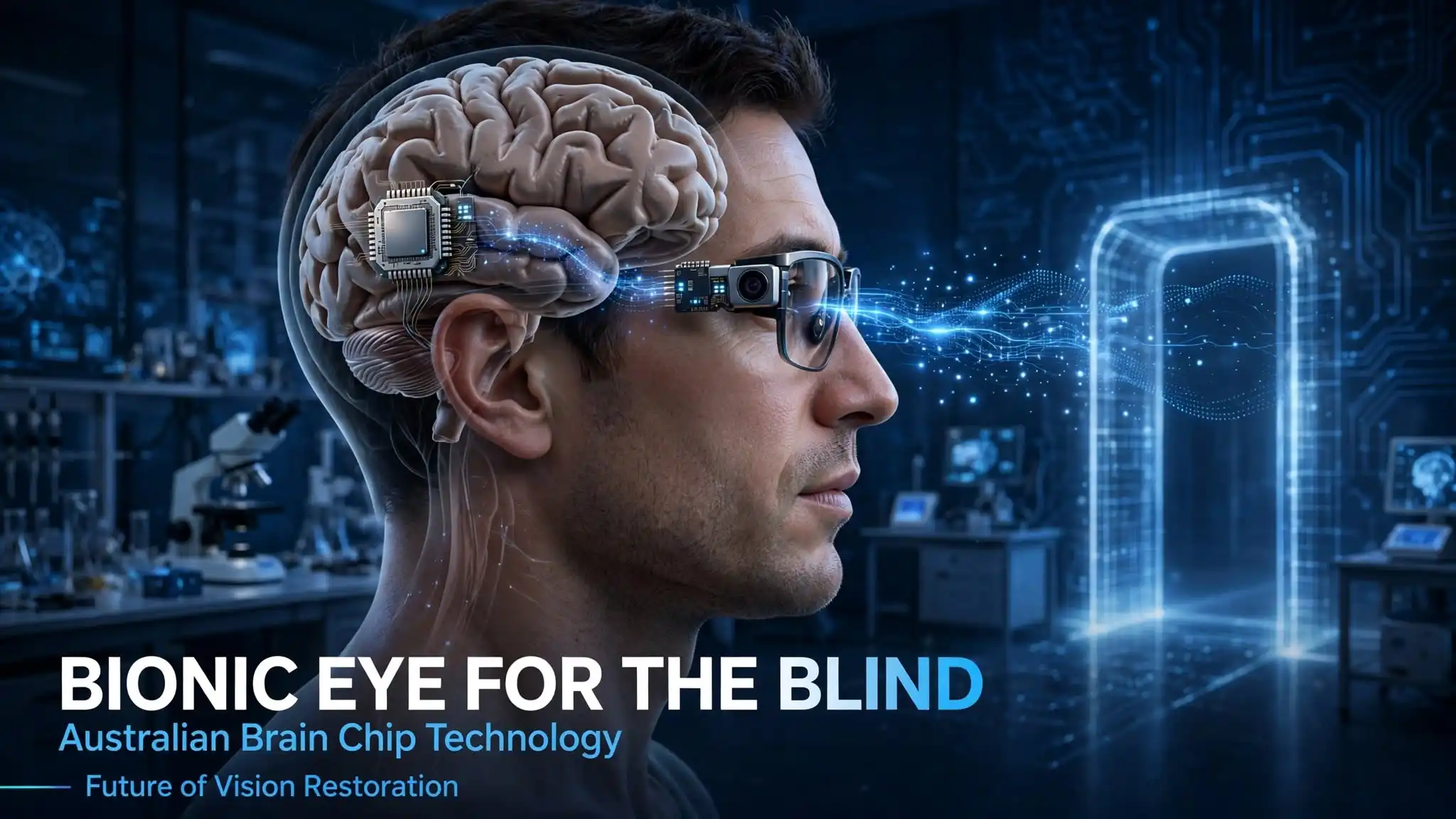
This technology is known as a Bionic Eye or Artificial Vision System. It uses a combination of cameras, computer processors, and specialised electronic implants to provide artificial visual signals to the brain. A camera captures images of the surrounding environment, a processor converts the information into electrical signals, and an implant delivers those signals to the brain.
Who Is Developing the Bionic Eye?
Scientists at Australia’s Monash University are working on a project called the Gennaris Bionic Vision System. It is being developed by the Monash Vision Group (MVG), with collaboration from medical institutions such as Alfred Health.
The project began around 2010 and is led by Professor Arthur Lowery. Its main objective is to develop an artificial vision system for people who have experienced severe damage to their eyes or optic nerves and cannot regain their sight through conventional treatments.
Most traditional bionic eye technologies use electronic implants placed inside the eye or near the retina. However, Gennaris follows a different approach. It places electronic implants near the brain’s Visual Cortex, the region responsible for processing visual information.
The advantage of this approach is that it attempts to bypass damaged eyes or optic nerves and deliver visual signals directly to the brain.
How Will the Gennaris Bionic Eye Work?
The Gennaris system consists of three main components: a camera, a vision processing unit, and a brain implant. Together, these components are designed to provide artificial visual perception.
First – Special Glasses with a Camera
The patient will wear specially designed glasses or a head-mounted device containing a small camera. This camera will capture images of people, objects, and the surrounding environment.
Second – Vision Processing Unit
The images captured by the camera will be sent to a specialised computer processor. This processor will analyse the images and convert important visual information into electrical signals.
For example, it may identify whether a person is standing in front of the patient, whether an obstacle is blocking the path, or whether a door is nearby.
Third – Brain Implant Chip
The electrical signals will then be transmitted wirelessly to the implant placed near the brain’s Visual Cortex.
The implant will deliver controlled electrical pulses to specific areas of the Visual Cortex. In response, the brain may generate sensations of small points of light. These sensations are scientifically known as Phosphenes.
With appropriate training, patients may gradually learn to interpret the patterns and positions of these light points to identify objects and understand their surroundings.
What Makes the Brain Implant Chip Special?
One of the most important components of the Gennaris project is its collection of small electronic implants, which researchers call Tiles.
| Feature | Details |
| Electrodes in each Tile | 43 |
| Maximum number of Tiles | 11 |
| Total electrodes | 473 |
| Implant location | Visual Cortex |
| Signal transmission | Wireless |
| Main purpose | Artificial visual perception |
Each Tile contains 43 tiny electrodes and an electronic circuit. These Tiles are designed to be placed on the surface of the Visual Cortex, located at the back of the brain.
When signals arrive from the processor, the electrodes deliver electrical pulses to different areas of the brain. This may create small points of light at different positions within the patient’s field of vision.
Researchers aim to arrange these points into meaningful patterns that can provide useful visual information. However, having more electrodes does not automatically guarantee clear or natural vision.
Will Patients Be Able to Recognise People and Objects Again?
This is one of the most important questions about bionic eye technology.
The objective of Gennaris is not to immediately restore 100% natural eyesight. Instead, the initial goal is to provide limited but useful visual information.
For example, if someone enters a room, the patient may receive a visual indication that a person or object is present. Similarly, if a large object is blocking a pathway, the system may help the patient estimate its position.
Potential applications include:
- Identifying the position of doors and pathways.
- Detecting the presence of people and objects.
- Recognising obstacles while walking.
- Understanding movements and activities nearby.
- Estimating the shapes and positions of surrounding objects.
Researchers at Monash have also developed an iPhone-based simulation to demonstrate what artificial vision through the Gennaris system might look like.
However, a simulation should not be considered proof of successful vision restoration in actual patients. The real level of visual improvement will only become clear through human clinical trials.
Can This Technology Treat Every Type of Blindness?
No. Gennaris is not designed to treat every form of blindness. It may be particularly useful for people whose eyes or optic nerves have suffered severe damage while their brain’s Visual Cortex remains functional.
Consider an example.
Suppose a person has damaged optic nerves, preventing visual information from travelling from the eyes to the brain. As a result, the brain no longer receives normal visual signals.
Gennaris attempts to bypass this damaged pathway by sending electronic signals directly to the brain’s visual processing region.
Potential candidates may include:
- Some patients with severe vision loss caused by glaucoma.
- People who have suffered damage to their eyes or optic nerves due to accidents.
- Patients who have lost vision because of certain eye or visual pathway disorders.
However, if the Visual Cortex itself is severely damaged, this technology may not provide significant benefits. Medical examinations will be necessary to determine whether an individual is suitable for the treatment.
What Is the Current Testing Status of Gennaris?
Before a technology such as Gennaris can be used in humans, researchers must establish its safety and technical reliability.
The Monash research team has spent several years developing the electronic implants, wireless communication system, and surgical procedures required for the technology.
Preclinical testing has involved sheep. Researchers implanted the system in three sheep to investigate its functionality and safety. These experiments helped evaluate whether the electronic implants could deliver controlled electrical signals over an extended period.
However, successful animal testing does not guarantee identical results in humans.
As of November 2026, according to the available information from Monash Vision Group, the team is working to secure funding for its first-in-human clinical trial.
The proposed trial is expected to involve Monash University’s Clayton Campus and The Alfred Hospital in Melbourne.
Patient recruitment for this trial has not yet started.
This means Gennaris is still a research-stage technology and is not currently available as a routine medical treatment.
Another Australian Company Is Also Developing Bionic Eye Technology
Apart from Gennaris, Australian company Bionic Vision Technologies (BVT) has also worked on developing bionic eye technology.
The project involved collaboration with research institutions such as the Centre for Eye Research Australia and the Bionics Institute.
The biggest difference between Gennaris and BVT is the location of their implants.
Gennaris sends electrical signals directly to the brain’s Visual Cortex, whereas BVT uses an implant positioned behind the retina.
In the BVT system, a camera mounted on special glasses captures images of the surroundings. A processor converts these images into electrical signals, which are then delivered to electrodes placed behind the retina.
The technology was primarily developed to help people suffering from severe vision loss caused by a genetic condition called Retinitis Pigmentosa (RP).
Retinitis Pigmentosa is a group of inherited eye disorders in which the light-sensitive cells of the retina gradually deteriorate, leading to progressive vision loss.
What Were the Results of BVT’s Human Trials?
One of the most important aspects of Bionic Vision Technologies’ project is that its retinal implant has already undergone human testing.
In 2018, four patients with severe vision loss caused by Retinitis Pigmentosa received a 44-channel suprachoroidal retinal prosthesis.
The patients were provided with special camera-equipped glasses, an electronic processor, and an implant positioned behind the retina.
A scientific study published in 2024 reported results from approximately 2.7 years of patient monitoring. Another study published in 2025 examined the safety and stability of the implant.
The important findings included:
- The implant was successfully placed in all four patients.
- Approximately 97% of the electrodes were still functioning at the end of the reported follow-up period.
- No serious device-related adverse events were reported.
- Patients demonstrated some level of useful visual perception.
- The system helped patients identify pathways and the positions of objects.
For example, patients were able to improve their ability to locate doorways, detect nearby objects, and identify obstacles in their surroundings.
However, the study involved only four patients. Larger clinical studies are still necessary to confirm the results and establish the technology’s long-term effectiveness.
What Is the Difference Between Gennaris and BVT Bionic Eye?
Both technologies aim to provide artificial vision to people with severe visual impairment, but they use different approaches.
| Feature | Gennaris | BVT Bionic Eye |
| Country | Australia | Australia |
| Developer | Monash Vision Group | Bionic Vision Technologies |
| Implant location | Visual Cortex | Behind the retina |
| Electrodes | Up to 473 | 44 |
| Camera | Special headgear | Special glasses |
| Main objective | Bypass the eyes and optic nerves | Stimulate remaining retinal cells |
| Human testing | Not yet started | Tested in four patients |
These projects demonstrate that there may not be just one approach to developing a bionic eye. Different technologies could be suitable for different patients, depending on the nature of their eye and brain conditions.
How Could Artificial Intelligence Improve Bionic Eye Technology?
Artificial Intelligence (AI) could play an important role in making future bionic eye systems more useful.
One of the biggest challenges is that an ordinary camera can capture millions of pixels, while an electronic implant has a limited number of electrodes to transmit visual information to the brain.
AI could help solve this problem by identifying the most important information in the images captured by the camera.
For example:
- Detecting the presence of a person in front of the patient.
- Identifying obstacles such as chairs or other objects on a pathway.
- Giving priority to important objects such as doors and stairs.
- Simplifying information about the shapes and positions of surrounding objects.
In the future, cameras, AI processors, and brain implants could work together to provide more useful artificial visual information.
However, these are future possibilities rather than currently proven capabilities of the Gennaris system.
What Are the Major Challenges Facing Bionic Eye Technology?
Developing a bionic eye involves much more than simply creating an electronic chip. Researchers must overcome several medical and engineering challenges before the technology can become widely available.
Complex Surgery: Placing electronic implants near the brain or inside the eye involves complicated surgical procedures. Researchers must minimise risks such as infection and damage to surrounding tissues.
Quality of Vision: The artificial light patterns generated by electrodes are not equivalent to the clear images produced by natural eyesight. Patients may require extensive training to interpret these patterns.
Long-Term Safety: The implant must function reliably inside the human body for many years. Researchers need to evaluate its electronic performance and compatibility with surrounding tissues.
Cost and Accessibility: Developing the technology, performing surgery, and providing rehabilitation could be expensive. Making the treatment affordable and accessible to patients worldwide will be another major challenge.
Conclusion
Bionic eye technology being developed in Australia has the potential to become an important advancement in medical science. The Gennaris project from Monash University is particularly interesting because it attempts to bypass damaged eyes and optic nerves by sending electrical signals directly to the brain’s Visual Cortex.
Meanwhile, Bionic Vision Technologies’ 44-electrode retinal implant has demonstrated promising results in a small group of patients. These developments indicate that electronic implants may provide limited but useful visual abilities to some people suffering from severe vision loss.
With continued progress in Artificial Intelligence, neurotechnology, and advanced electronic implants, researchers may be able to improve the quality of artificial vision in the future.
If clinical trials demonstrate safety and effectiveness and the necessary regulatory approvals are obtained, bionic eye technology could eventually offer a new option to people for whom conventional vision treatments are no longer effective.
Sources: Monash Technology, Bionic Vision Technologies – Clinical Research (2024), 44-Channel Bionic Eye Trial (2021).