Imagine placing a tiny battery inside a remote sensor, a spacecraft, or a medical device—and not having to replace it for decades. Now imagine a technology that could potentially produce electricity for thousands of years.
It sounds like science fiction, doesn’t it?
But scientists are exploring a technology called the diamond battery, which could turn radioactive carbon recovered from nuclear waste into a long-lasting source of energy.
Unlike the lithium-ion batteries used in smartphones, laptops, and electric vehicles, a diamond battery does not work by storing a large amount of electricity and releasing it quickly. Instead, it uses energy released during radioactive decay to generate a small electrical current.
Researchers at the University of Bristol and the UK Atomic Energy Authority (UKAEA) announced a carbon-14 diamond battery prototype in December 2024. The idea has attracted attention because it could offer a new way to use certain radioactive materials while powering devices that need very little electricity.
But there is an important question: Can this battery really power devices for thousands of years, and could it ever replace the batteries we use every day?
Let’s explore how it works, where it might be useful, and what scientists still need to solve.
What Exactly Is a Diamond Battery?
A diamond battery is a type of battery that converts energy released by radioactive material into electricity.
To understand it, think about two familiar technologies.
- A smartphone battery: Stores energy and releases it when your phone needs power. It must be recharged regularly.
- A diamond battery: Uses energy released naturally as a radioactive material decays. It could operate for a very long time without conventional recharging.
The diamond in this technology is not simply a decorative gemstone. It is a specially engineered material that helps convert the energy from radioactive decay into electrical power and helps contain the radioactive material.
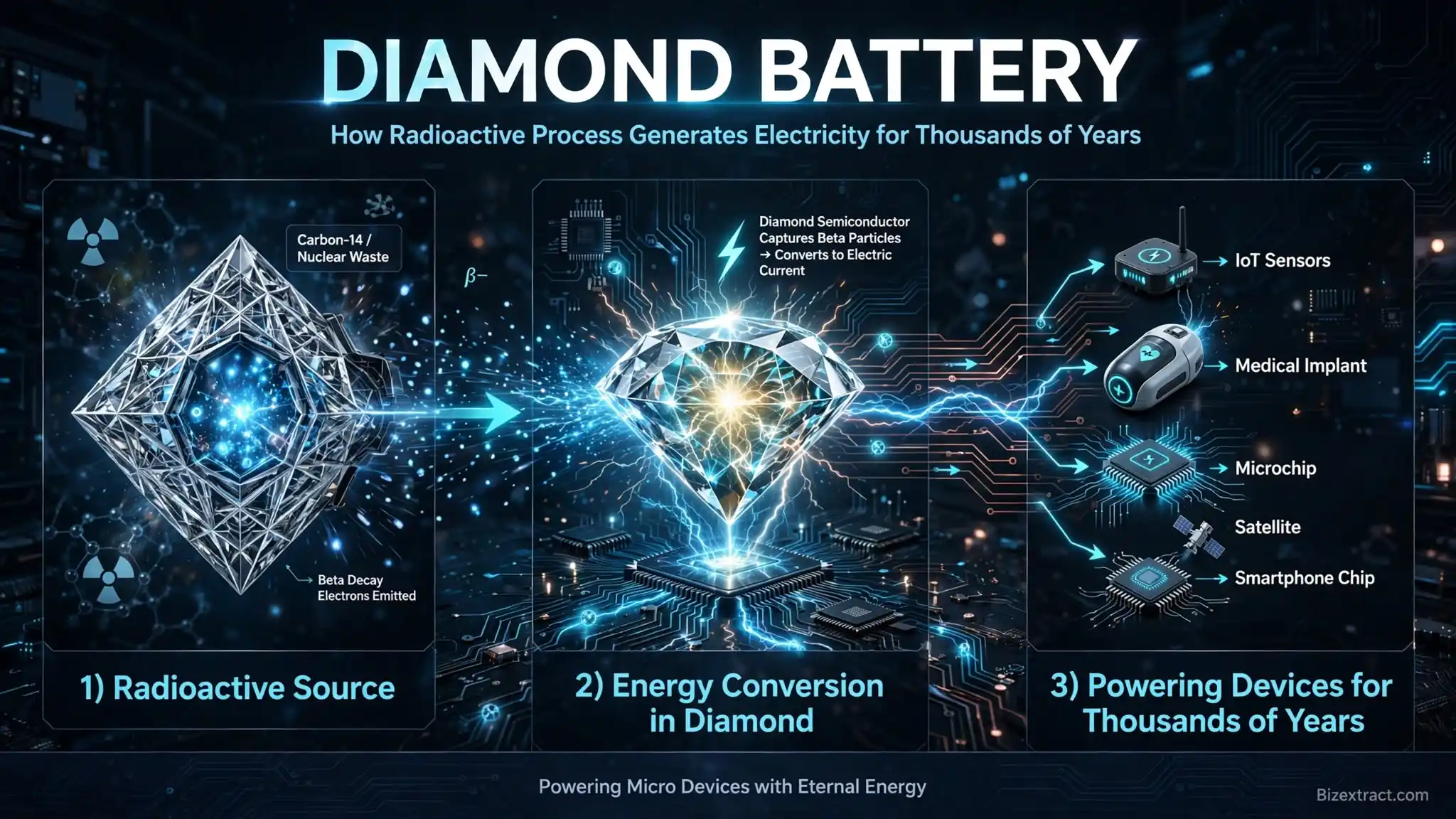
One proposed design uses carbon-14, a radioactive form of carbon. Carbon-14 can be recovered from certain types of nuclear waste and incorporated into a diamond structure.
The result is a potential long-lasting power source that could be useful in places where replacing a battery is difficult, expensive, or dangerous.
However, a diamond battery is not designed to produce the large amount of power needed to run a refrigerator, charge an electric car, or operate a smartphone continuously. Its main promise is long-lasting, low-power electricity.
Why Are Scientists Interested in Nuclear Waste?
Nuclear power stations produce electricity through nuclear reactions. During their operation, certain materials become radioactive and must be carefully managed.
Some of these materials contain carbon-14. One possible source is irradiated graphite used in certain nuclear reactors.
Managing radioactive waste can be complicated and expensive. Depending on the material, it may require controlled storage, monitoring, and eventual disposal.
Scientists are therefore investigating whether selected radioactive materials could also become useful resources.
The idea behind the carbon-14 diamond battery is simple:
- Recover suitable carbon-14 from certain nuclear waste materials.
- Process and purify the material under controlled conditions.
- Incorporate the carbon-14 into a synthetic diamond structure.
- Use the energy released by radioactive decay to generate electricity.
This does not mean that all nuclear waste can be turned into batteries. Only suitable materials could be considered, and the process must meet strict safety and regulatory requirements.
Why it matters: If the technology becomes practical, it could give some radioactive materials a useful application instead of treating them only as waste. It would not eliminate the need for nuclear waste management, but it could become one additional option.
How Does a Diamond Battery Actually Generate Electricity?
The science sounds complicated, but the basic idea is easier to understand with an example.
Imagine a tiny power station that never needs fuel deliveries. Instead, it contains a material that naturally releases energy as its atoms change over time.
A diamond battery uses a similar principle.
Step 1: Carbon-14 releases energy
Carbon-14 is radioactive. Over time, its atoms decay and release beta particles—high-energy electrons.
Step 2: The diamond structure helps convert that energy
The battery is designed so that energy from these particles can be converted into electrical energy within a suitable semiconductor structure.
Step 3: A small electric current is produced
The electricity generated can potentially power a device that needs only a tiny amount of energy.
This general process belongs to a family of technologies called betavoltaic batteries.
You can think of a betavoltaic battery as being somewhat similar to a solar panel. A solar panel converts energy from light into electricity, while a betavoltaic device converts energy from beta particles into electricity.
The underlying physics is different, but the comparison helps explain the basic concept.
One important difference is that the output from a diamond battery is expected to be very small. The technology is therefore more suitable for low-power applications than for devices that need a large burst of electricity.
How Can a Battery Potentially Last for Thousands of Years?
This is one of the most fascinating parts of the technology.
The key is the radioactive material used inside the battery.
Carbon-14 has a half-life of approximately 5,730 years.
A half-life is the time required for half of the radioactive atoms in a sample to decay. It does not mean that the material suddenly stops working after that period.
Let’s make this easier to understand.
Imagine that a battery initially contains 100 units of carbon-14. The amount remaining would decrease approximately as follows:
| Time elapsed | Approximate carbon-14 remaining |
| At the beginning | 100% |
| After 5,730 years | 50% |
| After 11,460 years | 25% |
| After 17,190 years | 12.5% |
| After 22,920 years | 6.25% |
| After 28,650 years | 3.125% |
These figures describe radioactive decay, not measured battery performance over thousands of years.
As the amount of carbon-14 decreases, the energy available from its decay also declines. Therefore, the battery’s electrical output would not remain constant indefinitely.
So, why do people discuss diamond batteries in connection with thousands of years?
Because carbon-14 decays slowly. Its long half-life means that radioactive decay can continue over an extremely long period.
The important distinction: A long radioactive half-life does not automatically prove that a complete battery can deliver useful electricity for the same period. Actual performance depends on the design, conversion efficiency, power requirements, material stability, and other factors.
The technology is promising, but a battery operating continuously for thousands of years has not been demonstrated by the prototype announcement.
What Did Scientists Announce in 2024?
In December 2024, the University of Bristol and the UK Atomic Energy Authority announced a prototype carbon-14 diamond battery.
The project explored how carbon-14 recovered from nuclear waste could be incorporated into a diamond structure to generate electricity.
The announcement was significant for two reasons.
First, it connected nuclear waste recovery with a potential energy technology. Instead of looking at suitable radioactive carbon only as a waste-management challenge, researchers investigated whether it could serve as a long-lasting energy source.
Second, it highlighted a different approach to battery design. Most familiar batteries focus on delivering substantial power over hours or days. A diamond battery aims to provide a very small amount of power over a much longer period.
However, the prototype should not be confused with a commercially available battery that can run ordinary consumer electronics for thousands of years. The announcement demonstrated a research direction, not a proven mass-market product with a guaranteed operating lifetime.
That distinction is essential when evaluating exciting new technologies.
Could a Diamond Battery Power Your Smartphone?
Let’s answer the question directly: A diamond battery is not currently a practical replacement for your smartphone battery.
Your phone needs substantial power to run its screen, processor, camera, wireless connections, and other components. It also needs extra power during demanding activities such as gaming, video recording, or mobile data use.
A diamond battery is intended to generate very small amounts of electricity.
Think of the difference this way:
- A smartphone battery is like a water tank with a tap that can deliver a large flow when needed.
- A diamond battery is more like a tiny spring that releases a little energy continuously over a long period.
The second system can be valuable, but it cannot necessarily meet the demands of the first.
Even if diamond battery technology advances, consumer electronics would still need to meet strict requirements for power output, cost, safety, and manufacturing.
The technology’s most promising applications are likely to be devices that consume very little power and are difficult to access once installed.
Where Could Diamond Batteries Be Useful?
Although diamond batteries may not replace everyday rechargeable batteries, they could be valuable in specialized applications.
A. Medical implants
Some medical devices are implanted inside the human body. Replacing their batteries can require a medical procedure, depending on the device.
A future low-power energy source could potentially help power certain implantable sensors or other specialized medical electronics.
However, medical use would require extensive testing for safety, reliability, compatibility, and regulatory approval. A diamond battery should not be assumed to be ready for use in pacemakers or other implants simply because the concept is promising.
B. Spacecraft and satellites
Space missions can last for many years, and repairing equipment in space is difficult or impossible in many situations.
A very long-lasting power source could potentially support low-power sensors, monitoring systems, or other electronics on future missions.
But spacecraft also need to consider radiation exposure, operating temperatures, mass, power requirements, and reliability. A diamond battery would be suitable only if it met the needs of a particular mission.
C. Remote sensors
Imagine a sensor installed deep underground, inside industrial equipment, or in an isolated location where replacing a battery is expensive.
If that sensor uses very little electricity, a long-lasting power source could reduce the need for maintenance visits.
Potential applications could include environmental monitoring, infrastructure monitoring, and selected industrial sensing systems.
D. Scientific instruments
Some scientific instruments collect measurements over long periods. In locations that are difficult to access, replacing batteries can interrupt data collection or create logistical problems.
A long-lived, low-power energy source could help certain instruments operate for longer periods.
These are potential applications, not a claim that commercial diamond batteries are already powering all these systems.
Diamond Battery vs. Lithium-Ion Battery
The two technologies are designed for different jobs.
| Feature | Diamond battery | Lithium-ion battery |
| Main energy source | Energy from radioactive decay | Stored electrochemical energy |
| Typical design goal | Very long operation at low power | Higher power for everyday devices |
| Recharging | Not designed for conventional recharging | Usually rechargeable |
| Power output | Expected to be very low in proposed diamond-battery applications | Can provide much higher power |
| Potential uses | Specialized sensors and other low-power equipment | Phones, laptops, electric vehicles and more |
| Main challenge | Low output, cost, engineering and regulation | Ageing, charging time, safety and material supply |
It would be misleading to call one technology universally better than the other.
Lithium-ion batteries are highly useful because they can deliver significant power in a relatively compact package. Diamond batteries could be useful where long operating life matters more than high power.
In the future, both technologies could serve different purposes.
Is a Diamond Battery Safe?
The word radioactive naturally raises concerns. Those concerns should be taken seriously.
Carbon-14 releases beta radiation. Beta particles have limited penetration compared with some other forms of radiation, but that does not mean radioactive materials can be handled carelessly.
A practical battery would need an engineered structure that controls exposure and prevents the radioactive material from escaping. Its safety would also depend on manufacturing quality, physical durability, failure conditions, and the environment in which it is used.
Researchers would need to evaluate questions such as:
- Can the radioactive material remain securely contained throughout the product’s life?
- What happens if the battery is damaged?
- How should the device be transported, stored, recycled, or disposed of?
- What regulatory approvals are required for each application?
Safety requirements would be particularly demanding for devices used inside the human body or in equipment that may be exposed to extreme conditions.
The diamond structure is part of the proposed approach, but the word diamond alone is not a guarantee of safety. The complete device must be tested and regulated appropriately.
What Are the Biggest Challenges?
The concept is exciting, but several obstacles stand between a research prototype and widespread commercial use.
Challenge 1: Very low power output
The battery is intended to deliver a small amount of electricity. Many devices need much more power, so its potential applications may be limited to specialized equipment.
Challenge 2: Converting energy efficiently
Not all the energy released by radioactive decay becomes usable electricity. Improving the conversion process is important if the technology is to become more practical.
Challenge 3: Manufacturing costs
Recovering and processing carbon-14, producing suitable diamond structures, and manufacturing a reliable device could be expensive.
The cost would need to make sense for the applications being targeted.
Challenge 4: Proving long-term reliability
A product cannot simply be declared reliable for thousands of years because its radioactive material has a long half-life.
Researchers need to understand how the materials, electrical performance, packaging, and other components behave over time. Accelerated testing can help answer some questions, but it cannot instantly prove every aspect of a multi-millennial operating life.
Challenge 5: Regulation and end-of-life management
Because the technology uses radioactive material, manufacturing, transport, use, and eventual disposal would need appropriate controls.
Challenge 6: Finding the right applications
A diamond battery does not need to replace every battery to become useful. Its best opportunities may be in situations where a tiny amount of power is valuable enough to justify a specialized and potentially expensive device.
Could Diamond Batteries Help Solve the Nuclear Waste Problem?
They could potentially help with one part of it—but they are not a complete solution.
Some nuclear waste materials require long-term management. If researchers can safely recover useful carbon-14 and turn it into a reliable energy source, that material could gain an additional purpose.
This could create a link between waste management and advanced energy technology.
However, several limitations remain.
Not all nuclear waste contains suitable carbon-14, and not all radioactive waste can be processed economically. Extracting and using selected materials would not eliminate the need to manage the remaining waste safely.
The environmental benefit would also depend on the complete manufacturing process, including the energy and resources needed to recover and process the material.
The most realistic view is that diamond batteries could become one specialized way to use certain radioactive materials, rather than a universal answer to nuclear waste.
What Is the Future of Diamond Battery Technology?
The next stage of development will depend on whether researchers can improve electrical output, conversion efficiency, manufacturing methods, and overall reliability.
Potential progress could include:
- More efficient designs that convert a greater share of decay energy into electricity.
- Better manufacturing processes that reduce costs.
- Reliable packaging and containment systems.
- Testing in practical low-power applications.
- Safety assessments and regulatory approval for specific uses.
If these challenges can be addressed, diamond batteries could eventually serve devices that need to operate for a long time without human intervention.
But commercial adoption will depend on measurable performance, not just an impressive lifespan claim.
As of October 2026, the 2024 announcement remains an important research milestone. Before describing diamond batteries as widely available commercial products, readers should look for newer evidence of production, independent performance testing, and confirmed real-world deployments.
A Tiny Battery With a Big Idea
Diamond battery technology offers an intriguing possibility: using the slow radioactive decay of carbon-14 to generate a small amount of electricity over a very long period.
It connects two subjects that rarely appear together in everyday conversations—nuclear waste management and long-lasting electronic power.
But the most important point is to separate the promise from the proven facts.
Carbon-14 has a half-life of approximately 5,730 years. That helps explain why researchers are interested in it as a potential long-term energy source. It does not, by itself, prove that a finished battery can deliver useful, constant electricity for thousands of years.
For now, diamond batteries are best understood as an emerging technology for specialized, low-power applications—not a replacement for smartphone, laptop, or electric-vehicle batteries.
The idea is still exciting. If researchers can make the technology efficient, safe, affordable, and reliable, it could one day help power devices in places where changing a battery is difficult or impossible.
The real breakthrough will not simply be making a battery that lasts a long time. It will be making one that can deliver the right amount of electricity safely and reliably for the applications that need it.
Source: University of Bristol, UK Atomic Energy Authority (UKAEA), AIP Publishing,