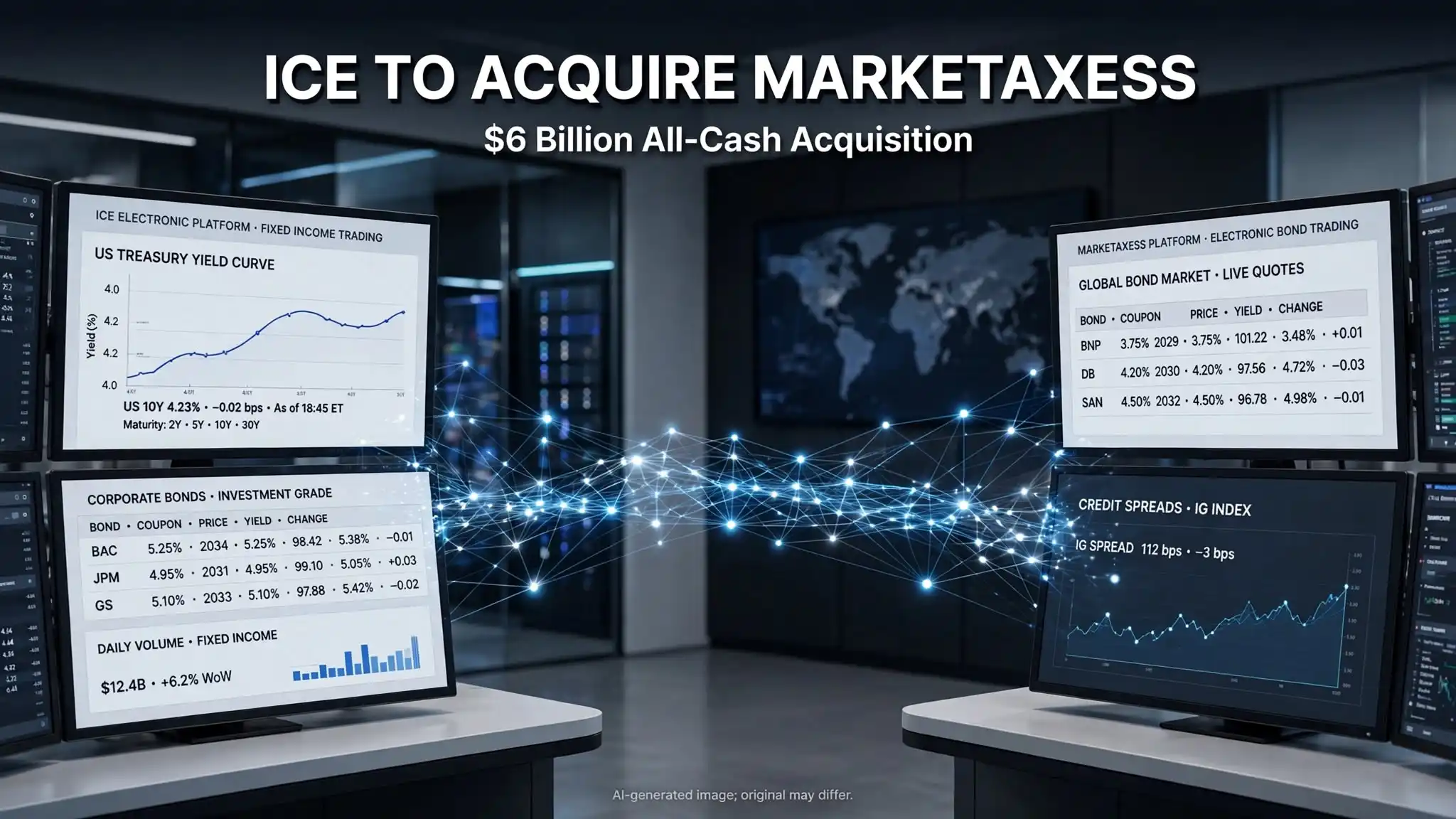
The global financial market is seeing another major consolidation in the electronic fixed-income trading space. Intercontinental Exchange (ICE), the company behind the New York Stock Exchange, has agreed to acquire MarketAxess Holdings, a leading electronic trading platform for fixed-income securities, in an all-cash transaction valued at approximately $6 billion. Under the proposed deal, ICE will pay $167 per MarketAxess share, and MarketAxess will become a wholly owned subsidiary of ICE after the transaction is completed.
The acquisition is important because the two companies operate in complementary areas of the financial market. MarketAxess has built a large electronic network connecting institutional investors and broker-dealers for bond trading, while ICE has businesses spanning financial exchanges, market infrastructure, data, analytics, indexes and fixed-income markets. By bringing these capabilities together, ICE aims to create a more connected fixed-income marketplace covering areas such as market data, analytics, price discovery, electronic trading and post-trade activities.
However, the transaction is not yet complete. It still requires regulatory review, shareholder approval and other closing conditions. The companies currently expect the acquisition to close in the first half of 2027.
ICE and MarketAxess Acquisition: At a Glance
| Point | Details |
| Acquirer | Intercontinental Exchange (NYSE:ICE) |
| Target | MarketAxess Holdings |
| Acquirer Country | USA |
| Sector | Financial Markets / FinTech |
| Industry | Electronic Fixed-Income Trading |
| Deal Type | Acquisition / Merger |
| Agreement Date | July 29, 2026 |
| Public Announcement | July 30, 2026 |
| Offer Price | $167 per share |
| Payment | 100% Cash |
| Equity Value | Approximately $6.0 billion |
| Enterprise Value | Approximately $5.7 billion |
| Premium | Approximately 33% |
| Synergy Target | Approximately $100 million annual run-rate |
| MarketAxess Network | Approximately 2,100 institutional investors and broker-dealers |
| Geographic Reach | More than 90 countries |
| Shareholder Meeting | October 29, 2026 |
| Latest HSR Refiling | September 29, 2026 |
| Expected Closing | First half of 2027 |
| Current Status | Pending regulatory and shareholder approvals |
What is Intercontinental Exchange (ICE)?
Intercontinental Exchange (ICE) is a global financial markets infrastructure and technology company.
The company operates exchanges, clearing houses, financial data and analytics businesses, and technology platforms used by financial institutions and investors.
ICE is best known for owning and operating the New York Stock Exchange (NYSE), one of the world’s largest stock exchanges.
However, ICE’s business extends beyond stock trading. The company also operates in areas such as:
- Financial exchanges
- Clearing and settlement
- Fixed-income markets
- Market data
- Financial analytics
- Indexes
- Energy and environmental markets
- Mortgage technology
This broad financial-market infrastructure is one of the reasons MarketAxess is strategically relevant to ICE.
What is MarketAxess Holdings?
MarketAxess Holdings is a financial technology company focused on electronic fixed-income trading.
Its platform allows institutional investors and broker-dealers to trade bonds electronically.
The company supports trading across several areas of the fixed-income market, including:
- Corporate bonds
- Emerging-market debt
- Municipal bonds
- Eurobonds
- U.S. Treasuries
- Other fixed-income securities
MarketAxess says its network connects approximately 2,100 institutional investors and broker-dealers across more than 90 countries.
Its platform includes the Open Trading marketplace along with automated and algorithmic trading capabilities.
In simple terms, MarketAxess provides the technology and network that helps large financial institutions trade bonds electronically.
What is the ICE and MarketAxess Acquisition?
ICE and MarketAxess entered into a definitive merger agreement under which ICE will acquire all outstanding shares of MarketAxess for cash.
The agreement was signed on July 29, 2026, and the transaction was publicly announced on July 30, 2026.
Under the proposed structure, ICE’s wholly owned subsidiary Igloo Merger Sub II will merge with MarketAxess.
Once the transaction is completed, MarketAxess will become a wholly owned subsidiary of ICE.
Why is ICE Acquiring MarketAxess?
The acquisition is primarily based on the complementary strengths of the two companies.
ICE already has substantial capabilities in:
- Fixed-income data
- Pricing
- Analytics
- Indexes
- Market infrastructure
- Retail bond trading
MarketAxess, on the other hand, has built a large institutional electronic trading network.
This gives ICE an opportunity to combine its existing fixed-income infrastructure with MarketAxess’ electronic institutional trading capabilities.
In simple terms:
MarketAxess = Institutional electronic bond trading
ICE = Market infrastructure + Data + Analytics + Indexes + Fixed-income capabilities
The proposed combination could create a broader fixed-income ecosystem.
Why is the Fixed-Income Market Important?
Fixed income refers broadly to financial instruments such as bonds that provide contractual or predetermined cash flows.
The global bond market is enormous. ICE estimated that approximately $145.1 trillion of bonds were outstanding globally in its transaction announcement.
Despite its size, bond trading can be more fragmented than stock trading.
For example, stocks are commonly traded through centralized exchanges or organized trading venues where prices can be relatively easy to observe.
Bond markets can involve:
- Dealers
- Institutional investors
- Multiple trading platforms
- Bilateral transactions
- Different liquidity conditions
As a result, investors can need multiple sources for pricing, liquidity information, execution and post-trade services.
This is where electronic trading platforms such as MarketAxess become important.
What Does MarketAxess Bring to ICE?
One of MarketAxess’ biggest strengths is its institutional electronic fixed-income trading network.
Institutional investors and broker-dealers can use the platform to trade bonds electronically rather than relying entirely on traditional trading methods.
Its Open Trading marketplace allows different market participants to interact electronically.
MarketAxess also provides automated and algorithmic trading solutions.
Therefore, ICE is acquiring not just a financial company but also:
- An electronic trading platform
- An institutional customer network
- Fixed-income trading technology
- Automated trading capabilities
- Market data generated through trading activity
These capabilities can complement ICE’s existing financial-market businesses.
What Does ICE Bring to MarketAxess?
ICE has a much broader financial-market infrastructure ecosystem.
Its capabilities include:
- Market data
- Financial analytics
- Indexes
- Exchange infrastructure
- Clearing
- Fixed-income products
- Retail bond trading
- Financial technology
The proposed acquisition could allow MarketAxess’ institutional trading capabilities to become more closely connected with these existing ICE businesses.
This is one of the central strategic reasons behind the transaction.
Connecting Institutional and Retail Bond Markets
Another important part of the proposed transaction is the potential connection between institutional and retail fixed-income markets.
MarketAxess has historically focused heavily on institutional investors and broker-dealers.
ICE has capabilities serving retail and wealth-management participants in fixed-income markets.
The combined structure could therefore connect different parts of the bond market.
A simple way to understand it is:
MarketAxess → Institutional electronic bond trading
ICE → Data, analytics, infrastructure and retail fixed-income capabilities
Combined ecosystem → Broader fixed-income marketplace
The companies have presented this broader connectivity as an important strategic objective of the acquisition.
How Could the Combined Platform Work?
The proposed combination could connect several stages of the fixed-income trading process.
1. Pre-Trade Analytics
Before making a trade, investors need information about the market.
This can include:
- Current bond prices
- Liquidity
- Comparable securities
- Market conditions
- Potential execution prices
ICE already has significant data and analytics capabilities that could complement MarketAxess’ trading platform.
2. Electronic Trading
After deciding to trade, investors can use an electronic platform to execute transactions.
MarketAxess already provides this capability to institutional market participants.
3. Data and Analytics
Trading information can be connected with ICE’s broader data and analytics businesses.
This can support activities such as:
- Pricing analysis
- Benchmarking
- Market analysis
- Trading decisions
4. Post-Trade Activities
The broader ecosystem could also support activities such as reporting, analysis, benchmarking and compliance-related workflows.
Therefore, the strategic idea is to connect the process from:
Pre-Trade Analysis → Price Discovery → Trading → Execution → Post-Trade
What is the Financial Structure of the Deal?
ICE will pay $167 in cash for each MarketAxess share.
The announced equity value of the transaction is approximately $6 billion, while the enterprise value is approximately $5.7 billion.
The transaction is structured as an all-cash acquisition.
This means MarketAxess shareholders are expected to receive cash rather than ICE shares.
ICE has said it expects to fund the transaction using a combination of available cash and incremental debt financing.
ICE Expects Approximately $100 Million in Annual Synergies
ICE expects approximately $100 million in annual run-rate expense synergies from the acquisition.
The company expects these savings to be fully realized over approximately three years following the closing of the transaction.
Potential areas for savings can include:
- Technology infrastructure
- Corporate functions
- Administrative operations
- Other overlapping costs
However, these are management estimates and are not guaranteed results. Actual savings could differ depending on the integration process and future business conditions.
ICE Plans to Increase Its Share Buyback
ICE also announced that it plans to increase its baseline share repurchase activity from $350 million per quarter to $400 million per quarter.
At the same time, ICE expects its gross leverage to initially increase to approximately 3.4x after the acquisition.
The company has said it expects to reduce gross leverage to 3.0x or below within 18 to 24 months.
This makes debt management an important financial consideration following the acquisition.
MarketAxess Financial Performance Before the Acquisition
MarketAxess reported its second-quarter 2026 financial results around the time of the acquisition announcement.
The company reported:
| Financial Metric | Q2 2026 |
| Revenue | $218.4 million |
| Net Income | $68.3 million |
| Diluted EPS | $1.93 |
| Services Revenue | $31.5 million |
| Operating Margin | 41.1% |
For the first half of 2026, MarketAxess reported revenue of $452 million, compared with $428 million during the same period in 2025.
That represents approximately 6% year-over-year growth.
This indicates that MarketAxess was continuing to expand its business before the proposed acquisition.
MarketAxess Trading Activity Also Increased
MarketAxess reported growth in several important trading categories during Q2 2026.
Block Trading
Block trading average daily volume increased 11% to $5.9 billion.
Portfolio Trading
Portfolio trading average daily volume increased 33% to a record $2.0 billion.
Services Revenue
Services revenue increased 14% to a record $31.5 million.
These figures demonstrate the importance of MarketAxess’ electronic trading technology and institutional network.
What Will Happen to MarketAxess After the Acquisition?
MarketAxess is expected to become a wholly owned subsidiary of ICE after the transaction closes.
It will therefore become part of the wider ICE financial-market ecosystem. However, the acquisition has not yet closed. Until the transaction is completed, both companies will continue to operate separately.
The integration of technology, systems and business operations would take place following the completion of the transaction.
Why Has the Acquisition Not Closed Yet?
The transaction still requires regulatory and shareholder approvals.
A significant development occurred in September 2026.
ICE and MarketAxess voluntarily withdrew their initial filings under the U.S. Hart-Scott-Rodino (HSR) Act on September 25, 2026.
The companies then refiled the HSR notifications on September 29, 2026.
The new HSR waiting period is scheduled to expire at 11:59 p.m. ET on October 29, 2026, although the process can change depending on regulatory action.
This means the transaction remains subject to regulatory review.
MarketAxess Shareholders Will Vote on the Deal
MarketAxess has scheduled a special shareholder meeting for October 29, 2026.
Shareholders will vote on the proposed merger agreement at the meeting.
Therefore, several important steps remain:
Regulatory Review → Shareholder Approval → Other Closing Conditions → Transaction Closing
The companies currently expect the transaction to close during the first half of 2027, subject to the required approvals and other closing conditions.
What Are the Main Risks and Uncertainties?
Like any large acquisition, the ICE-MarketAxess transaction has several areas that investors and market participants will need to monitor.
Regulatory Review
The U.S. regulatory review remains an important part of the transaction process.
The September HSR refiling means the waiting period extends into October 2026.
Integration Risk
Combining two financial technology businesses can involve technical and operational challenges.
ICE will need to integrate systems, technology, data and business processes while continuing to serve existing customers.
Synergy Risk
ICE expects approximately $100 million in annual run-rate expense synergies.
However, the actual savings and timing could differ from current estimates.
Higher Leverage
ICE expects leverage to increase initially because the transaction will involve incremental debt financing.
The company’s stated plan is to reduce leverage following the acquisition.
Fixed-Income Market Conditions
MarketAxess’ business is influenced by trading volumes, market activity and liquidity in fixed-income markets.
Changes in these factors can affect the company’s financial performance.
What Does the Acquisition Mean for the Financial Market?
The ICE-MarketAxess transaction is significant because both companies have established businesses in the fixed-income market, but their strengths are different.
MarketAxess provides:
- Electronic institutional bond trading
- A large institutional customer network
- Automated trading technology
- Fixed-income trading infrastructure
ICE provides:
- Financial market infrastructure
- Data
- Analytics
- Indexes
- Fixed-income capabilities
- Retail bond market capabilities
The proposed acquisition would bring these capabilities under the same corporate structure.
The broader strategy is to create a more connected fixed-income ecosystem covering:
Data → Analytics → Price Discovery → Electronic Trading → Execution → Post-Trade
Whether the transaction ultimately delivers the expected benefits will depend on regulatory approval, successful integration, market conditions and the companies’ ability to achieve their stated objectives.
This transaction would generally not be classified as an Asset/IP acquisition because ICE is acquiring the outstanding shares of MarketAxess. Following completion of the merger, MarketAxess is expected to become a wholly owned subsidiary of ICE.
Conclusion
The proposed acquisition of MarketAxess by Intercontinental Exchange represents a major transaction in the electronic fixed-income trading industry. ICE is seeking to combine MarketAxess’ institutional electronic bond-trading network with its own financial-market infrastructure, data, analytics and fixed-income capabilities.
The $6 billion all-cash transaction is still pending and has not yet closed. Regulatory review and the MarketAxess shareholder vote remain important steps, with the companies currently expecting completion in the first half of 2027.
The key question for the combined business will be how effectively ICE can integrate MarketAxess’ electronic trading capabilities with its existing fixed-income ecosystem and whether the expected operational synergies and strategic benefits are achieved over time.