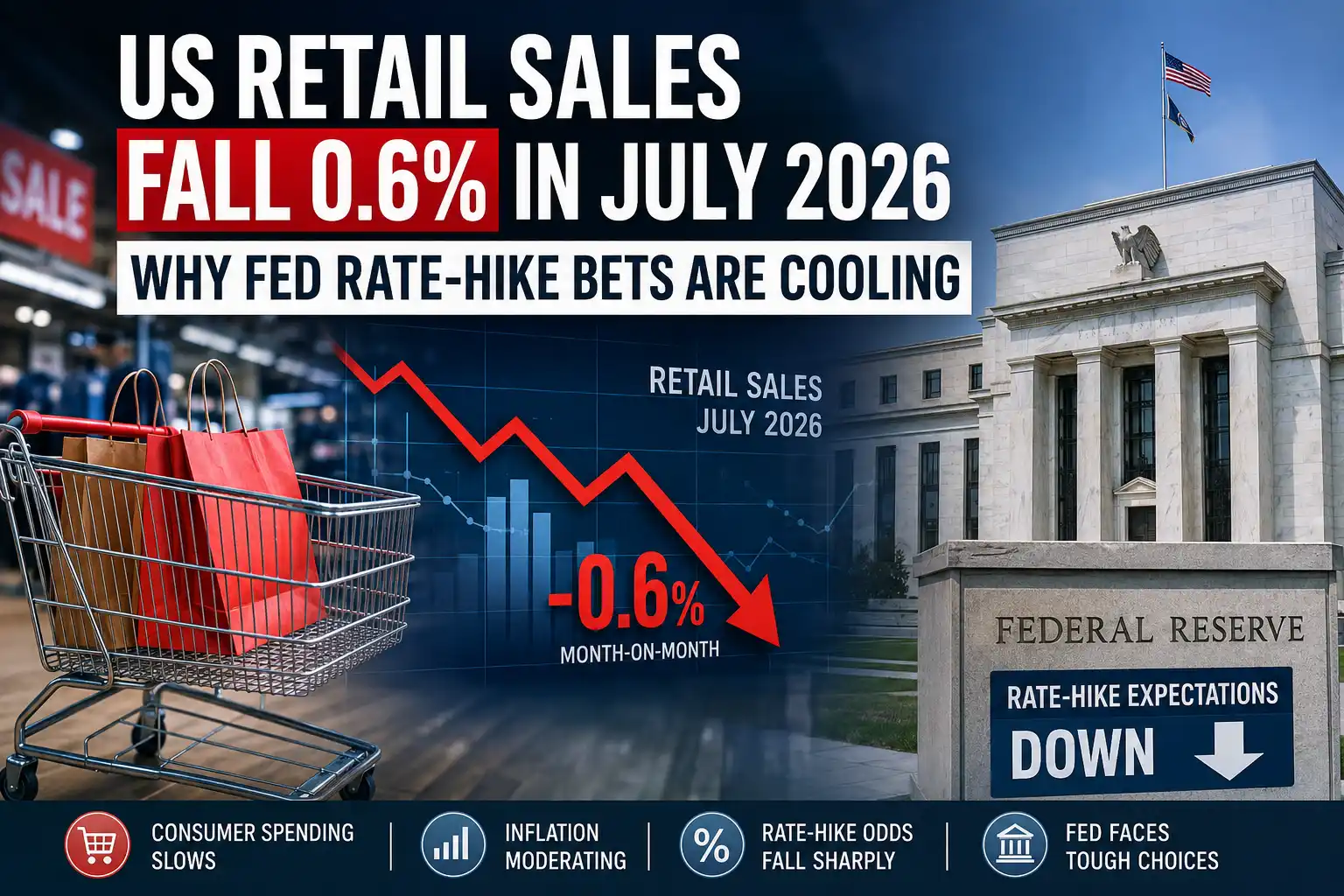
The U.S. consumer economy showed an unexpected sign of weakness in July 2026. U.S. retail and food-services sales fell 0.6% month-on-month, marking the first monthly decline in nine months and the largest drop in 14 months. Economists had expected a small increase of around 0.1%, making the result a clear downside surprise.
The report has become particularly important for financial markets because it came alongside softer employment data and moderating inflation. Together, these developments have reduced expectations that the Federal Reserve will raise interest rates at its September 2026 meeting.
However, the data does not yet mean that the U.S. consumer has collapsed. Retail sales were still about 5% higher than a year earlier, while several important spending categories continued to grow. The bigger question is whether July’s weakness was temporary or the beginning of a broader slowdown in consumer spending.
What Happened to US Retail Sales in July 2026?
According to the U.S. Census Bureau’s retail-sales data, U.S. retail and food-services sales fell to approximately $763.6 billion in July, down 0.6% from June.
The result was significantly weaker than economists had expected. June had recorded a 0.2% increase after revisions.
| Indicator | July 2026 |
| Retail & food-services sales | -0.6% MoM |
| Market expectation | Around +0.1% |
| Year-over-year growth | About +5% |
| Total sales | ~$763.6 billion |
| Control group | -0.4% |
The decline is important because consumer spending is one of the biggest drivers of the U.S. economy. If Americans spend less, businesses can experience weaker revenue growth, which can eventually affect hiring, investment and economic growth.
The U.S. Census Bureau describes its monthly retail-sales survey as an early indicator of sales and receipts from retail and food-service businesses.
Why Did Retail Sales Fall?
At first glance, a 0.6% decline looks worrying. But the reasons behind the fall are important.
Some of the weakness came from temporary or unusual factors, rather than a sudden collapse in consumer demand.
Amazon Prime Day Shifted Spending
One of the biggest reasons was the timing of online promotions.
Amazon moved its Prime Day event into June rather than July. This meant that some purchases that normally would have appeared in July’s retail-sales data were recorded in June instead.
As a result, non-store retail sales, which largely represent online shopping, dropped around 2.2% in July.
This means July’s online-sales decline should not be interpreted entirely as consumers abandoning online shopping.
In fact, online sales were still higher than a year earlier.
Auto Sales Also Declined
Motor-vehicle-related sales fell around 1.8% in July.
Cars are expensive purchases, so changes in automobile sales can have a relatively large effect on the headline retail-sales number.
This decline also indicates that consumers may have become somewhat more cautious about large purchases.
However, one month of weaker auto sales is not enough to establish a long-term trend.
Lower Gasoline Prices Reduced Sales Value
Gasoline-station sales also declined.
This is an important technical point because retail-sales figures measure dollar value, not simply how many gallons consumers purchase.
If gasoline prices fall, consumers can spend less money at fuel stations even if their physical fuel consumption does not change significantly.
Therefore, part of the headline 0.6% decline came from lower gasoline prices rather than a dramatic collapse in fuel demand.
Some Consumer Categories Actually Grew
The July report was not weak everywhere.
Several categories recorded increases:
- Clothing: +1.9%
- Restaurants and bars: +0.5%
- Furniture and home furnishings: +0.3%
This is important because it shows that American consumers were still spending in several discretionary categories.
Therefore, the report is better described as a slowdown in consumer momentum, rather than a complete consumer spending collapse.
The More Important Number: Control-Group Sales
Economists pay special attention to the retail-sales control group.
This measure excludes some volatile categories and is used in calculating consumer spending in GDP.
The control group fell approximately 0.4% in July.
This is significant because it suggests that the weakness was not caused only by gasoline prices and automobile sales.
In simple terms:
Some of July’s weakness was temporary, but underlying consumer spending also softened.
That is one reason economists became more cautious about the U.S. economic outlook.
Why Does Retail Sales Matter to the Federal Reserve?
The Federal Reserve has two major objectives:
- Maintain price stability.
- Support maximum sustainable employment.
Consumer spending is particularly important because it represents a major part of U.S. economic activity.
When consumers are spending strongly, businesses have greater pricing power. Strong demand can keep inflation elevated and encourage companies to hire more workers.
But when consumer demand starts slowing, businesses may find it harder to increase prices.
The chain can look like this:
Lower consumer demand → weaker pricing power → lower inflation pressure → less need for higher interest rates
This is why a weak retail-sales report can influence expectations for Fed policy.
Why Did September Fed Rate-Hike Expectations Fall?
The retail-sales report did not come in isolation.
Several economic indicators have recently pointed toward slower momentum.
Weak Retail Sales
July retail sales fell 0.6%, against expectations for a small increase.
Softer Employment
Recent U.S. employment data has also shown signs of cooling.
Reuters reported that unexpected job losses in July were among the factors causing economists to become less confident about further Fed tightening.
Inflation Has Moderated
Inflation has also eased somewhat, although it remains above the Federal Reserve’s 2% target.
The combination of softer economic activity and moderating inflation makes another rate hike less urgent.
Market Odds for a September Rate Hike Fell Sharply
This is where the retail-sales report had its biggest immediate impact.
By August 17, markets were pricing roughly a 30% probability of a September Fed rate hike, compared with more than 50% a week earlier. Reuters reported that traders had significantly reduced their expectations for another rate increase.
Goldman Sachs chief economist Jan Hatzius also said a September rate hike was looking very unlikely, citing weaker retail sales, softer employment data and cooling inflation.
This does not mean investors are suddenly expecting aggressive rate cuts.
The current market expectation is more accurately described as:
Fed hike → becoming less likely
rather than:
Fed cut → definitely coming
Fed Is Still Facing an Inflation Problem
There is an important reason the Fed cannot simply respond to weak retail sales by immediately cutting rates.
Inflation is still above the central bank’s target.
Reuters’ August economist poll found that a strong majority of economists expected the Fed to keep its policy rate in the 3.50%-3.75% range through the end of 2026.
So the Fed faces a difficult balancing act.
If it raises rates:
It could further slow consumer spending and economic growth.
If it cuts rates too quickly:
It could allow inflation to remain elevated or accelerate again.
Therefore, policymakers are likely to wait for more data before making a major change.
What Does This Mean for US Stocks?
The impact on stocks is complicated.
At first, weaker economic data can look negative because it indicates slower economic growth.
But markets can sometimes interpret weak economic data positively when it reduces the possibility of higher interest rates.
The logic is:
Weak economic data → lower rate-hike expectations → lower future borrowing costs → potentially higher stock valuations
This is especially relevant for technology and growth stocks, whose valuations are particularly sensitive to interest rates.
Reuters noted that expectations for rate relief helped support U.S. stock indexes despite concerns about weaker consumer spending.
But there is a limit.
If consumer spending continues to weaken for several months, investors may shift from:
“The Fed doesn’t need to hike.”
to:
“The U.S. economy is losing too much momentum.”
The second scenario would be considerably more negative for corporate earnings.
What Does This Mean for the US Dollar?
Lower expectations for Fed rate hikes can also put downward pressure on the U.S. dollar.
If investors expect U.S. interest rates to remain lower than previously thought, the dollar’s interest-rate advantage can decline.
Market analysis on August 17 showed the dollar under pressure following the softer U.S. economic data.
A weaker dollar can have mixed consequences.
It can benefit U.S. exporters because their products become relatively cheaper overseas, but it can also make imported goods and commodities more expensive.
What Does It Mean for US Consumers?
The July data suggests that consumers are becoming more selective.
Americans are still spending, but the pattern may be changing.
Consumers appear more willing to spend in some areas while becoming more cautious with large purchases.
This could be particularly important later in the year when retailers enter the critical holiday-shopping season.
Retailers may respond with:
- More discounts
- Promotions
- Lower-priced products
- Greater focus on value-conscious consumers
This could protect sales volumes but put pressure on profit margins.
Are US Consumers Heading Toward a Recession?
There is not enough evidence to say that yet.
The most important positive point is that retail sales remained about 5% above the previous year. Several categories also continued to grow.
Furthermore, some of July’s decline came from unusual factors such as the timing of Amazon Prime Day and lower gasoline prices.
At the same time, the 0.4% decline in the control group is a genuine warning sign.
Therefore, the best interpretation at this stage is:
The U.S. consumer is slowing, but has not collapsed.
Retailer Earnings Will Be the Next Big Test
Investors will now focus heavily on earnings from major American retailers.
Companies such as Walmart, Target and Home Depot can provide a clearer picture of what is happening inside American households.
Their earnings reports can answer important questions:
- Are consumers cutting spending?
- Are they moving toward cheaper products?
- Are higher prices reducing demand?
- Are higher-income consumers still spending strongly?
- Are retailers expecting a weaker holiday season?
Reuters also highlighted upcoming major retailer earnings as an important test for the strength of the American consumer.
What Should Investors Watch Next?
The next few economic reports will be more important than the July retail-sales number alone.
1. Employment data
If job creation continues to weaken, the case for keeping rates unchanged will become stronger.
2. PCE inflation
The Personal Consumption Expenditures price index is particularly important because it is the Federal Reserve’s preferred inflation measure.
3. August CPI
Another soft inflation report could further reduce expectations for a September rate hike.
4. Retailer earnings
Walmart, Target, Home Depot and other major retailers will provide real-world evidence about consumer demand.
5. Fed communication
Investors will closely monitor speeches, meeting minutes and the September FOMC meeting for clues about future policy.
Final Analysis
The 0.6% decline in U.S. retail sales in July 2026 is an important warning sign, but it should not be interpreted as evidence of an immediate recession.
The headline decline was partly influenced by temporary factors. Amazon’s Prime Day occurred in June instead of July, gasoline prices were lower and automobile sales declined. At the same time, clothing, restaurants and some other categories continued to grow.
However, the 0.4% decline in the retail-sales control group makes the report more significant because it points to some underlying weakness in consumer spending.
For the Federal Reserve, this is potentially good news because weaker demand can reduce inflation pressure. Combined with softer employment data and moderating inflation, it has already caused markets to sharply reduce expectations for a September rate hike.
The bigger story, therefore, is not simply that “US retail sales fell.”
The real story is that the U.S. economy may be entering a period where consumer demand is cooling at the same time that inflation is gradually moderating.
If that trend continues, the Fed may have less reason to raise interest rates. But if consumer spending weakens too much, investors will start worrying about corporate earnings and economic growth.
For now, the U.S. consumer appears weaker—but not broken. The next few months of employment, inflation and retail-sales data will determine whether July was simply a temporary pullback or the beginning of a broader slowdown.
Source: U.S. Census Bureau, Reuters, Federal Reserve, AP News, MarketWatch