
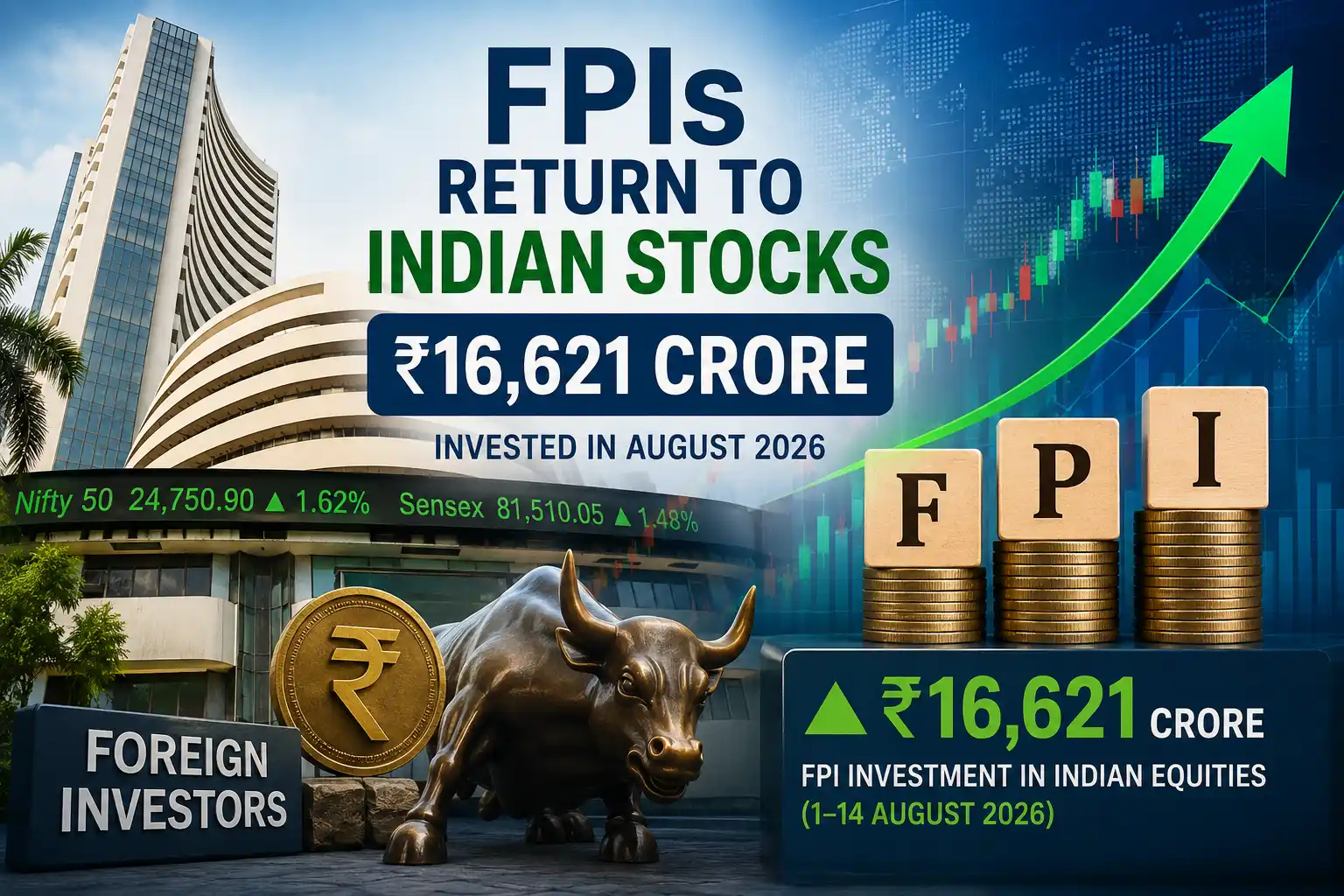
Foreign investors are showing renewed interest in Indian stocks after selling heavily earlier in 2026. Foreign Portfolio Investors (FPIs) invested ₹16,621 crore in Indian equities during the first half of August 2026, extending the buying trend that started in July.
The turnaround is important because foreign investors had pulled a large amount of money out of Indian equities during the previous months amid geopolitical tensions, expensive valuations, rupee weakness and concerns about global interest rates. Now, better valuations, resilient corporate earnings and expectations of softer US interest rates are encouraging global investors to return to Indian stocks.
However, this does not yet mean that foreign investors have completely reversed their 2026 selling trend. India still needs sustained FPI buying over several months to establish a stronger long-term trend.
Foreign Investors Invest ₹16,621 Crore in Indian Stocks
According to the latest data reported on August 16, FPIs invested ₹16,621 crore in Indian equities during the first half of August.
This follows another strong month in July, when foreign investors invested around ₹20,200 crore in Indian equities.
The August inflow is particularly significant because foreign investors had been major sellers earlier in the year.
FPI investment trend
| Period | FPI equity activity |
| July 2026 | +₹20,200 crore |
| August 1–14, 2026 | +₹16,621 crore |
| August first week | +₹12,921 crore |
| 2026 earlier period | Heavy selling |
The first week alone saw FPIs invest approximately ₹12,921 crore, showing that buying accelerated at the beginning of the month.
Why Are Foreign Investors Returning to India?
There is no single reason behind the renewed buying. Several factors are working together.
1. Indian Stock Valuations Have Become More Attractive
One of the biggest reasons is valuation.
Indian stocks had traded at relatively high valuations compared with many other emerging markets. After the market correction earlier in 2026, valuations became more reasonable.
This gives foreign investors a better entry point.
In simple terms:
Earlier:
Indian stocks = expensive → foreign investors were less interested.
Now:
Prices/valuations have become more attractive → foreign investors see better opportunities.
Market analysts have also pointed to improving valuations as one of the reasons behind the renewed foreign buying.
2. Indian Companies Are Delivering Resilient Earnings
Another important reason is corporate earnings.
Despite global uncertainty, several Indian companies have continued to report relatively resilient quarterly results.
This matters because foreign investors ultimately invest in companies, not just in the Indian economy.
If companies are showing:
- Revenue growth
- Profit growth
- Better margins
- Strong cash flows
- Healthy balance sheets
then investors have greater confidence that stock prices can be supported by actual business performance.
Recent market analysis also identified resilient corporate earnings as one of the factors supporting the FPI turnaround.
3. Expectations of Lower US Interest Rates
US monetary policy is extremely important for emerging markets such as India.
When US interest rates are high, investors can earn attractive returns from relatively safer US assets. That can reduce their willingness to invest in emerging markets.
But if investors expect US rates to fall, the situation changes.
Lower US rates can mean:
Lower US yields → weaker dollar pressure → more liquidity available → emerging markets become more attractive.
India can benefit because foreign investors may move some capital toward Indian equities and bonds in search of better growth opportunities.
The latest FPI buying has partly been attributed to expectations of softer US interest rates.
4. India’s Economic Growth Story Remains Attractive
India continues to be viewed as one of the major long-term growth economies.
Investors are watching:
- Infrastructure spending
- Manufacturing
- Digital economy
- Banking and credit growth
- Consumer demand
- Technology
- Renewable energy
- Defence
- Capital expenditure
The long-term growth opportunity remains one of the reasons global investors continue to maintain exposure to India.
Jefferies recently highlighted accelerating credit growth, renewed foreign capital flows and supportive RBI policies as positive factors for India’s financial markets.
5. Domestic Investors Are Providing Strong Support
One important change in India’s market structure is that foreign investors are no longer the only major source of equity demand.
Indian mutual funds, SIPs, insurance companies and other domestic institutional investors have become an important counterbalance to FPI selling.
For example, Reuters reported that Indian equity mutual-fund inflows remained positive for the 65th consecutive month in July, even though monthly inflows declined 14.8% from June. SIP contributions remained close to record levels.
This gives India’s stock market an important cushion.
Earlier
FPI selling → Indian market falls sharply
Now
FPI selling + strong domestic buying → market has greater support
That is a major structural change in India’s equity market.
6. The Rupee Situation Has Also Improved
Currency movements are very important for foreign investors.
If the Indian rupee falls sharply against the US dollar, foreign investors can lose part of their returns after converting their Indian investments back into dollars.
Recently, strong dollar inflows have helped India’s external position.
India’s foreign-exchange reserves reached around $707 billion as of August 7, a four-month high. Reserves increased by about $40 billion over the preceding six weeks, helped by strong foreign-currency inflows.
The RBI has also taken several measures to encourage foreign-currency inflows.
7. RBI’s Measures Are Helping Capital Inflows
The Reserve Bank of India introduced several measures to encourage foreign-currency inflows.
The response has been stronger than expected.
The RBI said more than $50 billion had flowed through the FCNR(B)-related measures, prompting it to bring forward the closing date of the discounted FX swap facility from September 30 to August 31.
This is important because stronger dollar inflows can help:
- Stabilise the rupee
- Increase forex reserves
- Improve India’s balance of payments
- Reduce external vulnerability
These factors indirectly make Indian financial assets more attractive to global investors.
But There Is an Important Warning
The headline ₹16,621 crore FPI buying looks very positive, but it should not be interpreted as proof that foreign investors have completely turned bullish on India.
Why?
Because foreign investors had already withdrawn a very large amount earlier in 2026.
SEBI data showed that FPIs were heavy sellers in May, pulling ₹32,963 crore from Indian equities that month alone.
Reuters also reported that foreign investors had purchased around $2.12 billion in July, but the year-to-date position remained deeply negative at that point.
So the current buying is better described as a recovery in foreign investor sentiment, rather than a complete reversal.
Foreign Investors Still Face Several Risks
1. High Crude Oil Prices
India imports a large portion of its crude oil requirements.
Therefore, higher crude prices can:
Higher oil → higher import bill → pressure on rupee → higher inflation → pressure on corporate margins
Reuters reported that Indian stocks came under pressure when crude moved toward $90 per barrel earlier in August.
This remains one of the biggest risks to India’s market.
2. US Federal Reserve Policy
If US inflation remains high and the Federal Reserve delays rate cuts, global investors could again prefer US assets.
That could reduce FPI flows into India.
Therefore, investors will closely watch:
- US inflation
- US jobs data
- Federal Reserve statements
- Treasury yields
- Dollar index
3. Geopolitical Tensions
The Middle East remains a major uncertainty.
A major escalation could push:
- Crude oil prices higher
- Shipping costs higher
- Inflation higher
- Global risk appetite lower
Emerging markets such as India could then experience another round of foreign outflows.
4. Indian Market Valuations Are Still Not Cheap Everywhere
Although valuations have become more attractive, that doesn’t mean every Indian stock is cheap.
Some small-cap and thematic areas can still have high valuations.
Market experts have warned about speculative pockets and recommend being selective rather than assuming that the entire Indian market is inexpensive.
Which Indian Sectors Could Benefit?
The return of foreign capital could benefit several sectors.
Financials
Banks and financial companies remain important because India’s credit growth has been strong. Jefferies recently highlighted domestic lending growth of around 17–18% year-on-year.
IT & Technology
If global technology spending remains strong and the US economy avoids a major slowdown, Indian IT companies could benefit.
Infrastructure & Capital Goods
Government infrastructure spending and private-sector investment can support companies involved in:
- Construction
- Engineering
- Capital goods
- Power
- Transport
Healthcare
Healthcare has also attracted attention because of relatively defensive earnings and India’s growing pharmaceutical and healthcare sectors.
Manufacturing
The government’s push toward manufacturing and supply-chain diversification continues to create long-term opportunities.
FPI Buying vs Domestic Investor Buying
India’s market has increasingly become a competition between foreign and domestic capital.
| Investor | Current trend |
| FPIs | 🟢 Buying again |
| Domestic mutual funds | 🟢 Continued inflows |
| SIP investors | 🟢 Strong |
| DIIs | 🟢 Important market support |
| Foreign bond investors | 🟢 Stronger inflows |
| Retail investors | 🟢 Active |
This combination makes India’s market less dependent on foreign investors than it was several years ago.
What Does ₹16,621 Crore Mean for the Indian Stock Market?
The immediate impact is positive.
FPI buying can increase demand for large Indian companies and improve market sentiment.
It can also support:
Foreign buying → higher demand for stocks → better sentiment → potentially higher valuations → more confidence among other investors
But the reverse is also possible if foreign investors start selling again.
Therefore, one fortnight of buying is not enough to establish a permanent trend.
The next few months are more important.
What Investors Should Watch Next
The following indicators will be particularly important:
US Federal Reserve: Will the Fed actually cut interest rates?
Crude oil: Can oil remain under control despite Middle East tensions?
Indian rupee: Can the rupee remain relatively stable?
Corporate earnings: Will Indian companies maintain profit growth?
FPI flows: Will foreign investors continue buying after August?
Domestic flows: Will SIP and mutual-fund inflows continue supporting the market?
Economic growth: Will India’s domestic demand and investment cycle remain strong?
Outcome
The ₹16,621 crore FPI investment in Indian equities during the first half of August 2026 is an important positive development, especially after months of foreign selling.
The return of foreign investors appears to be driven by a combination of more reasonable valuations, resilient corporate earnings, expectations of softer US interest rates, improving capital inflows and India’s long-term growth prospects.
However, investors should not assume that the foreign-money cycle has completely reversed. India remains vulnerable to crude oil prices, US monetary policy, geopolitical tensions and currency movements. Reuters’ recent market coverage also shows that higher crude prices can quickly weaken Indian equities even while foreign buying remains positive.
The most important question now is not whether FPIs have returned — they clearly have — but whether they can remain consistent buyers for the rest of 2026.
If FPI buying continues alongside strong domestic SIP flows and healthy corporate earnings, it could become a significant positive catalyst for Indian equities in the second half of 2026.
Source: National Securities Depository Limited (NSDL) – FPI Investment Data.