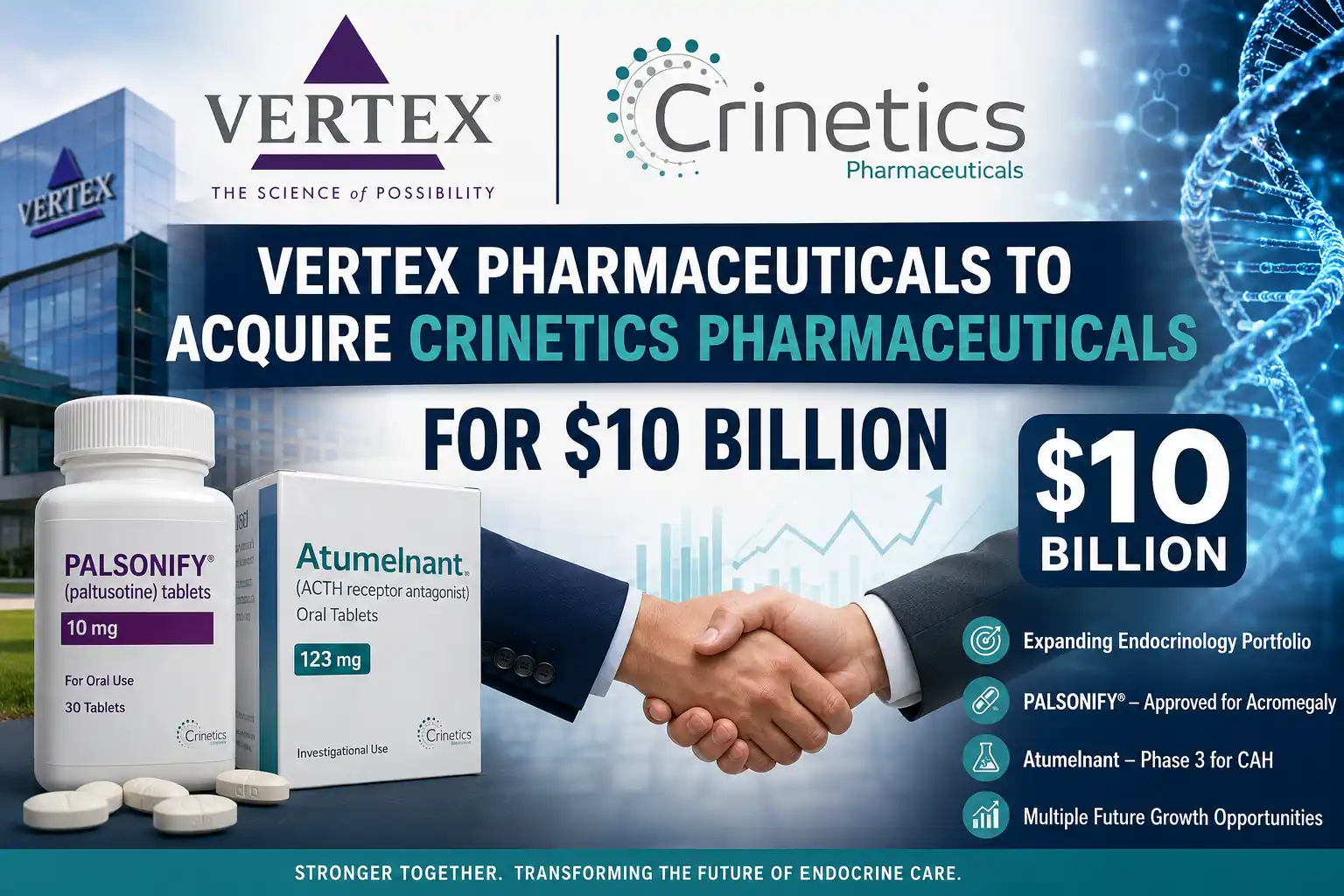
Vertex Pharmaceuticals has agreed to acquire Crinetics Pharmaceuticals in an all-cash deal valued at approximately $10 billion, making it the largest acquisition in Vertex’s history.
Under the agreement announced on July 6, 2026, Vertex will pay $85 per Crinetics share in cash. The transaction represents an equity value of approximately $10 billion, or around $8.8 billion after accounting for estimated cash acquired. Both companies’ boards unanimously approved the transaction.
The acquisition is particularly important because it gives Vertex a major entry into endocrinology, adding a new therapeutic area to its business. Crinetics brings two key assets: PALSONIFY (paltusotine), an already approved oral treatment for acromegaly, and atumelnant, a late-stage experimental medicine being developed for congenital adrenal hyperplasia (CAH).
As of August 15, 2026, the transaction has not yet closed. The companies are targeting completion in the third quarter of 2026, subject to Crinetics shareholder approval, antitrust and other regulatory clearances, and customary closing conditions.
Summary of the Vertex–Crinetics deal
| Deal Detail | Information |
| Acquirer | Vertex Pharmaceuticals |
| Target | Crinetics Pharmaceuticals |
| Announcement Date | July 6, 2026 |
| Deal Type | Acquisition / Cash Merger |
| Offer Price | $85 per share |
| Equity Value | Approximately $10 billion |
| Net Value | Approximately $8.8 billion after estimated cash acquired |
| Acquirer Exchange | Nasdaq |
| Acquirer Ticker | VRTX |
| Target Exchange | Nasdaq |
| Target Ticker | CRNX |
| Expected Closing | Q3 2026 |
| Payment | 100% Cash |
Vertex Pharmaceuticals: Company Introduction
Vertex Pharmaceuticals is a major global biopharmaceutical company headquartered in Boston, Massachusetts.
The company is best known for developing medicines for cystic fibrosis (CF) and has built a strong position in specialty and rare diseases.
In recent years, Vertex has been trying to reduce its dependence on its established cystic fibrosis business by expanding into additional areas such as:
- Hematology
- Kidney diseases
- Pain
- Cell and genetic therapies
- Endocrinology
The Crinetics acquisition fits directly into this diversification strategy. Vertex itself describes the deal as adding endocrinology as another major pillar of its business.
Crinetics Pharmaceuticals: Company Introduction
Crinetics Pharmaceuticals is a San Diego-based pharmaceutical company focused mainly on endocrine diseases and endocrine-related tumors.
The company develops small-molecule medicines designed to target specific biological pathways. Its technology platform focuses heavily on G-protein-coupled receptors (GPCRs).
Crinetics was founded in 2008 and has developed a pipeline covering diseases such as:
- Acromegaly
- Congenital adrenal hyperplasia
- Cushing’s syndrome
- Neuroendocrine tumors
- Graves’ disease
- Thyroid eye disease
- Hyperparathyroidism
Its most important achievement so far has been bringing PALSONIFY to the market.
The transaction is structured as an all-cash acquisition.
The $85-per-share offer represented a 101% premium to Crinetics’ July 2 closing price and a 127% premium to its 30-day volume-weighted average price, according to Crinetics’ SEC-filed materials.
Why Is Vertex Paying $10 Billion for Crinetics?
The simple answer is that Vertex is not just buying Crinetics’ current revenue.
It is buying a combination of:
- An already approved medicine
- A growing commercial product
- A potentially blockbuster Phase 3 drug
- Crinetics’ endocrine expertise
- Its drug-discovery platform
- Its future pipeline
Vertex estimates that Crinetics’ major assets could eventually generate more than $5 billion in combined annual revenue at peak.
This makes the deal more of a future growth acquisition than a simple purchase of an existing pharmaceutical business.
PALSONIFY: The First Major Asset
One of the biggest reasons behind the acquisition is PALSONIFY, also known as paltusotine.
PALSONIFY is an oral medicine used to treat acromegaly, a rare hormonal disorder in which the body produces too much growth hormone, usually because of a pituitary tumor.
The FDA approved PALSONIFY in September 2025, and it subsequently received approval in Europe. It is currently the first and only once-daily oral therapy for adults with acromegaly in its approved setting.
Why Is an Oral Drug Important?
Many existing treatments for acromegaly involve injections.
An oral, once-daily treatment can provide patients with a more convenient alternative.
That gives PALSONIFY an important commercial opportunity if Crinetics and, eventually, Vertex can continue expanding adoption.
PALSONIFY Was Already Showing Commercial Growth
Crinetics was not selling a theoretical product when Vertex announced the acquisition.
PALSONIFY had already entered the U.S. market.
In the first quarter of 2026, Crinetics reported:
- PALSONIFY net product revenue of $10.3 million
- Total quarterly revenue of $10.7 million
- 232 enrollment forms during the quarter
- 263 unique healthcare providers had prescribed PALSONIFY within the first two quarters of launch
- Around 70% of patients receiving PALSONIFY at the end of Q1 were on reimbursed therapy.
This early commercial traction is important because it gives Vertex a product that can potentially generate revenue relatively quickly after the acquisition closes.
Atumelnant: The Bigger Long-Term Opportunity?
While PALSONIFY provides an existing commercial business, atumelnant could become the bigger long-term growth driver.
Atumelnant is a once-daily oral ACTH receptor antagonist currently being developed for congenital adrenal hyperplasia (CAH).
It is in Phase 3 development for adults, with additional development in pediatric patients.
The drug is also being investigated for ACTH-dependent Cushing’s syndrome.
What Is Congenital Adrenal Hyperplasia?
Congenital adrenal hyperplasia, or CAH, is a group of inherited disorders affecting the adrenal glands.
In classic CAH, patients can have difficulty producing enough cortisol while simultaneously producing excessive adrenal androgens.
That creates a difficult treatment problem.
Current therapies can help replace cortisol, but achieving appropriate control of both cortisol and androgen levels can be challenging.
Vertex believes atumelnant could potentially address this treatment gap by controlling excess ACTH-driven hormone production while helping patients maintain more physiologic glucocorticoid replacement.
Why Atumelnant Could Be Extremely Valuable
Atumelnant is still an investigational drug, so its ultimate commercial success is not guaranteed.
However, its potential is significant because:
- It is an oral once-daily treatment.
- It is already in late-stage clinical development.
- It targets an important unmet medical need.
- It could potentially be used in multiple endocrine diseases.
- Vertex has the financial and commercial resources to support global development.
This is one reason Vertex estimates that Crinetics’ lead assets could eventually generate more than $5 billion in combined annual revenue at peak.
Why Crinetics Agreed to the Deal
Crinetics was building an independent endocrine pharmaceutical company, but Vertex offers something Crinetics could not easily replicate on its own: global scale.
Vertex brings:
- Large financial resources
- Global regulatory expertise
- Commercial infrastructure
- Experience with specialty and rare diseases
- Large-scale manufacturing capabilities
- International distribution
- Development expertise
Crinetics said Vertex’s global infrastructure and commercial capabilities could help expand PALSONIFY and accelerate development of its pipeline.
For Crinetics shareholders, the deal also provides immediate cash value at $85 per share.
Why This Deal Is Strategically Important for Vertex
The biggest strategic point is diversification.
Vertex has historically been heavily associated with cystic fibrosis medicines.
The company has been investing in other businesses, including hematology, pain and kidney diseases.
Crinetics adds endocrinology as another important area.
Vertex’s own transaction presentation describes the acquisition as adding a fifth major pillar to its business alongside cystic fibrosis, hematology, pain and renal disease.
So Vertex is effectively saying:
“We don’t want our future growth to depend on one major therapeutic franchise.”
How Will Vertex Finance the $10 Billion Acquisition?
Vertex plans to finance the acquisition using a combination of:
- Existing cash
- Debt
The company also has $4.5 billion of fully committed bridge financing from Bank of America and Morgan Stanley.
Importantly, the merger agreement does not contain a financing condition. In simple terms, Vertex cannot walk away merely because it fails to obtain financing.
When Will the Acquisition Close?
The transaction is expected to close during Q3 2026.
However, signing the agreement does not mean Vertex already owns Crinetics.
Several conditions still have to be satisfied, including:
- Approval by Crinetics shareholders
- U.S. antitrust clearance
- Required foreign regulatory approvals
- Other customary closing conditions
Until the transaction closes, Vertex and Crinetics remain separate companies.
Therefore, as of August 15, 2026, it is more accurate to say:
“Vertex has agreed to acquire Crinetics”
rather than:
“Vertex has completed the acquisition of Crinetics.”
What Happens to Crinetics Shares?
If the transaction closes according to the current agreement, each outstanding Crinetics common share will be converted into the right to receive $85 in cash, subject to applicable taxes and other terms.
Crinetics will then become a wholly owned subsidiary of Vertex, and its publicly traded shares will no longer remain independently listed.
What Is the Biggest Risk for Vertex?
The biggest risk is that Vertex is paying a very large amount today for revenues that are partly in the future.
PALSONIFY is already commercial, but its ultimate sales potential is still developing.
Atumelnant is even more uncertain because it remains in clinical development.
A Phase 3 drug can still fail to demonstrate sufficient efficacy or safety, or face regulatory delays.
Therefore, Vertex is essentially making a $10 billion bet on future endocrine growth.
What Is the Biggest Risk for Crinetics Shareholders?
For Crinetics shareholders, the major trade-off is different.
They receive a large immediate cash premium, but they give up the possibility of participating in the company’s future upside as an independent company.
If PALSONIFY becomes a major blockbuster and atumelnant becomes highly successful, Crinetics could potentially have been worth much more in the future.
However, shareholders also avoid the risks associated with developing and commercializing those drugs independently.
Is the Deal Strategically Logical?
From a strategic perspective, the acquisition makes considerable sense for Vertex.
The company is acquiring both current revenue and future pipeline potential.
PALSONIFY gives Vertex an already commercial product, while atumelnant provides a late-stage growth opportunity.
At the same time, Vertex gets access to Crinetics’ endocrine expertise and drug-discovery capabilities.
The deal also fits Vertex’s broader strategy of building multiple specialty medicine franchises rather than depending entirely on its existing core business.
However, the valuation is aggressive enough that execution will be critical.
Vertex expects the transaction to become accretive to non-GAAP operating income in 2029. That means the company does not expect the deal to immediately increase operating income on this measure; the financial benefits are expected to build over time.
What Investors Should Watch Next
The most important upcoming developments are:
1. Crinetics Shareholder Approval
Shareholders must approve the merger before it can close.
2. Regulatory Approvals
Antitrust and other regulatory clearances must be completed.
3. PALSONIFY Sales
Investors will want to see whether PALSONIFY can maintain strong prescription and reimbursement growth.
4. Atumelnant Phase 3 Results
Clinical data will be one of the biggest long-term value drivers.
5. Acquisition Closing
The companies are targeting completion during Q3 2026.
6. Vertex’s Financial Impact
Investors will monitor how quickly the acquisition begins contributing to revenue and earnings.
Bottom Line
Vertex Pharmaceuticals’ planned $10 billion acquisition of Crinetics Pharmaceuticals is much more than a conventional pharmaceutical takeover.
Vertex is acquiring an emerging endocrinology franchise consisting of an already approved drug, PALSONIFY, and a promising late-stage pipeline led by atumelnant.
For Crinetics, the transaction provides shareholders with $85 per share in cash and gives its medicines access to Vertex’s much larger global infrastructure.
For Vertex, the deal represents a major investment in future growth and diversification.
The key question now is not whether Vertex has agreed to buy Crinetics — that happened on July 6, 2026 — but whether PALSONIFY and atumelnant can ultimately generate the more than $5 billion in combined annual peak revenue that Vertex expects.
If the medicines perform as expected, the acquisition could become an important part of Vertex’s next phase of growth. If clinical development or commercial adoption disappoints, the $10 billion price tag could become much harder to justify.
Source: Vertex Pharmaceuticals, Crinetics Pharmaceuticals and SEC filings.