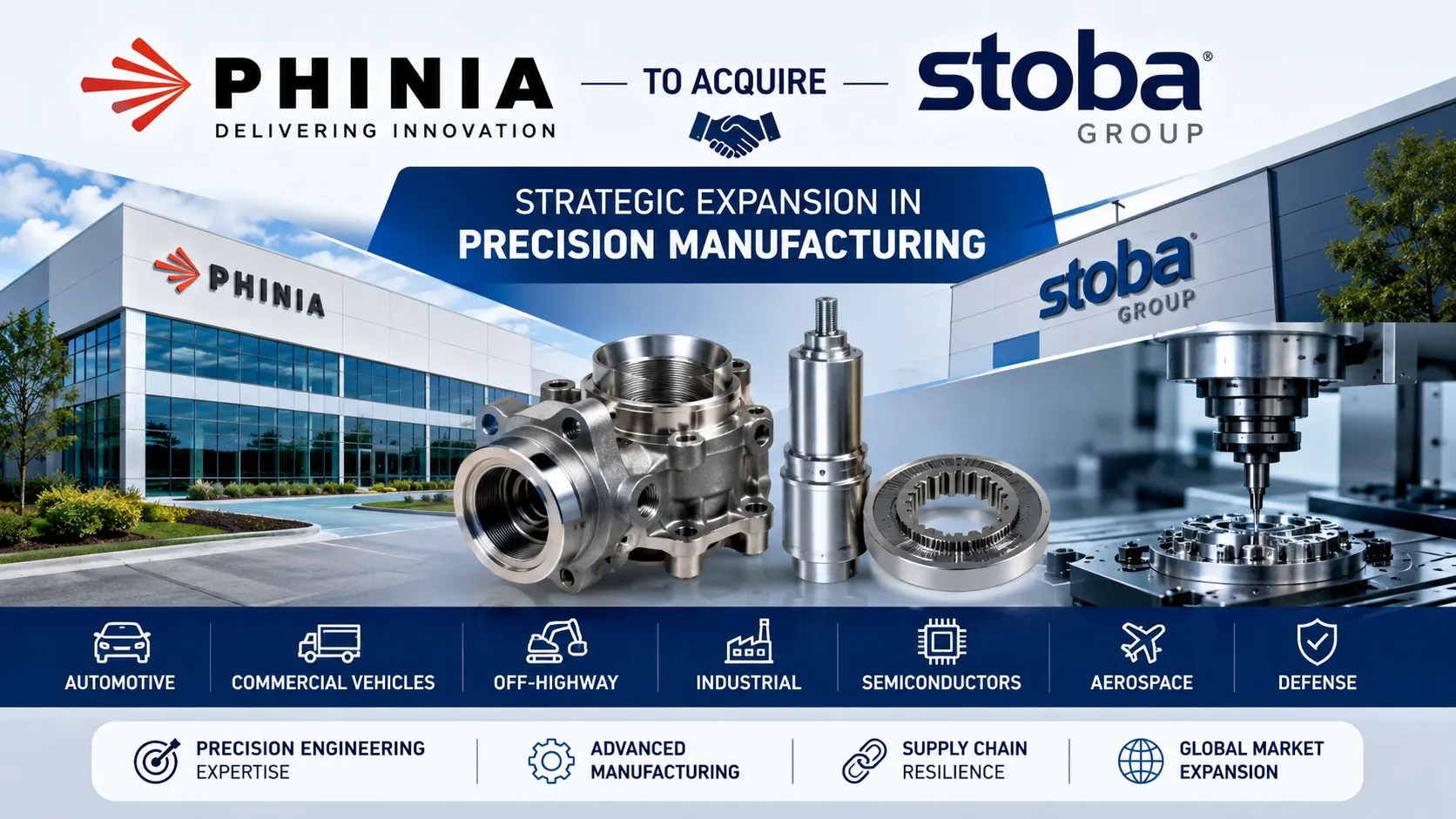
PHINIA Inc. has entered into a definitive agreement to acquire 100% of the equity interests of stoba Group, a Germany-based company specializing in high-precision components, systems and advanced manufacturing solutions.
PHINIA announced the agreement on June 30, 2026. The transaction remains subject to regulatory approvals and other customary closing conditions, with the company expecting the acquisition to close in Q4 2026.
The deal is strategically important because it will expand PHINIA’s capabilities in precision engineering, advanced manufacturing, component production and system integration.
However, the transaction is not yet complete. PHINIA has not publicly disclosed the purchase price or total transaction value.
PHINIA–stoba Acquisition: Key Deal Details
| Deal Detail | Information |
| Acquirer | PHINIA Inc. |
| Acquirer Country | USA |
| Ticker | NYSE: PHIN |
| Target | stoba Group |
| Deal Type | 100% Acquisition |
| Industry | Automotive & Industrial Manufacturing |
| Announcement Date | June 30, 2026 |
| Expected Closing | Q4 2026 |
| Deal Value | Not publicly disclosed |
| Funding | Available liquidity |
| Target Headquarters | Backnang, Germany |
| Target Employees | 1,000+ |
| Global Locations | 8 |
| Core Expertise | Precision components, systems and advanced manufacturing |
| Current Status | Pending regulatory approvals |
PHINIA has said it expects to fund the transaction using its available liquidity. The company has not disclosed the purchase price of stoba Group.
What is PHINIA?
PHINIA Inc. is a global automotive and industrial supplier headquartered in Auburn Hills, Michigan.
The company develops and manufactures technologies related to fuel systems, electrical systems and aftermarket solutions.
Its major brands include DELPHI, DELCO REMY and HARTRIDGE.
PHINIA has more than 100 years of manufacturing experience, approximately 12,500 employees, more than 40 locations and operations across around 20 countries.
Although automotive remains an important part of its business, PHINIA also serves several other markets, including:
- Commercial vehicles
- Off-highway equipment
- Industrial applications
- Marine
- Power generation
- Aerospace
- Defense
This diversification is important for understanding why the stoba acquisition makes strategic sense for PHINIA.
What is stoba Group?
stoba Group is a Germany-based precision manufacturing and engineering company headquartered in Backnang, Germany.
Founded in 1961, stoba specializes in the development and production of high-precision components, systems and customized manufacturing solutions.
In simple terms, stoba helps customers manufacture complex components where accuracy, engineering quality and production consistency are extremely important.
The company has:
- More than 1,000 employees
- Eight locations worldwide
- Precision engineering expertise
- Component development capabilities
- Production and assembly capabilities
- Customized manufacturing solutions
These capabilities complement PHINIA’s existing technology and manufacturing portfolio.
Why is PHINIA Acquiring stoba Group?
The main reason behind the acquisition is capability expansion.
PHINIA already has a large global manufacturing and customer network. stoba adds specialized expertise in precision engineering and advanced manufacturing.
The combination could allow PHINIA to offer customers a broader range of capabilities, from engineering and component development to manufacturing and system integration.
A Simple Example
Imagine PHINIA is supplying a sophisticated fuel or electrical system to a vehicle or industrial customer.
That system may require a highly precise metal component or complex assembly.
With stoba’s manufacturing capabilities, PHINIA could potentially have greater control over the engineering and production of such components.
So, this acquisition is not simply about adding another company to PHINIA’s portfolio.
It is about strengthening the engineering and manufacturing capabilities behind its products.
Acquisition Expands PHINIA’s Addressable Markets
One of the most important aspects of the transaction is the opportunity to expand beyond PHINIA’s traditional automotive markets.
Passenger Vehicles
Precision components are widely used in modern vehicles. stoba’s capabilities could complement PHINIA’s existing automotive customer relationships.
Commercial Vehicles
Trucks and commercial vehicles require durable and highly engineered components. PHINIA already has a strong presence in this market.
Off-Highway Equipment
Construction, agriculture and other heavy equipment manufacturers also require precision-engineered components.
Industrial Equipment
Industrial machinery is another important market for customized and complex components.
Capital Equipment
stoba’s advanced manufacturing expertise could help PHINIA pursue opportunities in capital equipment applications.
Semiconductor Applications
Precision manufacturing is also important in semiconductor-related equipment and applications, giving PHINIA another potential area for growth.
Aerospace and Defense
Aerospace and defense applications require extremely high levels of precision and manufacturing quality.
PHINIA already has exposure to these markets, and the stoba acquisition could strengthen this diversification strategy.
Why is Precision Manufacturing Important?
Modern industrial products are becoming increasingly complex.
A component may need to be:
- Extremely accurate
- Lightweight
- Durable
- Consistent in production
- Able to operate under demanding conditions
This makes precision manufacturing an increasingly valuable capability.
stoba’s expertise could therefore give PHINIA an opportunity to participate in markets where manufacturing accuracy and engineering complexity are more important than simply producing large volumes of standard components.
How Could the Deal Strengthen PHINIA’s Supply Chain?
Supply-chain resilience has become a major priority for automotive and industrial companies. A shortage of one critical component can stop an entire production line.
By bringing stoba’s manufacturing and engineering capabilities into its broader business, PHINIA could potentially gain:
- Greater control over critical components
- Additional manufacturing flexibility
- Stronger engineering capabilities
- Better supply continuity
- More control over complex component production
Therefore, the acquisition can be viewed partly as a supply-chain resilience strategy.
PHINIA’s Financial Position
The acquisition announcement was followed by PHINIA’s Q2 2026 financial results, released on July 30, 2026.
PHINIA reported Q2 revenue of approximately $940 million, representing a 5.6% year-over-year increase.
Net earnings were approximately $40 million, while adjusted EBITDA reached around $130 million, up $4 million from the same period a year earlier.
The company reported an adjusted EBITDA margin of approximately 13.8%.
At the end of the quarter, PHINIA had approximately:
- Cash: $370 million
- Available revolving credit capacity: $450 million
- Total debt: $1.019 billion
PHINIA has indicated that it expects to finance the stoba transaction using available liquidity.
The Three Biggest Strategic Benefits
From a strategic perspective, the acquisition has three major themes.
1. Diversification Beyond Automotive
PHINIA has historically been strongly associated with automotive technologies.
However, the company has increasingly expanded into industrial, aerospace, defense and other applications.
The acquisition of stoba could accelerate that diversification.
2. Stronger Manufacturing Capabilities
stoba brings specialized precision-engineering and manufacturing expertise.
This could allow PHINIA to strengthen its position across the value chain—from engineering and component development to manufacturing and system integration.
3. One Capability, Multiple Markets
Precision manufacturing is not limited to the automotive industry.
The same capabilities can potentially be applied across:
Automotive → Industrial → Semiconductor → Aerospace → Defense
This gives the acquisition a broader strategic logic than a traditional automotive supplier deal.
What Are the Risks?
Although the strategic rationale appears strong, the transaction also carries risks.
Integration Risk
Integrating two organizations, manufacturing systems and operations can be complex.
PHINIA will need to ensure that stoba’s operations are integrated without disrupting existing customer relationships or production.
Acquisition Price
The purchase price has not been publicly disclosed.
Without knowing the acquisition valuation, it is difficult to determine whether PHINIA is paying an attractive price for the business.
Balance Sheet and Liquidity
PHINIA had total debt of approximately $1.019 billion at the end of Q2 2026.
Although the company has liquidity available to fund the transaction, investors will still need to monitor how the acquisition affects cash flow and capital allocation.
Automotive Cyclicality
PHINIA continues to have significant exposure to automotive and commercial vehicle markets.
If global vehicle production weakens, the expected benefits from the acquisition could also be affected.
What Does the Acquisition Mean for PHINIA?
The transaction could represent an important step in PHINIA’s evolution from a traditional automotive supplier toward a broader industrial technology and precision manufacturing company.
stoba’s capabilities could complement PHINIA’s existing fuel, electrical and aftermarket businesses while also opening opportunities in markets that require highly precise and technically complex manufacturing.
The biggest potential opportunity is the ability to use stoba’s expertise across several industries rather than relying only on automotive demand.
Current Status of the Acquisition
The most important point for investors and readers is that the acquisition has not yet closed.
PHINIA and stoba Group signed the definitive agreement on June 30, 2026.
The transaction is subject to regulatory approvals and other customary closing conditions.
PHINIA currently expects the transaction to close in Q4 2026.
Therefore, it is more accurate to describe the transaction as:
“PHINIA agrees to acquire stoba Group”
rather than:
“PHINIA acquires stoba Group.”
Outcome
The proposed PHINIA–stoba Group acquisition is more than a conventional automotive-sector acquisition.
PHINIA is gaining access to stoba’s high-precision engineering, advanced manufacturing and component-production capabilities, which could strengthen its position across both automotive and industrial markets.
The deal could help PHINIA improve manufacturing depth, strengthen supply-chain resilience and expand into higher-precision industries such as industrial equipment, semiconductors, aerospace and defense.
However, the final financial impact will depend on three key factors: the acquisition price, successful integration and the actual revenue and margin synergies generated after closing.
Source: Phinia newsroom