
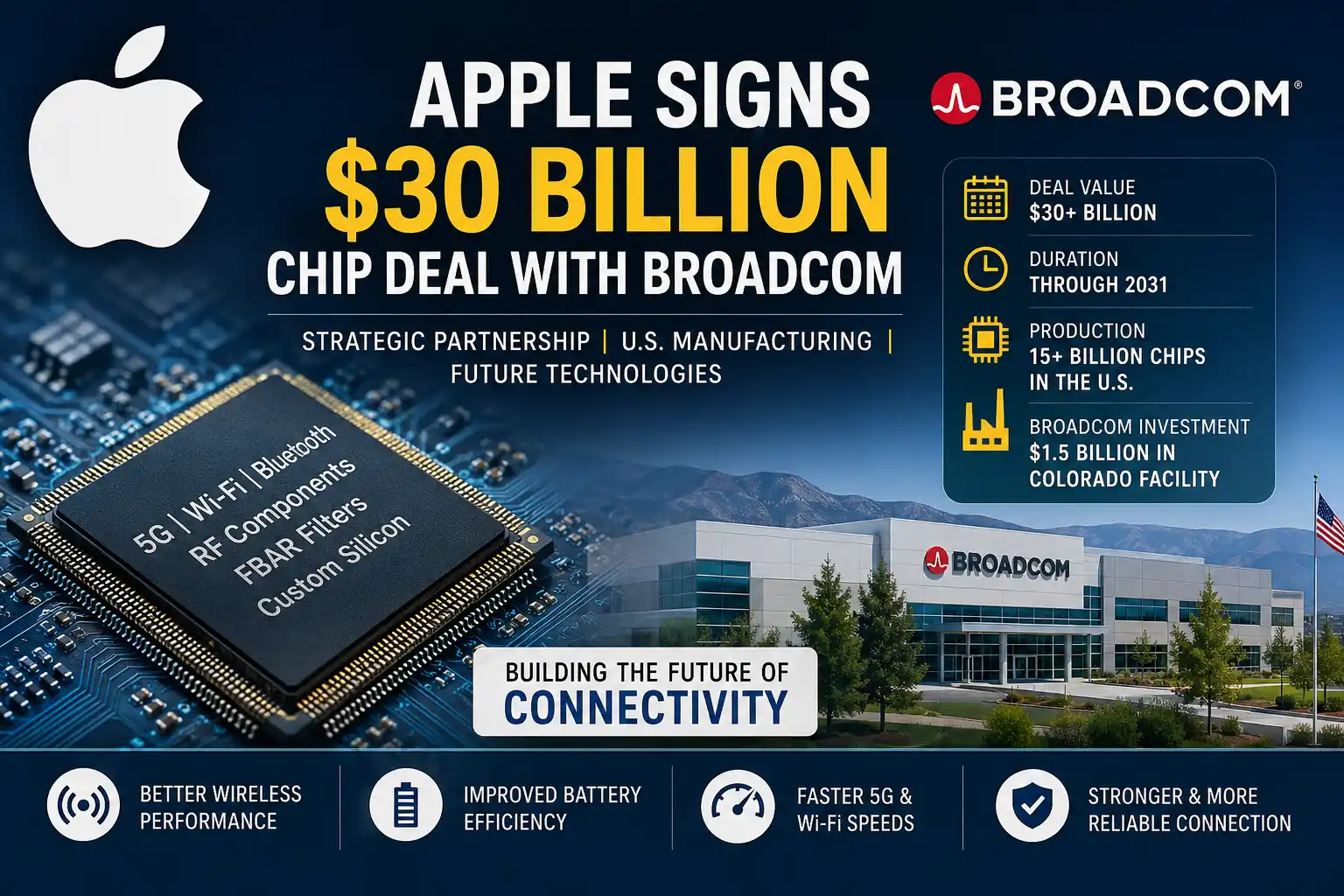
Apple has announced a new multi-year agreement worth more than $30 billion with Broadcom to design and manufacture custom semiconductor components for future Apple devices. The agreement will run through 2031 and is currently the largest commitment under Apple’s American Manufacturing Program.
As part of the agreement:
- Apple will spend over $30 billion on Broadcom-made chips.
- Broadcom will invest $1.5 billion to expand its manufacturing facility in Fort Collins, Colorado.
- The partnership is expected to produce more than 15 billion chips manufactured in the United States.
- The chips will be used in future generations of Apple products, including iPhones, iPads, Macs and other connected devices.
Deal Snapshot
| Item | Details |
| Buyer | Apple |
| Supplier | Broadcom |
| Deal Value | More than $30 Billion |
| Deal Type | Long-term Chip Supply & Development Agreement |
| Duration | Through 2031 |
| Manufacturing | United States |
| Broadcom Investment | $1.5 Billion |
| Expected Production | Over 15 Billion Chips |
What Is This Deal About?
Many people think Apple is buying processors like the A-series or M-series from Broadcom.
That is not correct.
The agreement mainly covers custom wireless connectivity technologies and radio-frequency (RF) chips, especially FBAR (Film Bulk Acoustic Resonator) filters, which help Apple devices maintain reliable wireless communication. Apple and Broadcom are also continuing work on custom silicon components developed together for future products.
These components are critical for:
- 5G connectivity
- Wi-Fi
- Bluetooth
- Network signal quality
- Faster wireless communication
- Lower power consumption
Without these chips, an iPhone would struggle to maintain high-quality wireless performance.
Why Is Apple Investing So Much?
Several strategic reasons explain the size of this investment.
1. Strengthening the Supply Chain
The semiconductor industry has faced repeated shortages over the past few years. By securing a long-term agreement, Apple ensures a stable supply of essential components through 2031.
2. Expanding U.S. Manufacturing
Apple has been increasing investment in U.S.-based manufacturing. Producing more chips domestically reduces dependence on overseas production and supports Apple’s broader U.S. investment strategy.
3. Preparing for Future Devices
Future Apple products will rely even more on:
- Artificial Intelligence
- Faster wireless communication
- Mixed Reality
- Wearables
- Smart Home devices
These technologies require increasingly advanced wireless chips.
4. Long-Term Partnership
Apple and Broadcom have worked together for many years.
Instead of changing suppliers, Apple has chosen to deepen its partnership because Broadcom has consistently delivered high-performance networking and wireless chips.
What Will Broadcom Gain?
This agreement is a major win for Broadcom.
Revenue Visibility
A contract extending through 2031 provides predictable long-term revenue from one of Broadcom’s largest customers. Analysts estimate Apple contributes around 20% of Broadcom’s annual revenue, making the renewed partnership strategically important.
Manufacturing Expansion
Broadcom will:
- Expand production capacity
- Modernize its Colorado facility
- Hire additional workers
- Increase U.S. chip production
Which Chips Are Included?
The deal focuses primarily on:
- FBAR Filters
- Radio Frequency Components
- Wireless Connectivity Chips
- Custom Networking Silicon
- Advanced Semiconductor Components
These are not Apple’s CPU chips like the A-series or M-series, but specialized components that enable reliable wireless connectivity across Apple devices.
Impact on Apple Products
Consumers are unlikely to notice immediate changes, but over time the agreement could deliver:
- Better wireless performance
- Improved battery efficiency
- Faster 5G speeds
- Stronger Wi-Fi connectivity
- More reliable Bluetooth performance
- Better performance for future AI-enabled devices
Market Reaction
The announcement was well received by investors.
- Broadcom shares rose after the news, reflecting optimism about long-term revenue.
- Apple shares moved only modestly, as investors viewed the deal as a strategic supply-chain decision rather than a short-term earnings catalyst.
Why This Matters for the Semiconductor Industry
This deal highlights several important trends:
- Long-term supply agreements are becoming more common.
- Major technology companies are investing more in domestic semiconductor manufacturing.
- Advanced wireless connectivity remains essential even as AI receives most of the industry’s attention.
- Strong supplier relationships are increasingly valuable in a competitive semiconductor market.
Risks to Watch
Although the deal strengthens both companies, there are still potential risks:
- Changes in semiconductor demand
- Technological shifts in wireless standards
- Geopolitical developments affecting global supply chains
- Rising manufacturing costs
However, the long-term nature of the agreement reduces short-term supply uncertainty for both companies.
Outcome
The $30+ billion Apple–Broadcom agreement is more than a supply contract—it is a strategic investment in Apple’s future hardware ecosystem. By locking in critical wireless technologies through 2031 and expanding U.S.-based production, Apple gains greater supply-chain resilience while Broadcom secures a long-term revenue stream and justifies further manufacturing investment.
Rather than focusing on headline value alone, the deal signals how leading technology companies are combining long-term supplier partnerships with domestic manufacturing to support next-generation devices and AI-enabled connectivity. For investors, it reinforces Broadcom’s role as a key Apple supplier while highlighting Apple’s emphasis on reliability, performance and supply security.
Overall, this is one of the most significant semiconductor supply agreements announced in 2026 and is likely to influence future investment decisions across the global chip industry.
Source: Apple newsroom