For decades, humans have dreamed of reaching Mars. From Hollywood movies to real-life space missions, the Red Planet has always been a symbol of curiosity and exploration. But sending humans to Mars is far more difficult than it sounds.
The distance between Earth and Mars is hundreds of millions of kilometers. With current rocket technology, reaching Mars can take several months. During such a long journey:
- fuel becomes a massive challenge,
- astronaut safety becomes difficult,
- and continuously powering a spacecraft is not easy either.
That is why scientists around the world are working on technologies that could make future space travel faster and more efficient.
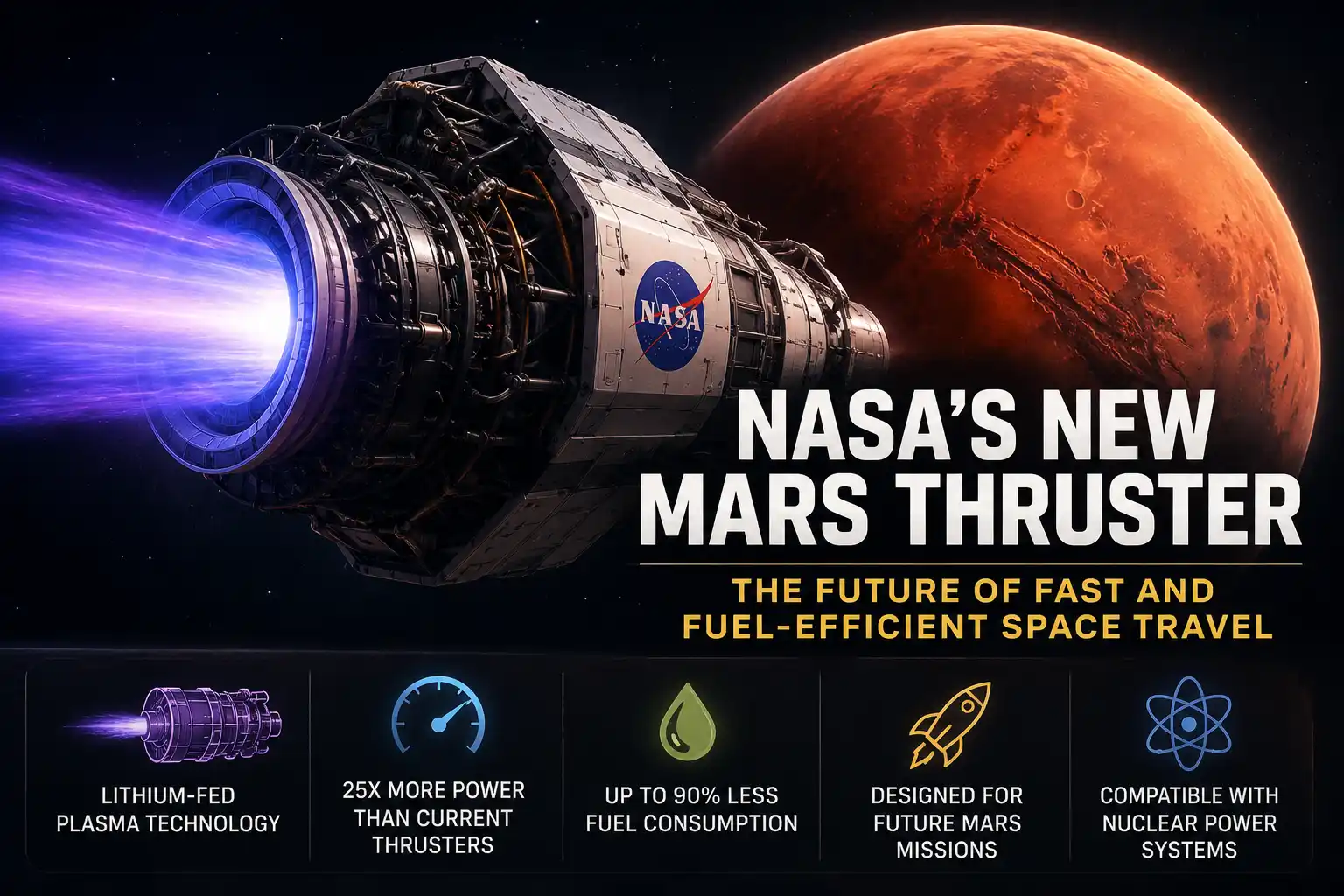
Now, in this direction, the National Aeronautics and Space Administration has tested a powerful new electric thruster that could help humans travel to Mars in the future.
This is not a normal rocket engine. Scientists believe this technology could make future Mars travel:
- faster,
- more fuel-efficient,
- and safer.
The most interesting part is that this engine does not use traditional rocket fuel. Instead, it uses lithium plasma, and its power is said to be many times greater than current space engines.
What Exactly Did NASA Test?
Scientists at NASA’s Jet Propulsion Laboratory (JPL) successfully tested a Lithium-Fed Magnetoplasmadynamic (MPD) Thruster.
The test was conducted in February 2026, and NASA officially shared details about it in April 2026.
During the test:
- the engine achieved up to 120 kilowatts of power,
- which is around 25 times more powerful than NASA’s current electric thrusters.
How Does This Thruster Work?
Traditional rockets create thrust by burning fuel.
NASA’s new MPD thruster works on a completely different concept.
What Happens Inside It?
- Lithium metal is converted into vapor.
- Powerful electric current and magnetic fields are applied.
- The lithium turns into plasma.
- The plasma is expelled at extremely high speed.
- That force pushes the spacecraft forward.
This process may sound like science fiction, but NASA has already tested it in the real world.
What Is Plasma?
In very simple terms:
Plasma is a highly energetic state of matter where particles become electrically charged.
Even the Sun is made of plasma.
NASA is trying to use this plasma in a controlled way to push spacecraft through space.
The Biggest Strength of This Technology
1. Much Lower Fuel Requirement
According to NASA, electric propulsion systems can use:
- nearly 90% less propellant compared to traditional chemical rockets.
This is extremely important for deep-space missions.
2. Continuous Long-Term Speed
Chemical rockets provide strong thrust quickly, but they also consume fuel very fast.
Electric thrusters:
- produce slower thrust,
- but continue operating for long periods,
- allowing spacecraft to gradually reach extremely high speeds.
NASA’s Psyche spacecraft already uses electric propulsion and can reach speeds of around 124,000 mph.
Why Could This Be a Game Changer for Mars Missions?
The biggest challenges of Mars missions are:
- long travel time,
- huge fuel requirements,
- and astronaut safety.
Scientists believe that if this MPD technology succeeds:
- travel time to Mars could decrease,
- spacecraft could carry more cargo,
- and human missions may become more practical.
Combination With Nuclear Power
NASA eventually wants to combine this thruster with a nuclear-electric propulsion system.
This means:
- a nuclear reactor would generate electricity,
- and that electricity would power the MPD thruster.
Such a system could become the foundation of future deep-space travel.
NASA’s Future Target
Right now, NASA has achieved 120 kilowatts of power.
But its future goal is:
- 500 kilowatts,
- then 1 megawatt,
- and eventually multi-megawatt systems.
For future human Mars missions:
- multiple thrusters may work together,
- operating continuously for thousands of hours.
What Is the Biggest Challenge?
The technology is impressive, but the challenges are also massive.
Heat Problem
During testing, the engine temperature exceeded:
- 5000°F (2800°C).
Handling such extreme heat for long durations is not easy.
Long-Term Reliability
For a Mars mission, the engine may need to:
- operate continuously for more than 20,000 hours.
This creates risks such as:
- material damage,
- erosion,
- and system failure.
Why Are Scientists So Excited About It?
The space community has reacted very positively to this test.
On Reddit and science forums, many experts described it as:
- “the future Mars engine”
- and a “deep-space revolution.”
Some users even called it:
- “an engine that throws plasma using magnets.”
Could This Change Space Travel Forever?
If NASA successfully solves:
- power scaling,
- heat management,
- and long-term reliability,
then the future of:
- Mars missions,
- asteroid mining,
- outer planet exploration,
- and deep-space cargo transport
could completely change.
This technology may eventually become the foundation for:
- space cargo vehicles,
- nuclear spacecraft,
- and human interplanetary travel.
Outcome
NASA’s new lithium-fed MPD thruster is still in its early stages, but its successful test is already being considered a major milestone in space technology.
This is not just another engine — it could become an important step toward an interplanetary human civilization.
Today, humanity is planning to build bases on the Moon.
Tomorrow, plasma engines like this may carry humans to Mars and even beyond.