Global financial markets are currently going through a transition phase where short-term relief and long-term risks are moving together.
In the past few days, oil prices have declined, creating an impression that the situation is improving. However, if we closely analyze the latest market data as of 6 April 2026 along with global developments, it becomes clear that uncertainty is still deeply embedded in the system.
The biggest issue in the market right now is:
- Positive news leads to immediate rallies
- Negative news leads to sharp declines
This indicates that the market is not in a stable trend but in a reaction-driven mode.
In simple terms:
“Calm on the surface, but instability underneath.”
Today’s Market Data (6 April 2026 – Actual Situation)
Oil Market (Detailed View)
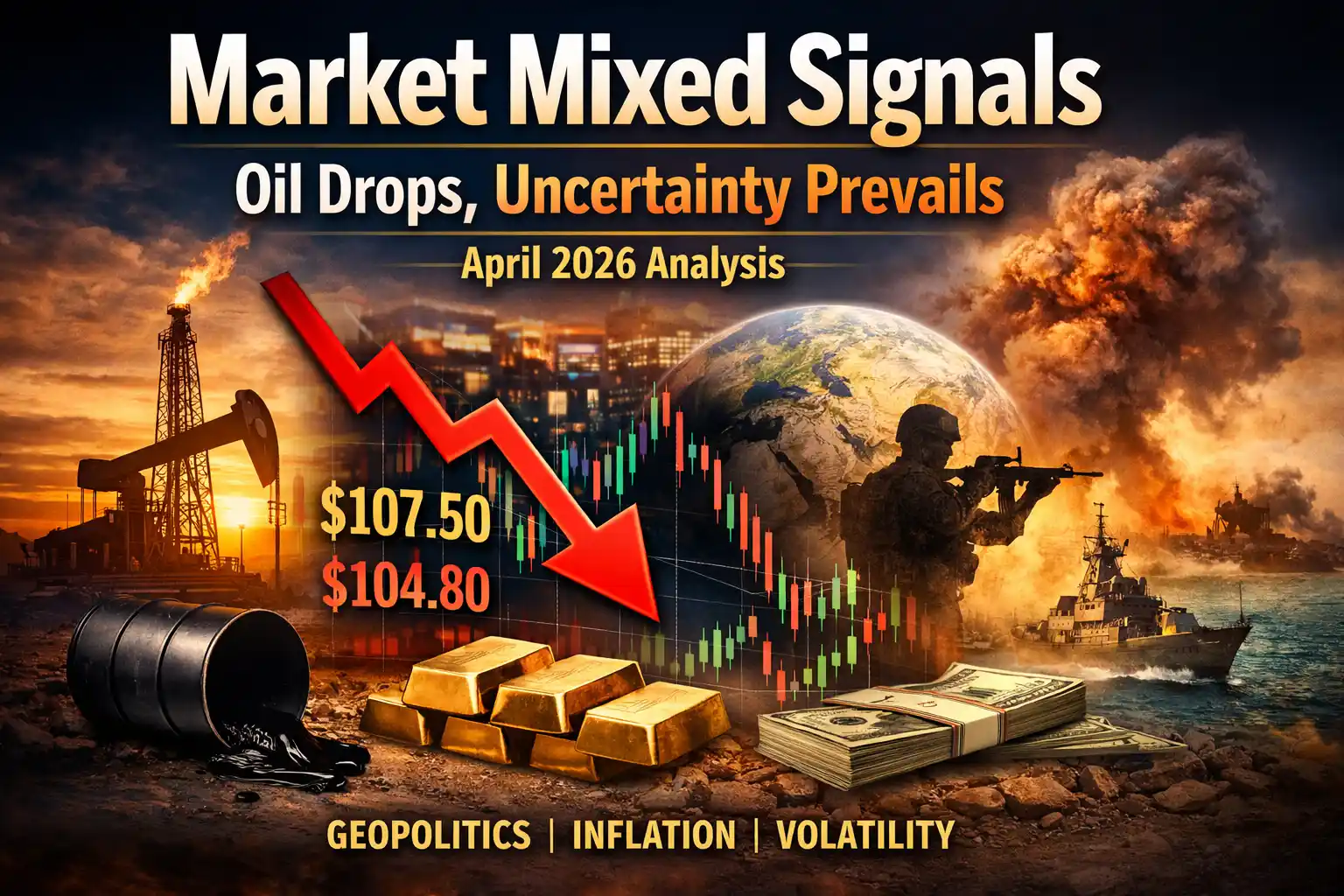
- Brent crude: around $107–109 per barrel
- WTI crude: around $104–106 per barrel
What does this mean?
- Recently, oil had surged to $110–112
- A correction has now taken place
- However, this is not a trend reversal, but a short-term adjustment
Important point:
Oil is still significantly higher than its recent average levels
Conclusion:
The panic has eased, but the risk is still priced in.
Stock Market (Global Behavior)
Current Situation:
- US futures: flat to slightly negative
- Asian markets: mixed trend
- European markets: uncertain opening
Interpretation:
- Investors are not aggressively buying
- Panic selling is also not visible
This suggests that the market is in a “wait and watch” mode.
Safe Assets (Risk Indicator)
- Gold remains strong
- Bond yields are stable or slightly lower
Interpretation:
Investors are still avoiding risk.
Fear has not completely disappeared.
Why Are Oil Prices Falling?
Short-Term Reasons for the Decline
1. Ceasefire Talks (Key Driver)
- News of negotiations between the US and Iran created optimism
- Traders reduced aggressive buying
- Profit booking increased
2. Technical Correction
- Oil surged rapidly above $110
- The market entered an overbought zone
This made a correction natural.
3. Slight Improvement in Supply
- Some shipping routes reopened
- Panic buying reduced
Reality Check
This decline is not driven by a fundamental improvement, but by a shift in sentiment.
Therefore, if negative news emerges, oil prices can spike again.
Geopolitical Risk: The Core Market Driver
Understanding the Situation
The Middle East conflict remains unresolved:
- The war has not ended
- Negotiations are ongoing, but trust is low
Oil Infrastructure Risk
- Reports of attacks in Gulf regions
- Production and storage facilities are at risk
This means supply can be disrupted suddenly.
Strait of Hormuz (Critical Factor)
Around 20% of global oil supply passes through this route.
Risk assessment:
- If blocked, it can trigger an oil shock
- If open, it provides temporary relief
The market is reacting to every update related to this route.
Why Are Stock Markets Giving Mixed Signals?
Current Pattern
- Markets are unable to form a clear trend
- Frequent swings are being observed
Positive Triggers
- Decline in oil prices
- Hope of de-escalation
Negative Triggers
- Ongoing war risk
- Inflation pressure
- Interest rate uncertainty
Deep Insight
The market is caught between two forces:
- Hope (possibility of peace)
- Fear (risk of escalation)
This conflict is creating mixed signals.
Inflation and Interest Rate Pressure (Hidden Risk)
Oil to Inflation Chain
When oil prices rise:
- Transportation costs increase
- Manufacturing costs increase
- Food prices rise
This leads to economy-wide inflation.
Central Bank Dilemma
- High inflation prevents rate cuts
- Slow growth demands rate cuts
This conflict creates policy uncertainty.
Impact on Markets
- Investors become uncertain
- Volatility increases
Supply Chain and Trade Impact
Shipping Disruptions
- Tankers are being rerouted
- Insurance and freight costs are rising
This leads to:
- Higher transportation costs
- Delays in delivery
Global Trade
- Trade growth may slow down
- Developing economies face greater pressure
Reasons:
- Higher import costs
- Currency depreciation risks
Why Is Market Volatility High?
Key Reasons
- News-driven trading
- Lack of visibility about the future
- Increased speculative activity
Result
- Large daily swings
- Unpredictable movements
Investor Behavior (Real Insight)
Current Strategy
- Shift towards safe assets
- Reduction in risk exposure
Psychological Factor
Investors are currently in “capital protection” mode:
- Preserving capital is the priority
- Profit generation is secondary
Impact on Global Economy
If the Situation Continues
- Economic growth may slow
- Inflation may rise
- Trade may weaken
Worst-Case Scenario
If oil rises to $120–140:
- Recession risk increases
- Emerging markets face significant pressure
Impact on India
India is a major oil importer, so the impact is significant.
Negative Effects
- Pressure on the rupee
- Higher import bill
- Inflation risk
Positive Efforts
- Government intervention to control prices
- Use of reserves
Conclusion
India remains relatively stable but is still exposed to external risks.
Future Outlook
Best Case
- Ceasefire achieved
- Oil stabilizes
- Market recovery
Base Case
- Tensions continue
- Volatility remains
Worst Case
- War escalates
- Oil spikes
- Market faces downside risk
Final Conclusion
As of 6 April 2026, the market clearly shows that the decline in oil prices is only a temporary relief, while underlying risks remain intact.
The market is currently standing at a delicate balance where positive developments can trigger short-term rallies, but structural risks such as geopolitical tensions, supply disruptions, and inflation pressures continue to pull it back.