In 2026, the movement of the US Dollar (USD) against the Indian Rupee (INR) is not just a normal currency fluctuation—it reflects the broader condition of the global economy.
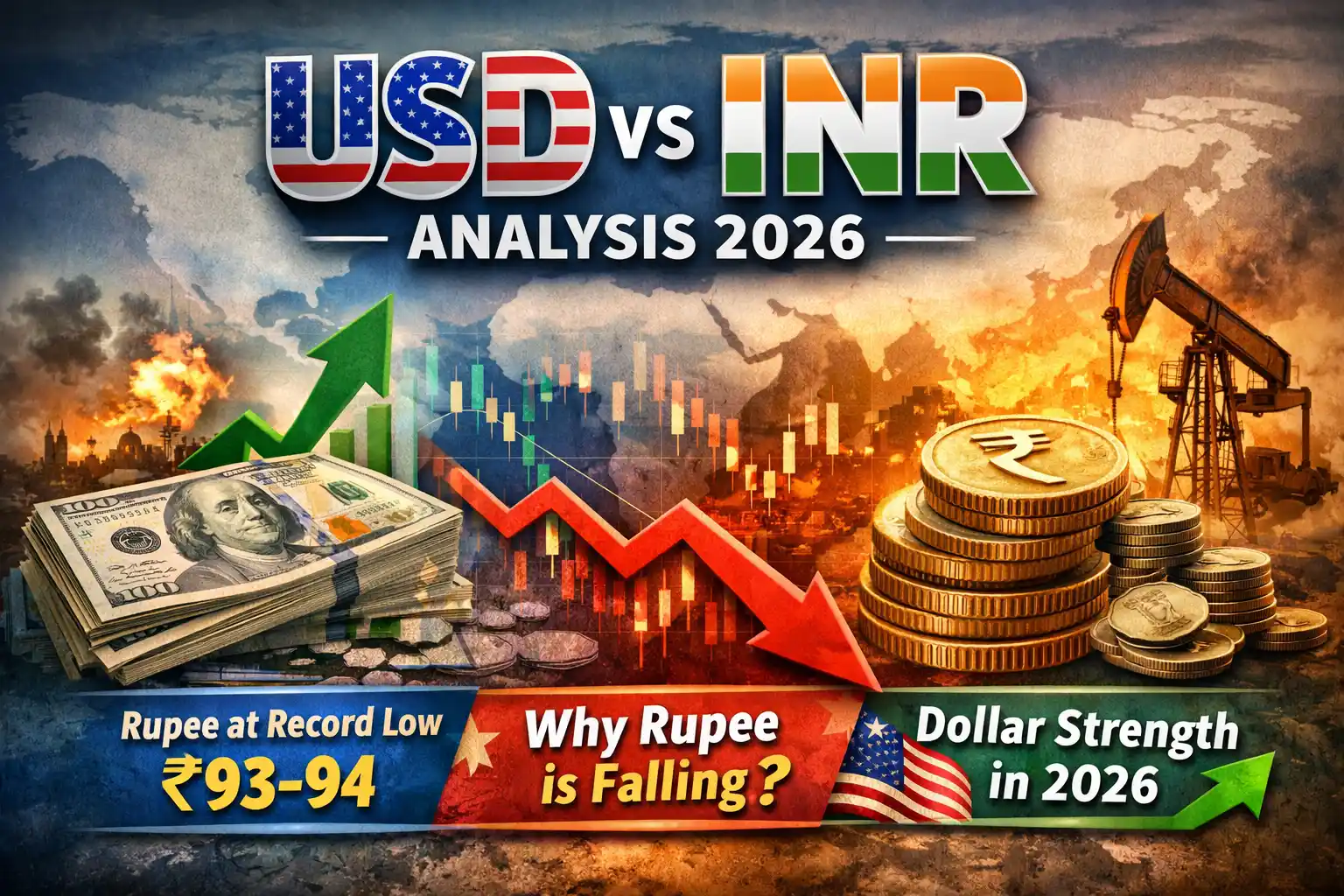
Recently, the rupee has weakened sharply, touching levels around ₹93–94 per dollar, which is considered a historic low. This sudden depreciation has raised concerns among investors, businesses, and policymakers.
However, it is important to understand that this is not just an India-specific issue. Many emerging market currencies are under pressure due to global factors. Still, the Indian rupee appears to be underperforming compared to several peers, making the situation more serious.
In this article, we will clearly explain:
- Why the rupee is weakening
- How it compares with other global currencies
- Why the US dollar is getting stronger
- What impact this has on the economy
- And what can happen next
Current USD vs INR Situation
Current Level (March 2026)
As of March 2026, the USD/INR exchange rate is trading around ₹93–94 per dollar, marking a record weak level for the rupee.
If we compare this with last year:
- 2025 level: ~₹83–84
- 2026 level: ~₹93+
This indicates a depreciation of nearly 8–9% in one year, which is quite significant for a major emerging market currency.
Recent Movement (Short-Term Trend)
The fall in the rupee has been particularly sharp in recent months:
- January 2026: ~₹90
- February 2026: ~₹91
- Early March: ~₹92
- Late March: ₹93+
The key observation here is that the decline is not gradual but sudden, indicating strong market pressure and panic-driven movements.
Why Is the Rupee Falling?
1. Rising Crude Oil Prices – The Biggest Factor
India imports around 80–85% of its crude oil needs, making it highly dependent on global oil prices.
When oil prices rise (currently above $100 per barrel):
- India needs to pay more in dollars for imports
- Demand for dollars increases
- The rupee weakens
Simple logic:
Higher oil prices → Higher dollar demand → Weaker rupee
This is the most important driver behind the current depreciation.
2. FII Outflows – Foreign Investors Pulling Out
Foreign Institutional Investors (FIIs) play a major role in India’s financial markets.
When global uncertainty rises, these investors:
- Sell Indian assets
- Convert rupees into dollars
- Move money to safer markets
This increases dollar demand and puts pressure on the rupee.
In 2026, due to global tensions and risk aversion, significant capital outflows have been observed.
3. Global Geopolitical Crisis
The ongoing geopolitical tensions, especially in the Middle East, have created uncertainty in global markets.
During such times:
- Investors prefer “safe haven” assets
- The US dollar becomes the top choice
Result:
Dollar strengthens, emerging market currencies (including INR) weaken
4. Strong US Dollar
The US dollar is the world’s dominant reserve currency.
When the global economy faces stress:
- Demand for the dollar increases
- US assets become more attractive
This strengthens the dollar globally and weakens currencies like the rupee.
5. Trade Deficit (Imports > Exports)
India consistently runs a trade deficit, meaning it imports more than it exports.
This leads to:
- Continuous demand for dollars
- Long-term pressure on the rupee
This structural issue ensures that the rupee tends to depreciate gradually over time.
6. Role of the Reserve Bank of India
The central bank intervenes in the forex market by selling dollars to support the rupee.
However:
- When global pressure is strong
- And demand for dollars is high
RBI intervention can only slow down the fall, not completely stop it.
Global Comparison: How Does INR Perform vs Other Currencies?
Major Currency Performance vs USD (2026)
| Currency | Trend | Performance vs USD | Status |
| 🇮🇳 Indian Rupee | 📉 Weak | -8% | Underperformer |
| 🇨🇳 Chinese Yuan | ⚖️ Stable | Slight weak | Controlled |
| 🇸🇬 Singapore Dollar | ⚖️ Stable | Strong | Safe currency |
| 🇰🇷 Korean Won | 📉 Weak | -3–5% | Moderate pressure |
| 🇹🇭 Thai Baht | 📉 Weak | -3% | Oil impact |
| 🇮🇩 Indonesian Rupiah | 📉 Weak | -2–3% | EM pressure |
| 🇧🇷 Brazilian Real | 📈 Strong | +2–4% | Outperformer |
| 🇲🇽 Mexican Peso | 📈 Strong | +3% | High yield advantage |
| 🇹🇷 Turkish Lira | 📉 Very Weak | -15%+ | Extreme case |
Key Insight
- The rupee is among the weakest currencies in Asia
- Commodity-exporting countries (Brazil, Mexico) are performing better
- Stable economies (Singapore, China) are managing their currencies effectively
Simple understanding:
Import-heavy economies like India suffer more during global crises
US Dollar Strength (DXY Analysis)
What is DXY?
The US Dollar Index (DXY) measures the strength of the dollar against a basket of major currencies.
Current Position
- DXY level: ~99–100
- Trend: Strong
Why Is the Dollar Strong?
- Global uncertainty
- Safe-haven demand
- Relative strength of the US economy
Result:
Stronger dollar = weaker emerging market currencies
Dollar Demand vs Supply
Demand for dollars is rising due to:
- Oil imports
- Capital outflows
- Global risk
At the same time, supply is limited
Result:
Dollar becomes expensive, rupee weakens
Global Trend
- Emerging market currencies are under pressure
- Developed market currencies are relatively stable
- The dollar is dominating global currency markets
Impact on Indian Economy
1. Higher Fuel Prices
- Cost of oil imports increases
- Petrol and diesel prices rise
2. Expensive Imports
- Electronics
- Gold
- Machinery
All imported goods become costlier
3. Rising Inflation
- Everyday goods become expensive
- Cost of living increases
4. Stock Market Volatility
- FII outflows create selling pressure
- Markets may decline
5. Government Pressure
- Higher fiscal deficit
- Increased current account deficit
Future Outlook
Short Term (2026)
- ₹94–95 per dollar possible
- Continued volatility expected
Medium Term
- Range: ₹87–95
- Depends on oil prices, global tensions, and US interest rates
Long Term
- Historical trend shows gradual rupee depreciation
- Structural factors will continue to influence movement
Key Risks Ahead
- Further rise in oil prices
- Escalation of geopolitical tensions
- Continued FII outflows
- Stronger US dollar
Any of these can push the rupee lower
Outcome
The depreciation of the rupee in 2026 is driven by a combination of global and domestic factors.
Key Takeaways:
- Rupee has fallen to record levels (~₹93+)
- Around 8–9% depreciation in one year
- Underperforming compared to other Asian currencies
- Strong dollar (DXY ~100) is a major driver
Final understanding:
The USD vs INR movement is now heavily dependent on global factors—especially oil prices and geopolitical tensions. As long as these remain elevated, pressure on the rupee is likely to continue.