Imagine a future where “artificial plants” are installed across cities and industries that use sunlight to produce fuel, hydrogen, or useful chemicals. No coal, no oil, and almost no pollution.
Scientists around the world are trying to turn this idea into reality through a technology called Artificial Photosynthesis. This technology mimics one of nature’s most powerful processes—photosynthesis.
Just as plants convert sunlight, water, and carbon dioxide into food and energy, artificial photosynthesis aims to convert solar energy directly into fuel and chemical energy. If this technology becomes commercially viable on a large scale, it could transform the global energy system.
What Is Artificial Photosynthesis?
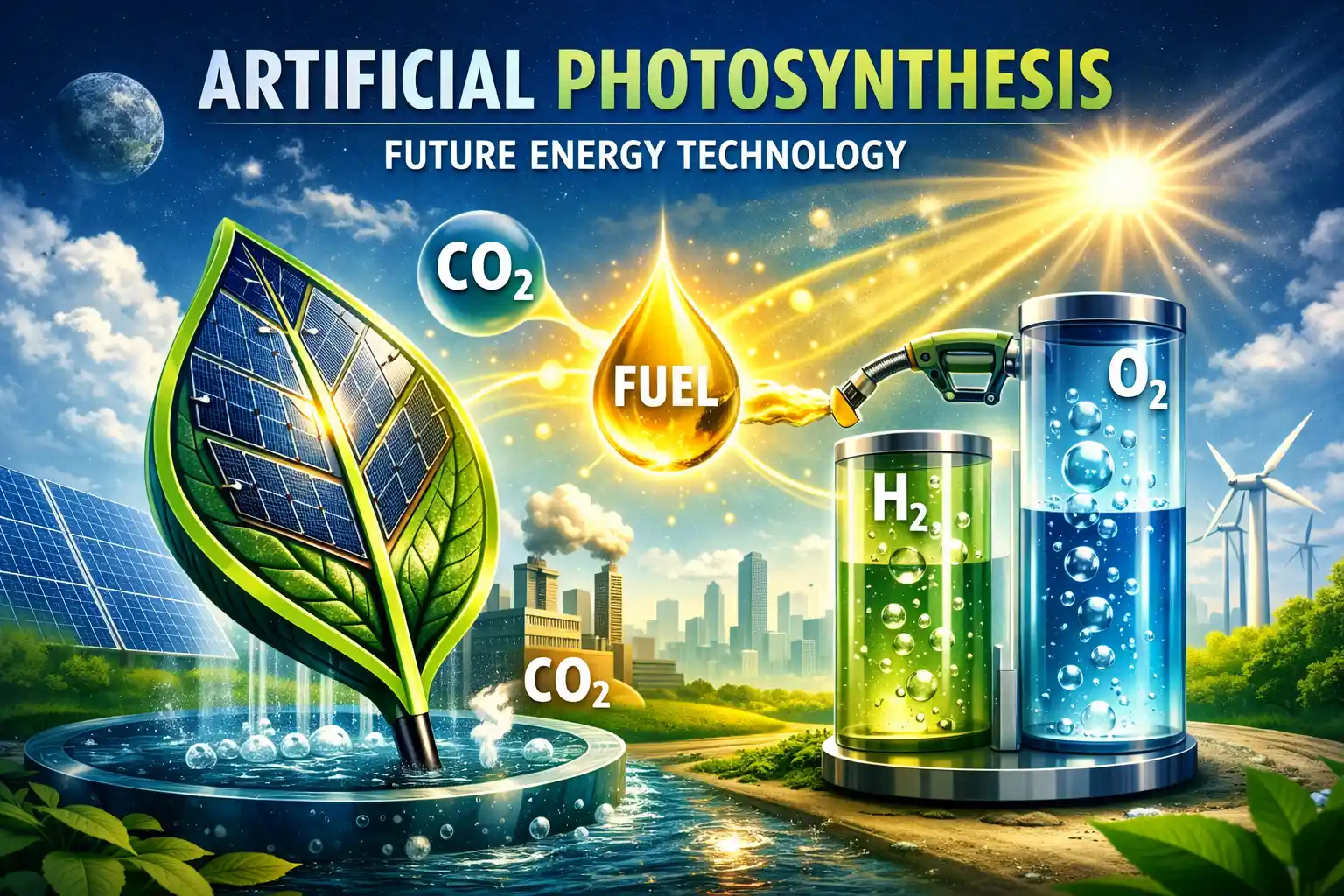
Artificial Photosynthesis is a renewable energy technology that uses sunlight to convert water and carbon dioxide into hydrogen, fuels, or valuable chemicals.
In simple terms:
Sunlight + Water + CO₂ → Fuel / Hydrogen / Chemicals
This process imitates natural photosynthesis but uses man-made devices, catalysts, and advanced materials.
The main goals of this technology are:
- Producing clean and renewable fuel
- Reducing carbon dioxide emissions
- Decreasing dependence on fossil fuels
How Does Artificial Photosynthesis Work?
The process typically involves three major steps.
1. Sunlight Capture
First, the system captures solar energy using semiconductor materials or solar cells. These materials absorb sunlight and convert it into chemical or electrical energy needed for the next steps.
2. Water Splitting
Next, water molecules (H₂O) are split into hydrogen and oxygen using catalysts and solar energy.
In 2008, scientist Daniel G. Nocera developed a prototype known as the Artificial Leaf, which can use sunlight to split water into hydrogen and oxygen.
3. Fuel or Chemical Production
The produced hydrogen can be combined with carbon dioxide to create various fuels and chemicals, such as:
- Synthetic fuels
- Methane
- Ethanol
- Jet fuel
- Raw materials for plastics
Some advanced systems can also directly convert CO₂ into useful industrial chemicals.
Which Organizations and Companies Are Working on This Technology?
Many research institutes, universities, and companies are actively developing artificial photosynthesis systems.
Research Institutes
Several leading institutions are conducting major research in this field, including:
- California Institute of Technology
- Lawrence Berkeley National Laboratory
- Joint Center for Artificial Photosynthesis
The Joint Center for Artificial Photosynthesis was established to specifically develop technologies that convert sunlight into renewable fuels.
Companies
1. Panasonic
The company has developed experimental artificial photosynthesis systems capable of producing hydrogen using sunlight.
2. Siemens Energy
The company is working on technologies that convert CO₂ and water into useful industrial chemicals.
3. Twelve
This startup focuses on converting carbon dioxide into jet fuel and industrial chemicals.
4. Evonik Industries
5. Mitsubishi Chemical
In addition, many universities and clean-tech startups are actively researching this technology.
Benefits of Artificial Photosynthesis
1. Clean Energy Production
This technology can generate fuel without producing significant pollution.
2. Carbon Dioxide Reduction
Artificial photosynthesis can capture carbon dioxide and convert it into useful fuels or chemicals, helping reduce greenhouse gas levels.
3. Unlimited Solar Fuel Potential
Since sunlight is abundant, artificial photosynthesis could provide a long-term and sustainable energy source.
4. Boost to the Hydrogen Economy
Hydrogen is widely considered a major clean fuel for the future, and artificial photosynthesis could make hydrogen production cheaper and more efficient.
5. Reduced Dependence on Fossil Fuels
If widely adopted, this technology could significantly reduce the global reliance on coal, oil, and natural gas.
When Will This Technology Become Available?
Artificial photosynthesis is still in the research and development stage, but progress is being made.
Possible timeline:
- 2025–2028: Early demonstration and pilot systems
- Around 2030: Small-scale commercial fuel production
- After 2035: Large industrial plants and cost-competitive production
Experts believe the first commercial applications may appear in hydrogen production and industrial chemical manufacturing.
Market and Industry Growth
The artificial photosynthesis sector is expected to grow steadily in the coming years.
Estimated market growth:
- 2022: Around $62 million
- 2030: Around $185 million
As global demand for clean energy increases, investments in this technology are likely to rise.
Potential Future Impact
If artificial photosynthesis becomes commercially viable, it could transform many industries.
Possible impacts include:
- Factories producing their own clean fuel
- Easier carbon capture and recycling
- Sustainable aviation fuels for airplanes
- Affordable long-term energy storage
In the future, cities may even develop “solar fuel plants” that produce clean energy using only sunlight, water, and carbon dioxide.
Outcome
Artificial Photosynthesis is more than just a new technology—it represents a possible energy revolution for the future.
Nature gave plants the remarkable ability to turn sunlight into the energy that sustains life on Earth. Today, scientists are attempting to replicate that same process using advanced technology.
If researchers succeed, the world could move toward a future where sunlight alone powers industries, transportation, and cities—producing fuel and chemicals without pollution or limited natural resources.
Artificial photosynthesis may not dominate the energy landscape today, but in the coming decades, it could become one of the most important technologies shaping the global energy economy.