
Gold has always been considered a reliable safe-haven asset by investors and economists worldwide.
During times of global uncertainty, inflation, economic stress, or geopolitical tension, investors flock to gold to protect their wealth.
Recently, gold has reached some of its highest levels in history — above $5,200 per ounce — and this rally has been extremely rapid over the past 1–2 weeks, attracting global attention from both investors and traders.
However, just looking at gold prices isn’t enough. The main driver behind this surge is the US Dollar and the Dollar Index (DXY).
Gold and DXY share an inverse relationship — meaning: a weaker dollar → stronger gold, a stronger dollar → weaker gold. This pattern is consistent across global financial markets.
The current surge isn’t just due to one or two trading days. Several macro and geopolitical factors have combined to push gold higher:
- Decline in the Dollar Index (DXY dropped to around 96)
- Increased safe-haven demand from global investors
- Political and trade uncertainties weakening risky assets
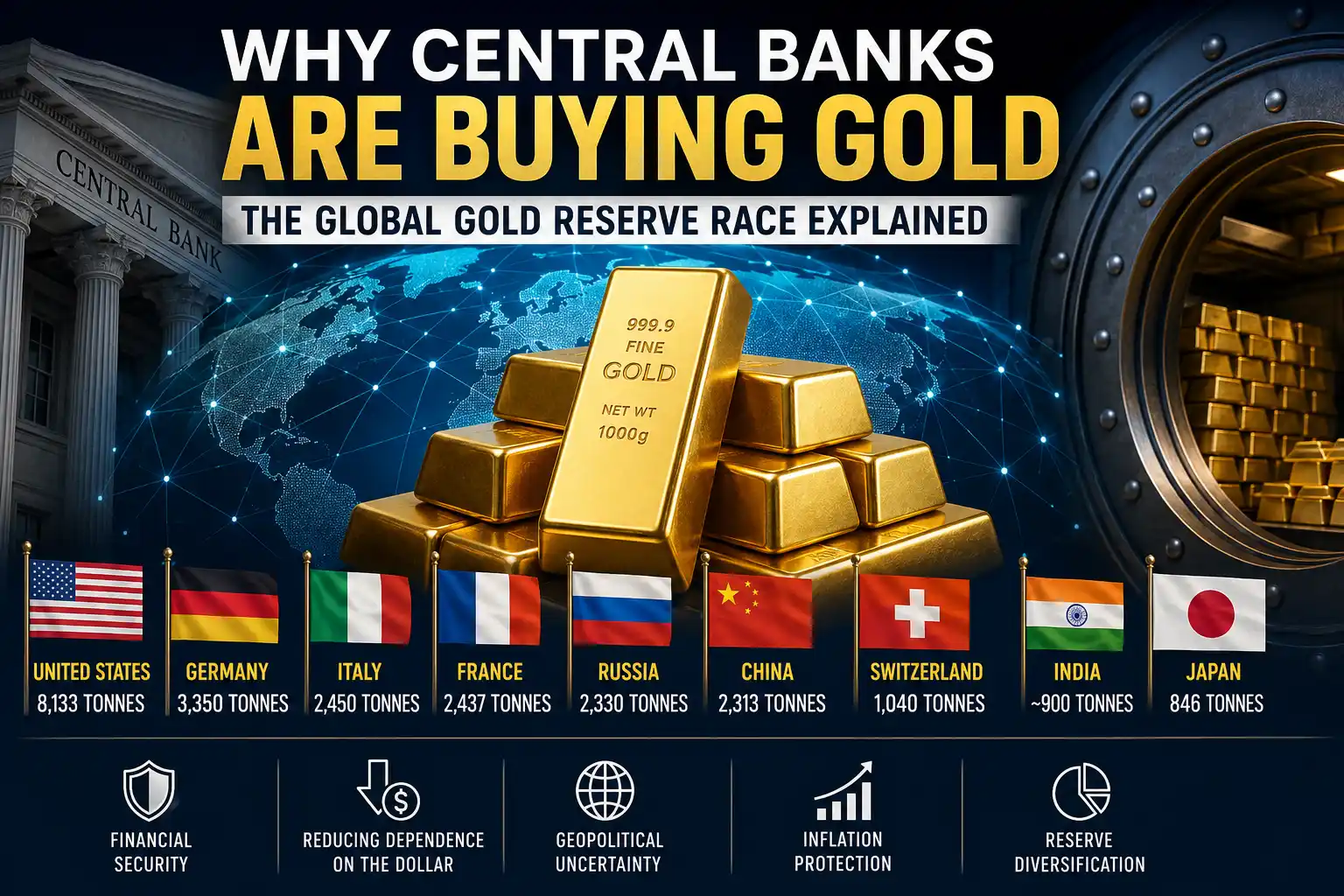
- Central banks increasing gold reserves
- Lower attractiveness of interest rates and bonds
This article explains:
how gold and the Dollar Index are connected, why gold is rising so fast, potential future trends, and what it means for investors —
Dollar Index (DXY) and Gold – The Direct Connection
Gold and the US Dollar Index have an inverse relationship:
- DXY falls → Gold rises
- DXY rises → Gold may fall
❓ Why does this happen?
Gold is priced globally in USD, so:
- A weaker dollar makes gold cheaper for investors holding other currencies → demand rises → price goes up
- A stronger dollar makes gold more expensive → demand may fall
This relationship is widely accepted and observed across financial markets.
Why the Dollar Index (DXY) Has Been Falling Recently
Last 1 Week Trend (as of 27 Jan 2026):
| Date | DXY Approx | Movement |
| 21 Jan 2026 | ~98.5 | High |
| 22 Jan 2026 | ~98.4 | Slight down |
| 23 Jan 2026 | ~98.2 | Down |
| 24 Jan 2026 | ~97.8 | Down |
| 25 Jan 2026 | ~97.5 | Down |
| 26 Jan 2026 | ~96.8 | Down sharply |
| 27 Jan 2026 | ~96.2 | Down further |
Summary: DXY started the week around 98+ and fell steadily to around 96.
➡️ This decline is the main reason for gold’s recent surge.
Main Causes:
- Fed Policy Uncertainty: Investors are unsure about the future interest rate policies of the US Federal Reserve.
- Geopolitical & Global Uncertainty: Political and trade tensions globally put pressure on the dollar.
- Safe-Haven Demand: Money moved from risky assets to gold.
- Central Bank Buying: Several central banks increased their gold reserves.
Main Reasons Behind Gold’s Surge
Gold has crossed $5,200+ per ounce. Key reasons:
- Weaker Dollar → Gold becomes cheaper and attractive
- Global geopolitical tension → Increased safe-haven demand
- Central bank buying → Supply-demand imbalance
- Lower bond yields and interest rates → Investors shifted to gold
Simple Example: Gold vs Dollar Index
| Scenario | Dollar Index (DXY) | Gold Price |
| DXY falls | ↓ | Gold rises ↑ |
| DXY rises | ↑ | Gold falls ↓ |
| DXY stable | → | Gold trend depends on other factors |
➡️ Gold prices are priced in USD globally, so changes in DXY are a key signal for gold.
Recent Trading Sessions Flow
- In recent weeks, as DXY declined, gold surged.
- Investors reacted to falling DXY and Fed policy uncertainty by buying gold.
- Short-term traders also entered momentum trades → further boosting the rally.
Future Outlook
📈 Bullish Potential
- Dollar remains weak in the long term
- Geopolitical tensions continue
- Expectations of Fed rate cuts increase
- Central banks continue gold purchases
📉 Potential Corrections
- Dollar strengthens suddenly
- Fed hints at interest rate hikes
- Positive global economic data emerges
Short-term corrections are possible, but the long-term trend remains bullish.
Investor Guidance
Long-term investors:
- Gold is useful as a portfolio hedge.
- Options: Physical gold, Gold ETFs, Sovereign Gold Bonds (when available).
Short-term traders:
- Buy gold when DXY falls
- Consider profit booking if DXY rises or gold becomes overbought
Diversification:
- Mix of Gold ETFs, digital gold, and bullion for exposure
Outcome
The inverse relationship between Gold and Dollar Index is a fundamental feature of global markets.
Today’s surge is driven by Dollar weakness, geopolitical tension, central bank buying, and investor demand.
Investors should:
- Keep gold as a hedge in long-term portfolios
- Monitor DXY and gold momentum for short-term trades
- Diversify across different gold assets
Gold prices are surging fast, but short-term corrections are always possible. Investment decisions should consider both DXY trends and global market developments.
(This article is for educational and informational purposes only and the analysis is based on market data)