
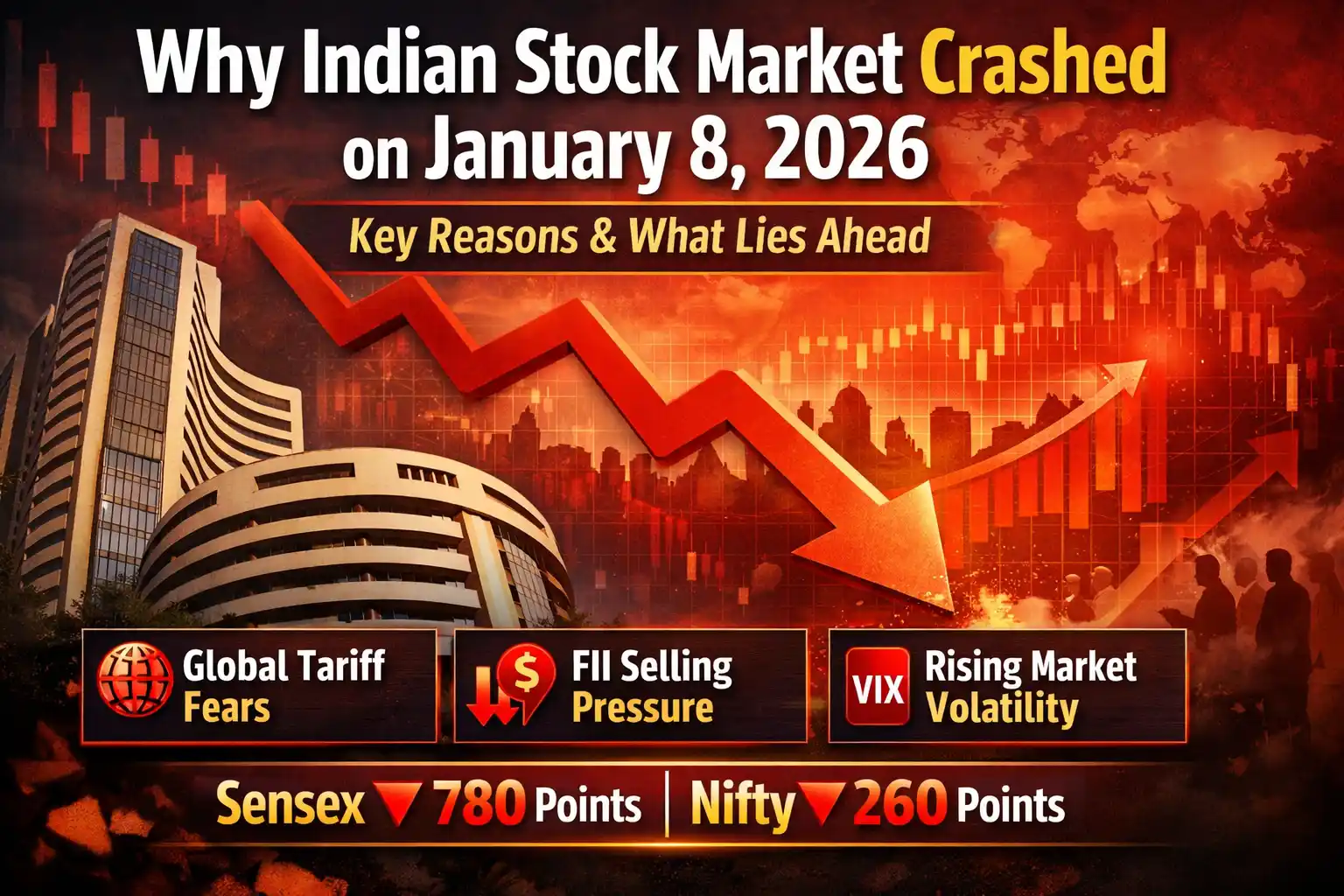
On January 8, 2026, Indian equity markets experienced one of their sharpest single-day declines in months, with both major benchmark indices — the Sensex and the Nifty 50 — ending deeply lower. This drop reflected a combination of global trade risk, foreign investor selling, and rising uncertainty in policy and macro conditions. Rather than being caused by one simple factor, this sell-off was the result of several forces acting together.
According to multiple credible market reports, including Reuters and leading Indian financial news sources:
• The Sensex fell about 780 points (-0.9%), while
• The Nifty 50 declined more than 260 points (-1.0%) — its largest single-day drop in over four months.
Below, we break down the key triggers, explain how markets reacted, and outline a clear strategy investors can adopt going forward.
US Tariff Anxiety and Trade Risk
The primary trigger for the market fall was renewed fear around US trade policy and potential tariffs. Reports suggested that proposals backed by US lawmakers could allow tariffs as high as 500% on countries continuing to import Russian oil, which includes India. Those tariff proposals created a sudden wave of uncertainty about India’s export competitiveness and corporate earnings.
Why This Matters
- Many Indian exporters earn significant revenue from overseas markets.
- Higher tariffs could reduce export demand and squeeze corporate profit margins.
- Even the possibility of these tariffs led to risk-off behavior among investors.
In response, stocks tied to export sectors — such as textiles, metals, and IT — bore strong selling pressure.
Continued Foreign Institutional Selling
Another major drag on market sentiment was persistent foreign institutional investor (FII) outflows.
Foreign investors sold Indian equities worth hundreds of crores, adding to selling pressure and weakening price support for benchmark indices.
Impact of Foreign Selling
- Reduces available capital in the market
- Signals lack of confidence among large global money managers
- Often leads domestic investors to also take profits or cut risk
This trend has been ongoing, with FIIs liquidating positions steadily since late 2025.
Technical Breakdown Below Key Support Levels
The decline wasn’t just a reaction to news — once major indices slipped below technically important levels (such as the 26,000 mark on the Nifty), algorithmic and systematic selling intensified.
Technical Effects
- Support zones act as psychological price barriers
- Breaking them can trigger automatic sell orders
- This often results in sharper declines as stop-losses and short positions kick in
As a result, the downtrend extended deeper into the session.
Broad-Based Sector Weakness
Rather than a selective sell-off, the decline was across almost all sectors:
- Metals & Mining: Among the worst hit as global commodity demand worried investors.
- Information Technology: Felt pressure amid export and global demand fears.
- Oil & Gas: Broader risk-off environment dampened energy stocks later in the day.
The market breadth — the number of stocks falling versus rising — was strongly negative, reinforcing the depth of bearish sentiment.
Rising Volatility Indicates Fear
The India VIX (Volatility Index) — often called the fear gauge — jumped significantly, indicating heightened anxiety among traders and investors. Rising VIX often precedes short-term volatility spikes and cautious investor behavior.
Market Summary (Jan 8, 2026)
| Metric | Result |
| Sensex | Down ~780 points |
| Nifty 50 | Down ~260+ points |
| Market Cap Wiped Out* | Nearly ₹7.7 trillion |
| Breadth | Majority of stocks declined |
| VIX | Significant increase |
*Aggregate market value loss figures were reported across major financial outlets.
What Can Investors Do Now?
Instead of reacting emotionally to short-term drops, investors should consider strategies suited for turbulent markets.
✅ 1. Stick with Systematic SIP Investing
For long-term investors using monthly SIPs (Systematic Investment Plans):
- Market corrections often lower your average buying price
- Over time, SIPs benefit from rupee cost averaging
- Historically, downturns have boosted long-term compilation returns
Staying consistent can help build wealth without timing the market.
⚠️ 2. Avoid High-Risk Leveraged Bets
In a volatile downtrend:
- Taking large leveraged positions (borrowing to invest) increases risk
- Short-term bets can turn costly if the market swings erratically
Maintain capital preservation first.
✔️ 3. Focus on Quality Stocks and Fundamentals
Invest in companies with:
- Strong profit growth
- Healthy balance sheets
- Resilient earnings prospects
Data shows that stocks with solid fundamentals weather downturns better and recover faster.
4. Watch Key Levels and Market Sentiment
Use defined technical levels for trading decisions:
- Avoid aggressive buys during persistent downtrends
- Consider re-entry only after reversal signs
- Setting defined stop-loss triggers helps protect capital
This is a disciplined approach endorsed by many market strategists.
What Might Happen Next?
🔹 Short Term (Next Weeks)
Expect continued volatility and news-driven price swings as investors react to:
- US trade policy developments
- Global macroeconomic releases
- Earnings announcements
🔹 Medium Term (Months Ahead)
If uncertainties fade and investor confidence returns:
- Slowly stabilizing markets
- Trend reversals possible
- Sectors like banking, infra, and defensives may lead recovery
🔹 Long Term (1–5+ Years)
India’s economy is one of the fastest growing major economies, and while short-term drops are normal, the long-term trend for quality assets historically remains positive.
Investor Takeaway
Market corrections can be uncomfortable, but:
- They are normal and essential parts of market cycles
- They provide opportunities to accumulate quality assets at lower prices
- Emotional trading often leads to losses, while disciplined strategies preserve capital and maximize growth
As one Reddit market summary aptly put it — corrections like this are a combination of fear, uncertainty, and broad reactions, not always a permanent change in fundamentals.
Final Thoughts
The Jan 8, 2026 downturn was a reaction to:
- Rising tariff fears
- Foreign selling pressures
- Technical breakdowns
- Broad sector weakness
But thoughtful investors who focus on long-term growth, diversification, and risk management can navigate such periods more confidently.
Disclaimer: This article is for educational and informational purposes only, based on media reports and market analysis. Before making any buy or sell decisions, investors should do their own research or consult a certified financial advisor.