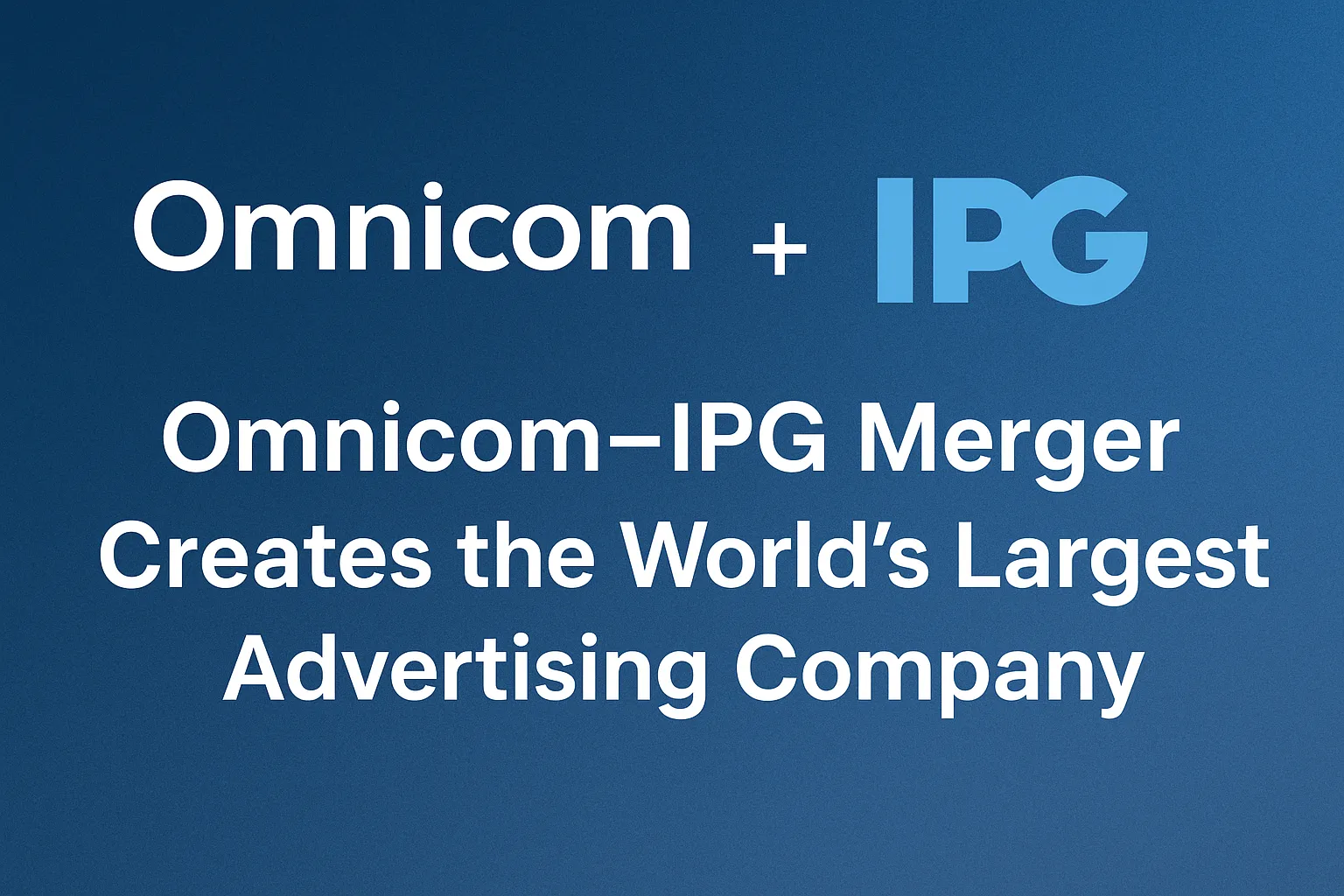
Omnicom Group has officially completed its long-awaited acquisition of Interpublic Group (IPG), creating the world’s largest marketing, media, and advertising holding company. The deal, valued at over $13 billion in an all-stock transaction, has transformed the global advertising landscape and set a new benchmark for scale, technology integration, and competitive positioning.
The merger brings together two of the most influential names in the industry, merging their creative, media, technology, data, and digital capabilities into one unified global powerhouse. With this, the re-shaped company will now operate with a combined pro-forma revenue surpassing $25 billion annually, making it the biggest marketing group in history.
Timeline: How the Merger Reached the Finish Line
- December 2024: Omnicom and IPG signed a definitive merger agreement.
- March 18, 2025: Shareholders of both companies officially approved the deal.
- June 23, 2025: The U.S. Federal Trade Commission (FTC) completed its antitrust review and cleared the deal.
- November 24, 2025: The European Commission granted unconditional approval, confirming no competition concerns.
- November 26, 2025: All closing conditions were met, and the merger officially completed.
The companies highlighted that the merger process remained smooth, with timely regulatory clearances across major jurisdictions.
Key Terms of the Deal
Under the terms of the agreement:
- Each IPG shareholder received 0.344 shares of Omnicom for every IPG share they owned.
- Following the transaction, legacy Omnicom shareholders now hold around 60.6%, and legacy IPG shareholders hold about 39.4% of the combined company.
- Omnicom continues to trade on the New York Stock Exchange (NYSE) under its existing ticker symbol “OMC.”
With the completion of the acquisition, all existing IPG operations, agencies, and subsidiary brands now fall under Omnicom’s unified holding structure.
Company Profiles: Who Are Omnicom and IPG?
Omnicom Group
Omnicom is a leading global provider of marketing communications, offering services in:
- Creative advertising
- Media planning and buying
- Digital marketing
- Public relations
- Healthcare communications
- CRM, brand strategy, and analytics
Its network includes internationally recognized agencies and specialized communications companies operating across more than 100 countries.
Interpublic Group (IPG)
IPG is one of the world’s oldest and most respected advertising groups, providing:
- Media buying and planning
- Creative and branding services
- Digital, data, and performance marketing
- PR and corporate communications
- Healthcare and experiential marketing
IPG’s wide ecosystem of agencies has served global brands across every major industry.
Together, the merged company integrates robust creative capabilities with powerful data, AI, and media technologies.
Why the Merger Matters: Strategic Importance
1. Global Scale & Cost Efficiencies
The merged entity gains massive scale in media buying, technology infrastructure, and operations. The companies project annual cost synergies of nearly $750 million, improving margins and enabling more competitive pricing for global clients.
2. Integrated Data + Tech + Creative Ecosystem
Marketing today is driven by AI, analytics, personalization, and omnichannel execution.
Omnicom’s “Omni” data platform — already a strong asset — now gains access to IPG’s technology, enhancing its intelligence and performance capabilities.
3. Stronger Market Position Against New Competitors
The advertising world is rapidly shifting, with consulting firms, analytics companies, and technology giants entering the marketing space.
This merger gives Omnicom–IPG a stronger defense against new-age challengers like Accenture Song, Deloitte Digital, and global digital-first networks.
4. End-to-End Solutions Under One Roof
From creative storytelling to advanced programmatic media buying and real-time data analytics — the combined group can now serve global companies with fully integrated marketing solutions.
Challenges Ahead
Despite the positives, the merger also brings challenges:
1. Client Conflicts
Many major global brands work with both Omnicom and IPG across different categories. Overlapping accounts could lead to conflicts, forcing re-pitching or reassignments.
2. Complex Integration Process
Merging thousands of employees, dozens of global agencies, and multiple technology platforms will be a multi-year challenge. Integration risk is high in large mergers.
3. Potential Job Cuts
Industry analysts estimate 15,000–20,000 job reductions globally due to overlapping teams, back-office functions, and duplicate services.
4. Rising Competition
Despite becoming the largest player, the company still faces competition from tech-first digital ad platforms, consulting firms, and niche creative agencies.
Global and India-Specific Impact
Worldwide Impact
- Multinational companies will benefit from more integrated creative, media, and analytics capabilities.
- Media buying at scale will lead to better pricing, making campaigns more cost-efficient for brands.
- Consolidation across the industry may accelerate, with other holding companies reconsidering their strategies.
Impact on India
- Both Omnicom and IPG already operate strong networks in India; now local brands will gain access to global-level unified marketing solutions.
- The merger could intensify competition in India’s fast-growing digital ad market.
- Smaller and mid-size agencies may face pricing pressure but could thrive by offering niche or regional services.
What the Merger Means for the Future of Advertising
This merger symbolizes a major shift in the advertising industry:
- The future of marketing lies in AI-driven insights, data-powered decisions, and integrated execution.
- Creative work will increasingly be supported by intelligent technologies.
- Media, analytics, and content will be closely connected within a single platform.
If the newly merged Omnicom–IPG manages its integration well and leverages its combined capabilities, it has the potential to redefine advertising worldwide.
Outcome
The completion of the Omnicom–IPG merger on November 26, 2025, marks the beginning of a new era for global advertising. It is not just the union of two major companies — it is the evolution of the entire industry toward a tech-driven, data-heavy, integrated future.
With the largest footprint, the strongest media buying power, and an unparalleled combination of creative and analytical capabilities, the new Omnicom–IPG entity is now positioned to shape how brands communicate with consumers in the coming decade.
The success of this merger will depend on how effectively the companies integrate operations and navigate challenges. But for now, the industry has witnessed the birth of its most powerful player ever — and the world of marketing may never be the same again.
Source: Omnicom Newsroom , European commision