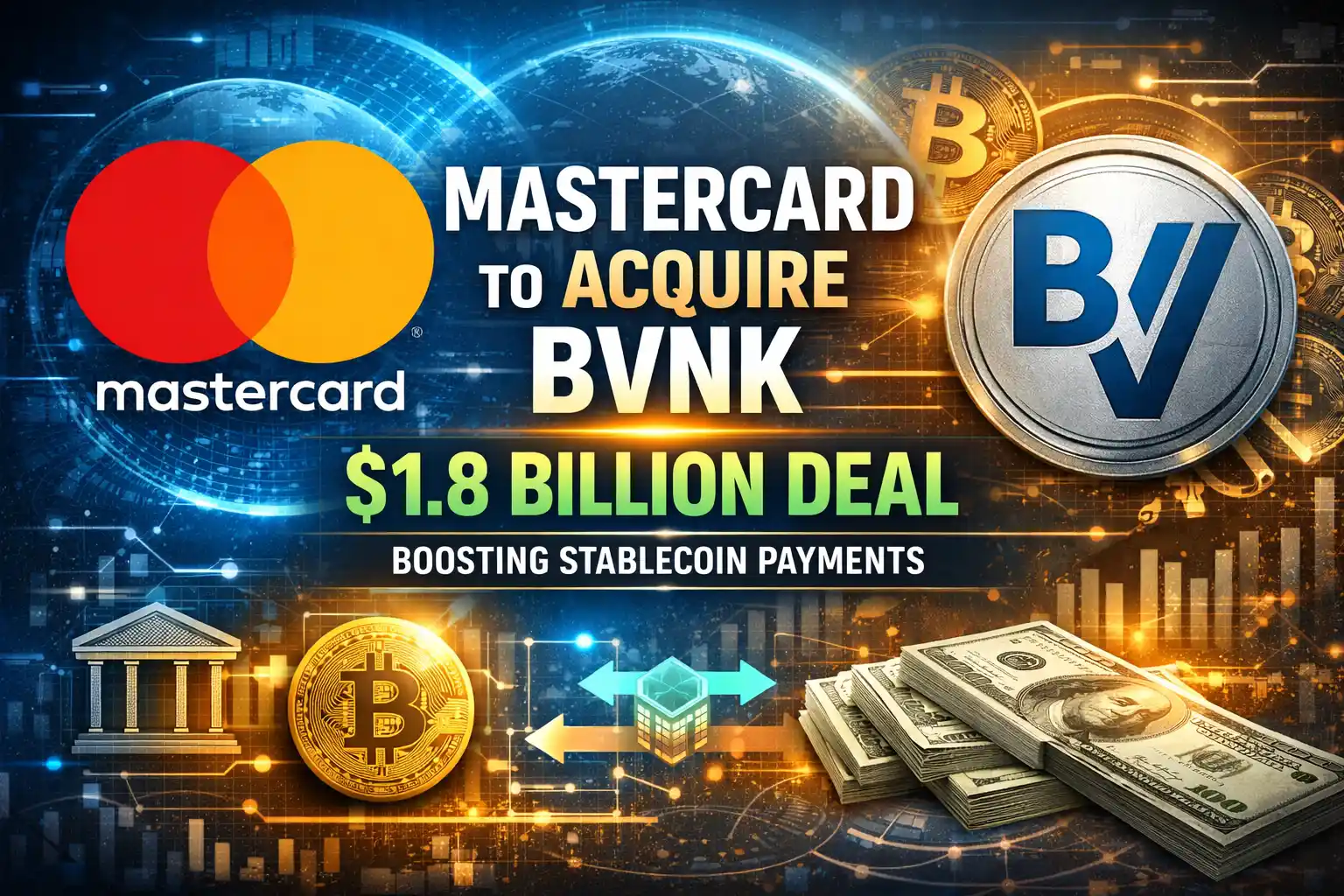
Global payments leader Mastercard has announced a major acquisition of crypto infrastructure firm BVNK in a deal valued at up to $1.8 billion.
The transaction includes an additional $300 million in performance-linked payouts, depending on future growth targets. The deal is expected to close by late 2026, subject to regulatory approvals across multiple jurisdictions.
This move represents one of Mastercard’s largest and most aggressive bets on blockchain technology and digital currencies, particularly in the fast-growing stablecoin payments segment.
Companies Overview
🔹 Mastercard
Founded in 1966, Mastercard is a global leader in digital payments, operating a vast network that connects banks, merchants, and consumers in over 200 countries.
The company earns revenue by facilitating transactions through its payment network, primarily via debit and credit cards. In recent years, Mastercard has been actively expanding into digital payments, fintech partnerships, and blockchain-based solutions.
🔹 BVNK
BVNK is a rapidly growing fintech company focused on crypto-native payment infrastructure, especially stablecoins.
The platform allows businesses to:
- Accept and send payments in stablecoins and fiat currencies
- Instantly convert crypto into traditional currencies
- Operate across multiple blockchain networks
BVNK serves clients in over 130 countries and is considered a key player in bridging traditional finance with decentralized finance (DeFi).
Deal Structure and Strategic Intent
The acquisition is a full buyout, giving Mastercard complete control over BVNK’s technology, team, and global operations.
Key Deal Highlights:
- Total Value: Up to $1.8 billion
- Earn-out Component: $300 million
- Timeline: Expected completion by end of 2026
- Condition: Subject to global regulatory approvals
👉 This is not just a financial investment—it is a strategic integration move aimed at long-term transformation.
Why Mastercard Is Making This Move
🔸 1. Entering the Stablecoin Economy at Scale
Stablecoins are emerging as one of the most practical use cases of blockchain technology, especially for:
- Cross-border payments
- Remittances
- Business-to-business (B2B) transactions
By acquiring BVNK, Mastercard is positioning itself at the center of this rapidly expanding ecosystem.
🔸 2. Building a Hybrid Payment Network
Traditionally, Mastercard has operated within the fiat-based financial system.
With BVNK, it can now create a hybrid payment infrastructure that combines:
- Traditional currencies (USD, EUR, INR, etc.)
- Blockchain-based assets (stablecoins)
👉 This integration could enable seamless movement of money between bank accounts and blockchain networks.
🔸 3. Competing in the Next Generation Payments Race
The global payments industry is undergoing a transformation, with increasing competition from:
- Fintech companies
- Crypto-native firms
- Rival networks like Visa
This acquisition allows Mastercard to stay competitive by adopting next-generation payment technologies.
🔸 4. Accelerating Innovation Without Delay
Developing blockchain infrastructure internally would take years. By acquiring BVNK, Mastercard gains:
- Proven technology
- Existing customer base
- Experienced crypto talent
👉 This significantly reduces time-to-market.
How the Combined Technology Will Work
After integration, Mastercard and BVNK are expected to enable a wide range of new capabilities:
🔹 Unified Payment System
- Users can pay using cards, bank accounts, or stablecoins
- Merchants can receive payments in their preferred currency
🔹 Real-Time Cross-Border Transfers
- Blockchain enables near-instant settlement
- Eliminates delays associated with traditional banking systems
🔹 Multi-Currency & Multi-Chain Support
- Transactions across different currencies and blockchain networks
- Automatic conversion between crypto and fiat
👉 This could redefine how global payments are processed.
Industry Impact and Market Analysis
🔹 1. Shift Toward Blockchain-Based Payments
The deal reflects a broader industry trend where traditional financial institutions are moving toward blockchain infrastructure.
👉 The future may see a gradual shift from:
Card-based systems → Programmable, blockchain-based payments
🔹 2. Strong Growth Potential for Stablecoins
Stablecoins are gaining traction due to:
- Price stability (pegged to fiat currencies)
- Faster transactions
- Lower costs
This acquisition validates the long-term growth potential of stablecoins in global finance.
🔹 3. Increased Institutional Participation
Large-scale deals like this encourage:
- Banks to explore crypto services
- Corporates to adopt blockchain payments
- Governments to develop clearer regulations
👉 This leads to wider adoption across the financial ecosystem.
🔹 4. Impact on Emerging Markets
Countries with high remittance flows (like India, Southeast Asia, Africa) could benefit significantly from:
- Lower transfer costs
- Faster settlements
- Greater financial inclusion
Risks and Challenges
Despite its potential, the deal faces several risks:
🔸 Regulatory Uncertainty
Crypto regulations vary across countries and could delay or impact the deal.
🔸 Security Concerns
Blockchain systems must be protected against cyber threats and fraud.
🔸 Adoption Barriers
Mainstream users and businesses may take time to fully adopt crypto-based payments.
🔸 Integration Complexity
Combining traditional payment infrastructure with blockchain systems is technically challenging.
Outcome
The acquisition of BVNK by Mastercard marks a turning point in the evolution of global payments.
It highlights a clear shift toward a future where:
👉 Traditional finance and blockchain technology coexist and integrate seamlessly
Rather than replacing the existing system, this move suggests the creation of a hybrid financial ecosystem, where users can move money effortlessly between fiat and digital currencies.
As competition intensifies and innovation accelerates, this deal could play a crucial role in shaping the next generation of global payment infrastructure.
Source: mastercard news