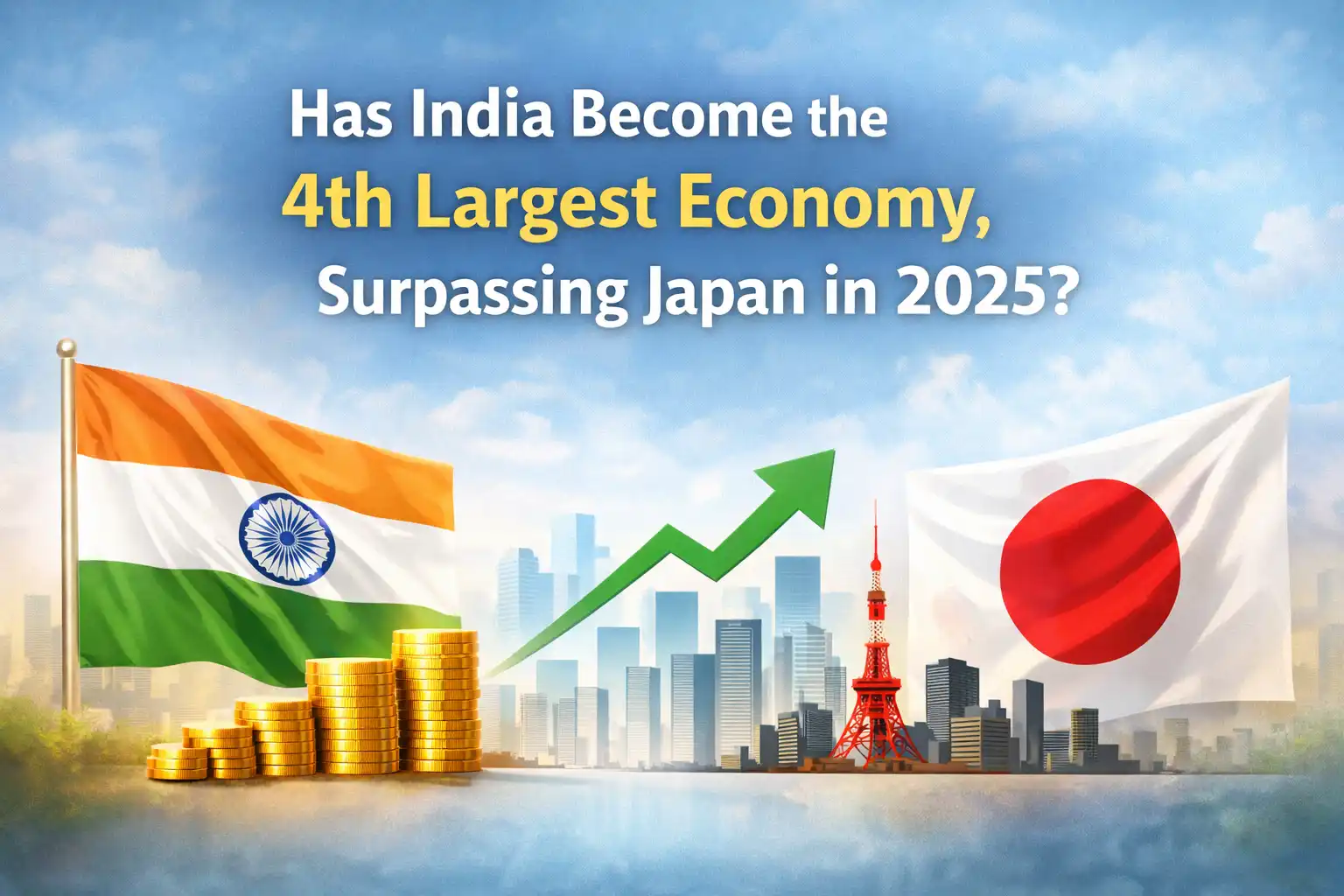
Late 2025 saw a lot of news about India’s economy:
“India overtakes Japan to become the world’s fourth‑largest economy.”
This grabbed headlines globally and across Indian media. But many readers felt confused when they checked official IMF data and found something slightly different.
This article explains:
✔️ Which data sources matter
✔️ What India’s position really is in 2025
✔️ Why some reports said India moved ahead
✔️ How the IMF data changes over time
✔️ What final confirmation we expect in 2026
✔️ What the economic implications truly mean
Let’s break this down in easy, fact‑based.
How Economies Are Compared
Countries are typically compared using these three indicators:
- Nominal GDP – Total economic size measured in US dollars
- GDP (PPP) – GDP adjusted for local prices (Purchasing Power Parity)
- Per Capita Income – Average income per person
👉 The current headlines are based on Nominal GDP ranking.
What Is Nominal GDP?
Nominal GDP means:
The total value of all goods and services produced in a country in one year, measured in current US dollars.
It reflects:
- Total economic activity
- Production, consumption, services, investment
- Export and import activity
It does not show:
- How wealthy people are individually
- How evenly income is distributed
- Purchasing power within the country
That’s why it’s possible for a country’s GDP ranking to rise even if average incomes remain lower than in other countries.
Data Timeline: April 2025 vs October 2025
🟡 1. IMF April 2025 Forecast (Earlier Projection)
In April 2025, IMF’s World Economic Outlook (WEO) released a forecast for the 2025 full year.
The forecast showed:
| Country | Nominal GDP (IMF April 2025) |
| 🇮🇳 India | ~$4.187 trillion |
| 🇯🇵 Japan | ~$4.186 trillion |
👉 This forecast suggested India slightly ahead of Japan, based on estimates of economic activity, exchange rates, and growth.
This narrow lead is what many media outlets used for headlines.
IMF October 2025 Updated Data (Official Latest Numbers)
IMF updates its data periodically as more information becomes available. The latest official database (October 2025) shows:
| Country | Nominal GDP (IMF Oct 2025) |
| 🇯🇵 Japan | ~$4.28 trillion |
| 🇮🇳 India | ~$4.13 trillion |
👉 According to these updated figures, Japan’s economy is still larger than India’s in 2025 based on Nominal GDP.
You can check this directly from the IMF Data Mapper:
🔗 Nominal GDP Tool: IMF
📌 Why Did the Data Change?
IMF revises economic estimates based on real data that becomes available throughout the year. The key reasons for change:
✔️ Updated GDP data from national statistical agencies
✔️ Revised exchange rates (especially USD vs INR and USD vs JPY)
✔️ New information on growth, trade, industry output
✔️ Finalized quarterly economic performance
Because of these revisions, the earlier forecast changed when the October data came out.
What Does This Mean?
🔹 April 2025 forecast showed India slightly ahead of Japan.
🔹 October 2025 actual data shows Japan leading in Nominal GDP.
🔹 The difference is due to updated economic realities and exchange rates.
🔹 India’s economy is still growing fast and could overtake Japan in the future—but not yet confirmed by final IMF data.
When Will We Get Final Confirmation?
IMF publishes its World Economic Outlook (WEO) reports regularly:
📍 April 2026 WEO Report
➡️ This will provide the final, authoritative GDP figures for 2025 after full data review.
Once the April 2026 report comes out, we will have:
✔️ Official confirmed Nominal GDP for 2025
✔️ Final rankings of major economies
✔️ Verified comparison between India, Japan, Germany, etc.
Per Capita Income: The Other Side of the Story
Nominal GDP tells the size of the economy, but not how income is distributed.
Here’s a comparison:
| Metric | India | Japan |
| Nominal GDP (2025) | ~$4.13 trillion | ~$4.28 trillion |
| Per Capita Income (2025 est.) | ~$2,800 – $3,000 | ~$30,000+ |
| Population | ~1.45 billion | ~125 million |
📌 Even though India is large in population and output, the per person income in Japan remains much higher.
Why This Ranking Still Matters
India’s rapid economic growth has important implications:
✔️ For Investors
- Global investors see India as a fast‑growing market
- Capital inflows may increase
- Long‑term business confidence improves
✔️ For the Government
- More tax revenue for infrastructure
- Better resource allocation for health and education
- Stronger bargaining power in global forums
⚠️ For Citizens
- Growth must translate into jobs and improved incomes
- Focus on skill development and job creation is essential
- Per capita income needs sustained improvement
📌 What Should Readers Understand?
➡️ India’s economy is large and growing rapidly.
➡️ Some projections showed India slightly ahead of Japan earlier in 2025.
➡️ Latest official IMF data (Oct 2025) shows Japan still ahead in nominal GDP.
➡️ Final confirmation will come with IMF’s April 2026 report.
➡️ Per Capita Income still shows a large gap between India and Japan.
This gives a balanced and accurate view without confusion.